
Table of Contents
Ivermectin for onchocerciasis is an established treatment for a parasitic infection commonly known as river blindness.
Onchocerciasis is caused by the parasitic worm Onchocerca volvulus and is transmitted through repeated bites from infected blackflies. The disease can affect the skin and eyes and, in severe or longstanding infections, may lead to permanent vision loss.
Ivermectin is the principal medicine used to control onchocerciasis because it kills the microscopic immature worms, known as microfilariae. It does not directly kill the adult worms.
This guide explains what onchocerciasis is, how ivermectin is used, why repeated treatment may be necessary, important safety considerations and when medical evaluation is required.
Medical disclaimer: This article is for general educational purposes only. It is not individualized medical advice and should not replace consultation with a qualified healthcare professional.
What Is Onchocerciasis?
Onchocerciasis is a parasitic disease caused by Onchocerca volvulus.
It is commonly called river blindness because the blackflies that transmit the infection breed near rapidly flowing rivers and streams. More than 99% of infected people live in countries in sub-Saharan Africa, with additional endemic areas in Yemen and parts of Latin America.
The parasite has a long life cycle inside the human body.
Adult worms can live in nodules under the skin and produce microscopic larvae called microfilariae.
These microfilariae can migrate through the skin and eyes, where they contribute to inflammation and tissue damage.
How Is River Blindness Spread?
Onchocerciasis is transmitted through the bite of an infected blackfly of the genus Simulium.
The transmission cycle is:
Infected person → Blackfly bite → Parasite develops inside fly → Blackfly bites another person → Infection
Repeated exposure to infected blackflies increases the risk of acquiring the disease.
Onchocerciasis is therefore not normally spread through ordinary person-to-person contact.
What Are the Symptoms of Onchocerciasis?
Some people with onchocerciasis have few or no noticeable symptoms.
When symptoms occur, they can include:
- Severe or persistent itching
- Skin rash
- Changes in skin appearance
- Nodules under the skin
- Eye inflammation
- Visual impairment
- Progressive vision loss in longstanding infection
The CDC notes that clinical presentations range from no symptoms to skin disease, eye disease and subcutaneous nodules.
Why Is It Called River Blindness?
The term river blindness refers to the eye complications that can occur with onchocerciasis.
Microfilariae can migrate into tissues around the eyes and cause inflammatory damage.
Longstanding and intense infection can result in visual impairment and, in severe cases, permanent blindness.
This is why controlling the parasite is important even when symptoms initially appear mild.
Ivermectin for Onchocerciasis
Ivermectin is the treatment of choice for onchocerciasis.
It primarily works by killing the parasite’s microfilariae.
This can:
- Reduce itching
- Reduce skin complications
- Reduce the risk of eye damage
- Lower the number of parasites available for transmission
The CDC states that ivermectin reduces the occurrence of blindness and the occurrence and severity of skin symptoms associated with onchocerciasis.
Does Ivermectin Kill Adult Onchocerca Worms?
No.
This is an important distinction.
Ivermectin is highly effective against the microfilariae, but it does not directly kill the adult worms.
Adult worms can remain in nodules beneath the skin and continue producing microfilariae.
This is one reason treatment may need to be repeated over an extended period.
Why Can Ivermectin Treatment Be Repeated?
Because adult worms can survive after ivermectin treatment, new microfilariae may continue to be produced.
For population-based elimination programs, WHO recommends ivermectin treatment at least once yearly for approximately 10–15 years, depending on the circumstances of the affected population and local program.
For individual patients, treatment intervals can vary.
The current U.S. ivermectin tablet labeling states that retreatment for individual patients may be considered at intervals as short as three months, while international treatment programs commonly use approximately 12-month intervals.
Do not interpret these intervals as instructions for self-treatment. Treatment frequency should be determined by a healthcare professional or the applicable public-health program.
Ivermectin Dosage for Onchocerciasis
Current U.S. prescribing information recommends a single oral dose designed to provide approximately 150 micrograms of ivermectin per kilogram of body weight for onchocerciasis.
The exact number of tablets depends on body weight and the tablet strength being used.
For example, the current U.S. labeling provides weight-based guidance using 3 mg ivermectin tablets.
Because ivermectin dosing depends on factors including body weight, age, diagnosis and clinical circumstances, individuals should not calculate their own treatment regimen solely from an online article.
For general information about ivermectin dosing, see our:
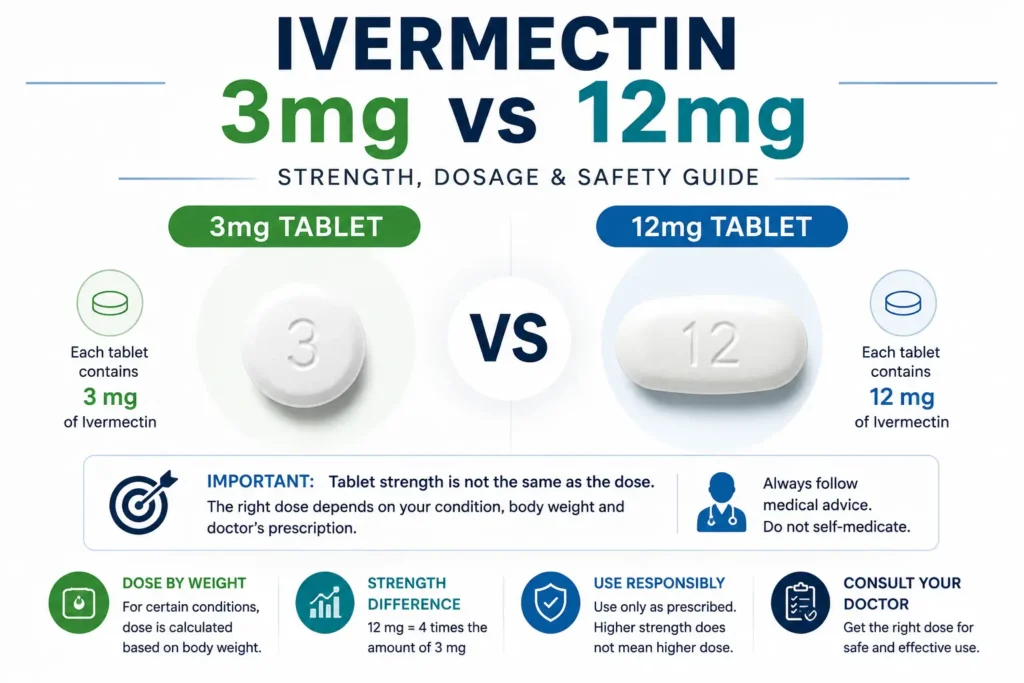
Ivermectin 3 mg vs 12 mg for Onchocerciasis
Ivermectin is available in different strengths and formulations in different markets.
The current U.S. ivermectin tablet labeling referenced by DailyMed uses 3 mg tablets and provides weight-based dosing instructions.
This is important because:
Tablet strength ≠ recommended dose.
A person should not assume that taking one 12 mg tablet is equivalent to taking a specific number of 3 mg tablets without appropriate medical guidance.
The correct regimen depends on the prescribed dose and the individual patient’s circumstances.
Who May Need Treatment for Onchocerciasis?
Treatment is particularly relevant for people who:
- Live in an endemic region
- Have lived in an endemic region
- Have repeated exposure to blackflies
- Have symptoms consistent with onchocerciasis
- Have been diagnosed with Onchocerca volvulus infection
- Are part of a public-health treatment program
Because symptoms can sometimes be absent, people living in endemic communities may receive ivermectin through organized mass drug administration programs even when they feel well.
How Is Onchocerciasis Diagnosed?
Diagnosis is generally based on clinical assessment and appropriate laboratory or ophthalmological evaluation.
The CDC identifies skin snip examination as the traditional diagnostic method for detecting microfilariae. Other approaches may include:
- Examination of skin nodules
- Eye examination
- Serological testing
- Other laboratory methods where available
Because other parasitic and dermatological conditions can cause similar symptoms, proper diagnosis is important.
Ivermectin and Loa Loa Infection
This is one of the most important safety considerations with ivermectin treatment for onchocerciasis.
Loa loa, also known as the African eye worm, can occur in some of the same regions of Central Africa where onchocerciasis is found.
People with high levels of Loa loa microfilariae in the blood can experience a serious, potentially fatal encephalitic reaction following ivermectin treatment.
Therefore, people who may have been exposed to Loa loa should receive appropriate medical assessment before ivermectin treatment for onchocerciasis.
This is not a situation for self-treatment.
Ivermectin and Pregnancy
Pregnancy requires special consideration.
The CDC notes that available data on ivermectin use during pregnancy are limited and that WHO excludes pregnant women from mass drug administration campaigns using ivermectin.
If you are pregnant or planning pregnancy and have suspected or confirmed onchocerciasis, discuss treatment with a qualified healthcare professional.
Ivermectin for Children
Children may be included in some public-health treatment programs depending on age, weight and local guidelines.
However, treatment should not be determined solely from an online dosage table.
A healthcare professional or public-health program should determine whether ivermectin is appropriate for a particular child.
Ivermectin Side Effects in Onchocerciasis
Some reactions following ivermectin treatment can occur because the medicine kills large numbers of microfilariae.
Possible reactions may include:
- Fever
- Itching
- Rash
- Dizziness
- Headache
- Muscle or joint discomfort
- Swelling
The severity of reactions can be related to the number of microfilariae present and the inflammatory response following treatment.
For broader information, see our:
Ivermectin Side Effects & Safety Guide
Can Ivermectin Cure River Blindness Permanently?
It is better to think of ivermectin as a long-term control and elimination tool rather than a one-time permanent cure in every situation.
The medicine kills microfilariae but does not kill adult worms.
Consequently, repeated treatment may be necessary until transmission is interrupted and the adult parasite population dies out.
This is particularly important in endemic communities.
Ivermectin and Public Health Programs
Ivermectin has played a major role in global efforts to control and eliminate onchocerciasis.
WHO recommends community-wide ivermectin treatment in appropriate endemic areas as part of elimination programs.
In 2024, more than 171 million people in Africa were treated with ivermectin through community-directed treatment programs.
These programs are fundamentally different from an individual deciding to take ivermectin independently.
Public-health programs determine:
- Who should receive treatment
- Treatment intervals
- Eligibility
- Monitoring
- Management of adverse events
- Strategies for areas where Loa loa is also present
Can Onchocerciasis Be Prevented?
There is currently no vaccine or preventive medicine that guarantees protection from acquiring onchocerciasis.
Reducing exposure to infected blackflies can help.
Useful measures include:
- Wearing protective clothing
- Using appropriate insect-repellent measures
- Avoiding areas with heavy blackfly exposure when possible
- Following local public-health recommendations
Community ivermectin programs also play an important role in reducing transmission.
Ivermectin for Onchocerciasis vs Other Parasitic Infections
Ivermectin is active against several parasites, but the treatment regimen is not the same for every infection.
For example:
- Onchocerciasis → Onchocerca volvulus
- Strongyloidiasis → Strongyloides stercoralis
- Scabies → parasitic mite
- Head lice → parasitic insect
Different conditions require different formulations, doses, treatment schedules and safety considerations.
Our educational cluster covers several of these separately so that readers don’t assume one ivermectin regimen applies to every condition.
When Should You See a Healthcare Professional?
Seek medical evaluation if you:
- Have persistent severe itching after living or travelling in an endemic region
- Develop unexplained skin changes
- Experience visual changes
- Have been exposed to blackflies in an endemic region
- Have been diagnosed with onchocerciasis
- May have been exposed to Loa loa
- Are pregnant and may require treatment
- Are considering ivermectin treatment for a child
Any new or worsening vision problem requires prompt medical assessment.
Frequently Asked Questions About Ivermectin for Onchocerciasis
What is ivermectin used for in onchocerciasis?
Ivermectin is the principal treatment used to kill the microfilariae of Onchocerca volvulus and reduce skin and eye complications.
Does ivermectin kill adult worms?
No. Ivermectin primarily kills microfilariae and does not directly kill adult Onchocerca volvulus worms.
Why does ivermectin need to be repeated?
Adult worms can survive treatment and continue producing microfilariae. Repeated treatment helps maintain suppression of the parasite population and supports elimination efforts.
How often is ivermectin given for river blindness?
Public-health programs commonly administer ivermectin approximately once yearly, with treatment continuing for many years. Individual treatment schedules can differ.
What is the usual ivermectin dose for onchocerciasis?
Current U.S. labeling describes a single oral dose of approximately 150 mcg/kg, with tablet numbers determined by body weight.
Can I use ivermectin 12 mg tablets for river blindness?
Do not select a tablet strength or calculate a regimen yourself. The appropriate ivermectin dose is weight-based and should follow professional medical guidance and the applicable product information.
What causes river blindness?
River blindness is caused by Onchocerca volvulus, a parasitic worm transmitted by infected blackflies.
Can river blindness cause permanent blindness?
Yes. Longstanding and intense infection can cause eye disease, visual impairment and permanent blindness.
Is onchocerciasis contagious?
It is transmitted primarily through repeated bites from infected blackflies rather than ordinary person-to-person contact.
Can ivermectin prevent river blindness?
Ivermectin treatment reduces the microfilariae responsible for disease and is central to public-health elimination programs. It is not a vaccine and does not provide permanent immunity against future infection.
Can everyone with onchocerciasis take ivermectin?
No. Particular caution is required in people who may have Loa loa co-infection because ivermectin can cause severe reactions in individuals with high Loa loa microfilarial levels.
Key Takeaways
Ivermectin remains the principal medicine used to control onchocerciasis (river blindness).
Remember:
- 🦠 Cause: Onchocerca volvulus
- 🪰 Transmission: Infected blackfly bites
- 💊 Main treatment: Ivermectin
- 🎯 Main target: Microfilariae
- ⚠️ Adult worms: Not directly killed by ivermectin
- 🔄 Repeat treatment: Often necessary
- 👁️ Major complication: Eye damage and vision loss
- ⚠️ Important safety issue: Loa loa co-infection
- 🩺 Treatment: Should follow medical/public-health guidance
Early diagnosis and appropriate treatment can help reduce the skin and eye complications associated with this disease.
Related Ivermectin Guides
Continue learning about ivermectin through our related educational resources:
Ivermectin Uses: Medical Uses & Indications
Ivermectin Side Effects & Safety Guide
Ivermectin Drug Interactions Guide
Ivermectin for Strongyloidiasis
Medical Disclaimer
This article is provided for general educational and informational purposes only. It is not intended to diagnose, treat, cure or prevent any disease and should not replace advice from a qualified healthcare professional.
Ivermectin products differ in formulation, strength, indication, dosage and regulatory status. Always follow the official product information applicable to your country and consult a qualified healthcare professional for individual medical advice.
Authoritative References
CDC — Clinical Treatment of Onchocerciasis
CDC: Clinical Treatment of Onchocerciasis
CDC — Treatment of Onchocerciasis
CDC: Treatment of Onchocerciasis
WHO — Onchocerciasis (River Blindness)
WHO: Onchocerciasis
DailyMed — Ivermectin Tablets
DailyMed: Ivermectin Tablets