
Table of Contents
Ivermectin drug interactions are an important consideration whenever ivermectin is being used alongside other medicines, supplements or health products.
Although ivermectin is generally well tolerated when used appropriately for approved indications, it can interact with other medicines in some circumstances. The current U.S. prescribing information reports rare post-marketing cases of increased INR (International Normalized Ratio) when ivermectin was co-administered with warfarin, a medicine used to reduce blood clotting.
This is why people taking ivermectin should provide their healthcare professional with a complete list of medicines, vitamins, supplements and herbal products they use.
Important: This article is for general educational purposes only. It does not provide personalized medical advice or determine whether ivermectin is appropriate for a particular person. Always follow the instructions provided by your qualified healthcare professional and the applicable product information.
For a broader overview, see our Ivermectin educational guide. Ivermectin educational guide
What Are Ivermectin Drug Interactions?
A drug interaction occurs when one medicine, supplement, food or medical condition changes the way another medicine works.
Interactions can potentially:
- Increase or decrease the effect of a medicine
- Increase the risk of side effects
- Change how a medicine is processed by the body
- Require additional monitoring
- Require a healthcare professional to adjust treatment
Not every medicine taken alongside ivermectin will cause an interaction.
The important point is that you should not assume that a medicine is compatible with ivermectin simply because it is commonly used.
MedlinePlus specifically recommends telling your doctor and pharmacist about all prescription and nonprescription medicines, vitamins, nutritional supplements and herbal products you are taking or planning to take.
Does Ivermectin Interact With Other Medicines?
Ivermectin can interact with certain medicines, although the extent and clinical importance of an interaction depends on the specific medicines involved and the individual patient.
The current U.S. prescribing information identifies a specific post-marketing interaction involving warfarin, while FDA consumer information also warns that ivermectin can interact with other medicines such as blood thinners.
This does not mean that everyone taking ivermectin will experience an interaction.
Instead, it means that medication history should be reviewed before ivermectin is taken.
Ivermectin and Warfarin
This is one of the most important documented interactions to know about.
Warfarin is an anticoagulant, commonly described as a blood thinner. It works by reducing the blood’s ability to form clots.
The current U.S. ivermectin prescribing information reports that rare increases in INR have been reported after ivermectin was co-administered with warfarin.
INR is a laboratory measurement used to monitor the effect of warfarin.
An unexpected change in INR can be clinically important for someone receiving anticoagulant therapy.
What should someone taking warfarin do?
If you take warfarin and have been prescribed ivermectin, tell your doctor or pharmacist before taking the medicine.
Your healthcare professional can determine whether additional monitoring or other precautions are appropriate.
Do not change your warfarin dose yourself.
Ivermectin and Blood Thinners
Warfarin is the clearest specific interaction identified in the ivermectin prescribing information.
However, FDA consumer information notes that ivermectin can interact with medicines such as blood thinners.
If you take an anticoagulant or another medicine affecting blood clotting, inform your healthcare professional before taking ivermectin.
Do not assume that a medication is safe to combine with ivermectin merely because you have taken both medicines separately in the past.
Ivermectin and Prescription Medicines
If you are taking prescription medicines, provide your doctor or pharmacist with the complete list before starting ivermectin.
This is particularly important if you regularly take medicines for:
- Blood clotting
- Heart or cardiovascular conditions
- Blood pressure
- Seizure disorders
- Immune-system conditions
- Chronic infections
- Other long-term medical conditions
This does not mean ivermectin automatically interacts with medicines in all of these categories.
Rather, your complete medication history allows a healthcare professional to identify potential concerns specific to your situation.
MedlinePlus specifically recommends telling your healthcare professional about prescription and nonprescription medicines as well as supplements and herbal products.
Ivermectin and Over-the-Counter Medicines
People sometimes forget to mention over-the-counter medicines when discussing drug interactions.
Examples include:
- Pain relievers
- Allergy medicines
- Cold and flu medicines
- Digestive medicines
- Sleep products
- Vitamins and minerals
Not all of these products interact with ivermectin.
However, your healthcare professional should know what you are taking so that the overall medication profile can be evaluated.
Ivermectin and Vitamins or Supplements
Supplements should also be included when discussing ivermectin drug interactions.
Tell your healthcare professional if you take:
- Multivitamins
- Mineral supplements
- Herbal products
- Nutritional supplements
- Other nonprescription health products
MedlinePlus specifically includes vitamins, nutritional supplements and herbal products among the products patients should disclose before taking ivermectin.
A product being marketed as “natural” does not automatically mean that it cannot interact with medicines.
Ivermectin and Herbal Products
Herbal products can contain biologically active ingredients and may affect how medicines work.
Because the available evidence for individual herbal products can vary, it is better to provide your healthcare professional with the exact name of the product and its ingredients, where available.
Do not assume that an herbal supplement is automatically compatible with ivermectin.
Ivermectin and Alcohol
There is a lot of conflicting information online about ivermectin and alcohol.
Rather than making a blanket claim, the safest approach is to follow the instructions provided with the specific ivermectin product and discuss alcohol use with a healthcare professional if you have concerns.
Alcohol may also be relevant because it can affect overall health, medication adherence and certain medical conditions.
There is not enough basis to present alcohol as a universally established ivermectin drug interaction.
This is an example of why our article deliberately avoids repeating unsupported interaction lists found on random websites.
Ivermectin and Pregnancy
If you are pregnant, planning to become pregnant or breastfeeding, tell your doctor before taking ivermectin.
MedlinePlus specifically advises patients to inform their doctor if they are pregnant, planning pregnancy or breastfeeding.
Pregnancy-related medication decisions should be individualized rather than based on an online interaction chart.
Ivermectin and Medical Conditions
Drug safety is not determined only by other medicines.
Your medical history can also be important.
Before taking ivermectin, tell your healthcare professional if you have:
- A condition affecting the immune system
- A history of significant medical problems
- A known allergy to ivermectin or its ingredients
- Pregnancy or breastfeeding
- Relevant travel or residence history in areas where Loa loa infection occurs
MedlinePlus specifically highlights immune-system conditions and exposure to areas of West or Central Africa where loiasis is common as information that should be discussed with a doctor.
Ivermectin and Loa loa Infection
This is an important but often overlooked safety consideration.
People who have had significant exposure to areas of West or Central Africa where Loa loa infection is common may require particular assessment before ivermectin treatment.
MedlinePlus warns that people receiving ivermectin for strongyloidiasis who have had loiasis or significant exposure to areas where loiasis is common can experience a serious reaction. Symptoms requiring immediate medical attention can include:
- Blurred vision
- Head or neck pain
- Seizures
- Difficulty walking or standing
The current prescribing information similarly recommends appropriate assessment and careful follow-up for people with significant exposure to Loa loa-endemic areas.
This is an excellent example of why ivermectin should be used based on the patient’s actual medical circumstances rather than simply selecting a tablet strength.
Can Ivermectin Interact With Every Medicine?
No.
It would be incorrect to say that ivermectin interacts with every medicine or that taking another medicine automatically makes ivermectin unsafe.
The clinically relevant question is:
Which medicine is being taken, at what dose, for what condition, and what other patient-specific factors are present?
For this reason, reliable drug-interaction information should come from official prescribing information and qualified healthcare professionals rather than generic internet lists.
What Information Should You Give Your Doctor?
Before taking ivermectin, prepare a complete list of everything you currently use.
Include:
Prescription medicines
List the name, strength and frequency.
Over-the-counter medicines
Include products you take regularly or occasionally.
Vitamins and minerals
Include multivitamins and individual supplements.
Herbal products
Provide the product name and ingredients when available.
Other medicines
Mention medicines recently started or stopped as well.
MedlinePlus recommends keeping a written list of prescription and nonprescription medicines, vitamins, minerals and dietary supplements and bringing it to healthcare appointments.
What If You Are Already Taking Another Medicine?
Do not automatically stop an existing medicine simply because you have been prescribed ivermectin.
Instead:
- Tell your doctor or pharmacist what you are taking.
- Provide the name and strength of each medicine.
- Mention vitamins and supplements.
- Explain any relevant medical conditions.
- Follow the instructions given by your healthcare professional.
Never change the dose of an important long-term medicine without appropriate medical advice.
What About Taking More Ivermectin?
Taking more ivermectin does not necessarily provide greater benefit and can increase the risk of harm.
The FDA warns that large doses of ivermectin can be dangerous. Reported overdose effects can include neurological symptoms such as dizziness, loss of coordination, seizures and, in severe cases, coma.
MedlinePlus also advises patients to take ivermectin exactly as directed and not to take more, less or more frequently than prescribed.
This is particularly important for people who find ivermectin dosage information online and attempt to modify their own treatment.
For a detailed discussion of dosage, see our Ivermectin Dosage Guide.
Ivermectin Drug Interactions and Tablet Strength
Tablet strength should not be confused with drug interaction risk.
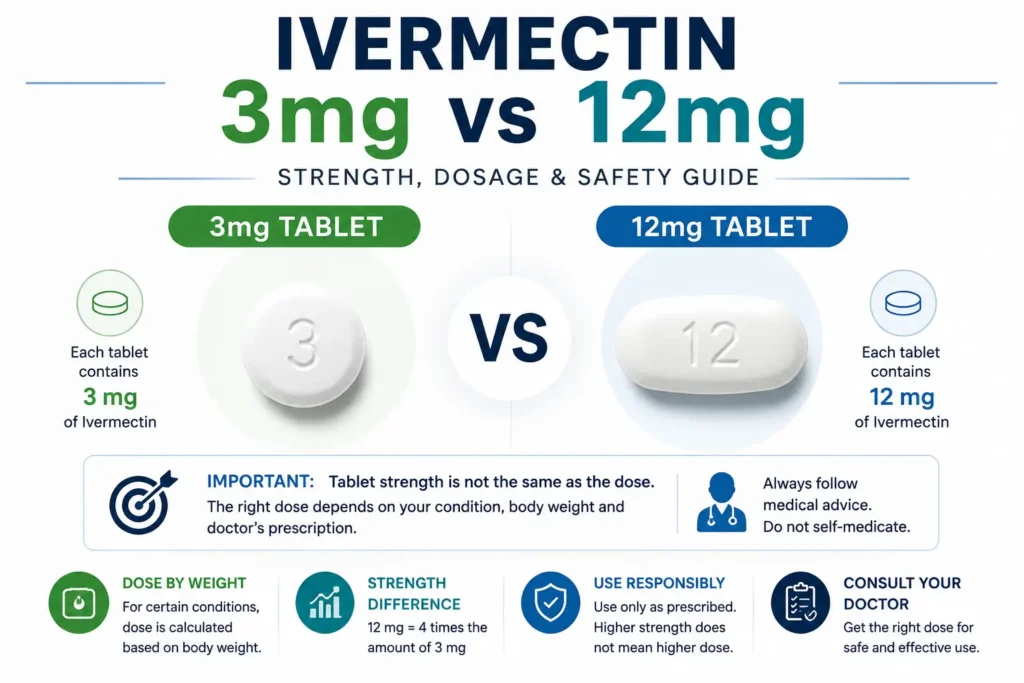
For example, ivermectin may be available in different tablet strengths depending on the product and market.
A higher-strength tablet does not automatically mean that it is appropriate for a particular person.
Similarly, changing from one tablet strength to another should not be treated as a simple medication substitution without considering the prescribed dose and applicable product information.
For our detailed comparison of strengths, see:
Ivermectin 3mg vs 12mg: Key Differences, Strength & Safety Guide
Ivermectin and Veterinary Medicines
Human ivermectin products and veterinary ivermectin products should not be treated as interchangeable.
The FDA warns that animal ivermectin products are formulated and evaluated for specific animal species and can cause serious harm if used by humans.
Never substitute a veterinary ivermectin product for a medicine intended for human use.
Ivermectin and COVID-19
Ivermectin drug-interaction information should not be interpreted as a recommendation to use ivermectin for COVID-19.
The FDA states that ivermectin is not authorized or approved for preventing or treating COVID-19 in humans. FDA-approved human ivermectin tablets are used for specific parasitic infections, while certain topical ivermectin formulations have other approved uses.
Therefore, information about ivermectin dosage or interactions for approved uses should not be repurposed as a COVID-19 treatment recommendation.
When Should You Contact a Healthcare Professional?
Seek professional advice before taking ivermectin if:
- You take warfarin or another medicine affecting blood clotting.
- You take multiple prescription medicines.
- You take several supplements or herbal products.
- You are pregnant or breastfeeding.
- You have significant medical conditions.
- You have relevant exposure to Loa loa-endemic regions.
- You are unsure whether ivermectin is appropriate for your condition.
- You are considering changing or repeating your dose.
If you experience severe symptoms after taking a medicine, seek appropriate urgent medical care.
Frequently Asked Questions About Ivermectin Drug Interactions
Does ivermectin interact with warfarin?
Rare increases in INR have been reported when ivermectin was co-administered with warfarin. Anyone taking warfarin should discuss ivermectin with their healthcare professional before use.
Can I take ivermectin with my other medicines?
It depends on the medicines involved. Tell your doctor or pharmacist about all prescription and nonprescription medicines, vitamins, supplements and herbal products you take.
Does ivermectin interact with blood thinners?
FDA information warns that ivermectin can interact with medicines such as blood thinners. Warfarin is specifically identified in ivermectin prescribing information as having rare reports of increased INR when co-administered.
Can I take ivermectin with vitamins?
Tell your doctor or pharmacist about vitamins and nutritional supplements you use. This allows your complete medication and supplement profile to be reviewed.
Can I take ivermectin with herbal supplements?
Inform your healthcare professional about herbal products you take or plan to take. Do not assume that an herbal product is automatically free of interactions.
Is alcohol an ivermectin interaction?
There is not enough basis to describe alcohol as a universally established ivermectin interaction. Follow the instructions for your specific product and discuss alcohol use with your healthcare professional if you have concerns.
Can ivermectin be taken during pregnancy?
Pregnancy should be discussed with a healthcare professional before taking ivermectin. MedlinePlus specifically advises patients to tell their doctor if they are pregnant, planning pregnancy or breastfeeding.
Can I use veterinary ivermectin instead?
No. Veterinary ivermectin products are formulated and evaluated for animals and should not be substituted for human medicines.
Can I take more ivermectin if my symptoms continue?
Do not increase or repeat your dose without appropriate medical guidance. MedlinePlus advises taking ivermectin exactly as directed.
Key Takeaway
The most important point about ivermectin drug interactions is that there is no universal interaction list that can determine whether ivermectin is appropriate for every person.
The current prescribing information identifies rare increases in INR with warfarin, while patient guidance recommends informing healthcare professionals about all medicines, vitamins, supplements and herbal products.
Before taking ivermectin:
- Review your current medicines with a healthcare professional.
- Mention vitamins and supplements.
- Tell your doctor about relevant medical conditions.
- Discuss pregnancy or breastfeeding.
- Mention relevant travel or residence in Loa loa-endemic areas.
- Follow the prescribed dose.
- Never use veterinary ivermectin in humans.
- Do not use ivermectin for COVID-19 based on information intended for other approved uses.
Safe medication decisions depend on the individual, the indication, the product and the complete medical history.
Related Ivermectin Guides
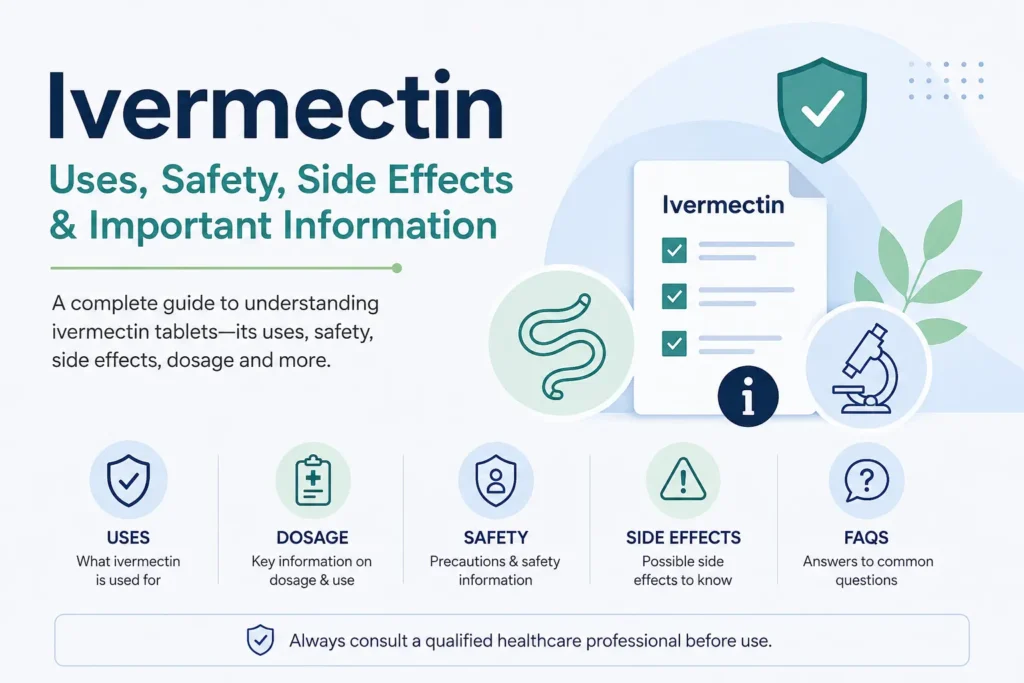
Ivermectin: Uses, Safety, Side Effects & Important Information
Ivermectin educational guide
Ivermectin Dosage: Dose by Weight, Tablet Strength & Safety Guide
Ivermectin dosage guide
Ivermectin 3mg vs 12mg: Key Differences, Strength & Safety Guide
Ivermectin 3mg vs 12mg guide
Ivermectin Side Effects & Safety Guide
Ivermectin side effects guide
Medical Disclaimer
This article is provided for general educational and informational purposes only. It is not intended to provide medical diagnosis, treatment or individualized medical advice. Ivermectin products can differ by formulation, strength, manufacturer, indication and regulatory approval. Always consult a qualified healthcare professional and follow the applicable product information before using any medicine. Never use veterinary medicines in humans.
Authoritative References
DailyMed — Ivermectin Tablets
DailyMed: Ivermectin Tablets
MedlinePlus — Ivermectin Drug Information
MedlinePlus: Ivermectin
FDA — Ivermectin and COVID-19
FDA: Ivermectin and COVID-19