Table of Contents
Strongyloides hyperinfection syndrome is a severe complication of infection with the parasitic worm Strongyloides stercoralis.
Unlike many intestinal worm infections, Strongyloides can remain in the body for years because of its ability to autoinfect the same person repeatedly. In people whose immune system becomes significantly suppressed, the number of larvae can increase dramatically and spread beyond the intestine into other organs.
Ivermectin is the established treatment for strongyloidiasis, but hyperinfection is a medical emergency and requires urgent professional management. Treatment is substantially different from simply taking a routine single dose for uncomplicated infection.
Medical disclaimer: This article is for general educational purposes only. It is not individualized medical advice and should not replace urgent medical evaluation or advice from a qualified healthcare professional.
What Is Strongyloides Hyperinfection?
Strongyloides hyperinfection occurs when the normal life cycle of Strongyloides stercoralis becomes greatly accelerated, producing a much larger number of larvae.
The larvae can migrate beyond their usual intestinal and skin-associated cycle and enter areas such as:
- Lungs
- Gastrointestinal tract
- Skin
- Bloodstream
- Other organs
When larvae spread widely beyond these systems, the condition is often called disseminated strongyloidiasis.
This can become life-threatening because the migrating larvae can carry intestinal bacteria into the bloodstream and other tissues, potentially causing serious bacterial infections and sepsis.
How Does Strongyloides Normally Infect People?
Strongyloides stercoralis is a soil-transmitted parasitic worm.
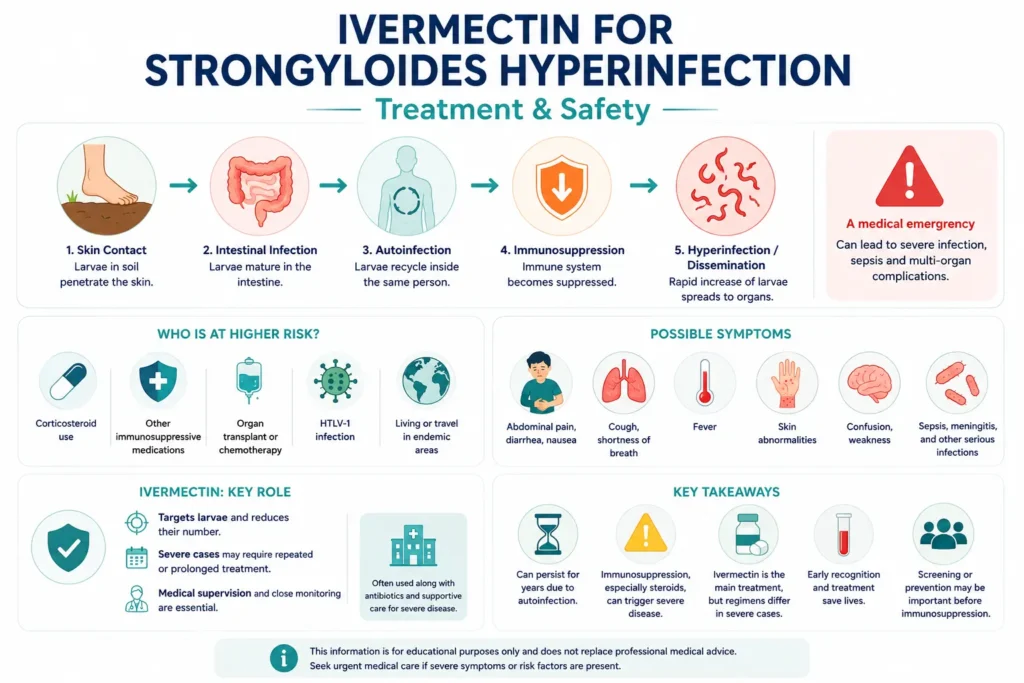
Infection commonly begins when larvae in contaminated soil penetrate the skin, often through bare feet.
The parasite can then migrate through the body and eventually reach the intestine, where adult female worms produce larvae.
One unusual characteristic of Strongyloides is its ability to complete an autoinfective cycle inside the same person.
This means infection can persist for many years if it is not treated.
What Is Autoinfection?
Autoinfection is one of the most important concepts for understanding Strongyloides.
In simple terms:
Soil exposure → infection → intestine → larvae → new infection within the same person → infection continues
Because this cycle can continue internally, someone who acquired Strongyloides many years earlier may still have the infection later in life.
This becomes particularly important if that person subsequently develops significant immunosuppression.
What Causes Strongyloides Hyperinfection?
The strongest recognized risk factor is immunosuppression, particularly treatment with corticosteroids.
CDC information identifies corticosteroid administration as the most commonly associated trigger and notes that hyperinfection can occur regardless of the steroid dose or duration.
Other situations associated with increased risk can include:
- Certain immunosuppressive medicines
- Organ transplantation
- Some cancers and chemotherapy
- Other conditions affecting immune function
- HTLV-1 infection
Why Are Corticosteroids Important?
This is one of the most important educational points about Strongyloides.
Someone can have chronic, relatively mild or even unnoticed Strongyloides infection.
If that person later receives corticosteroids, the infection can potentially accelerate dramatically.
CDC has documented Strongyloides hyperinfection associated with corticosteroid exposure, including situations in which the underlying infection had not previously been recognized.
Therefore, people from areas where Strongyloides is endemic may need appropriate screening or preventive consideration before significant immunosuppression, depending on their circumstances.
Who May Be at Higher Risk?
People who have a history of exposure to Strongyloides and subsequently become immunosuppressed may be at increased risk.
Potential risk factors include:
- Residence in or travel to endemic areas
- Previous exposure to contaminated soil
- Long-standing untreated Strongyloides infection
- Corticosteroid therapy
- Organ transplantation
- Certain cancer treatments
- Other immunosuppressive therapies
- HTLV-1 infection
What Are the Symptoms of Strongyloides Hyperinfection?
Symptoms can be variable and may involve several body systems.
Possible symptoms include:
- Abdominal pain
- Diarrhea
- Nausea
- Cough
- Shortness of breath
- Fever
- Skin abnormalities
- Weakness
- Confusion or altered mental status
Severe cases can involve bacterial bloodstream infections, pneumonia, meningitis and sepsis.
Because the symptoms can resemble other serious illnesses, diagnosis may be challenging.
Can Strongyloides Hyperinfection Affect the Lungs?
Yes.
During hyperinfection, large numbers of larvae can migrate through the lungs.
This may cause:
- Cough
- Breathing difficulties
- Pneumonia-like symptoms
- Pulmonary inflammation
- Respiratory failure in severe cases
The infection can also facilitate movement of intestinal bacteria into the bloodstream.
Can Strongyloides Hyperinfection Cause Sepsis?
Yes.
This is one of the major dangers of disseminated Strongyloides.
As larvae migrate through intestinal and other tissues, they can carry enteric bacteria into normally sterile parts of the body.
This can result in:
- Bacteremia
- Sepsis
- Meningitis
- Other severe bacterial infections
CDC reports significant mortality associated with disseminated strongyloidiasis, emphasizing the importance of early recognition and treatment.
Is Strongyloides Hyperinfection an Emergency?
Yes.
Suspected Strongyloides hyperinfection or dissemination requires urgent medical evaluation and treatment.
This is very different from uncomplicated chronic strongyloidiasis, which may be treated with a standard antiparasitic regimen.
Disseminated disease can progress rapidly and may become fatal without appropriate treatment.
Is Ivermectin Used for Strongyloides Hyperinfection?
Yes.
Ivermectin is the principal antiparasitic medicine used to treat Strongyloides infection, including severe disease.
However, hyperinfection should not be treated by simply taking the routine ivermectin dose used for uncomplicated strongyloidiasis.
Current U.S. ivermectin labeling describes a standard single oral dose of approximately 200 micrograms/kg for uncomplicated strongyloidiasis.
Severe hyperinfection/dissemination requires specialist-directed treatment, often involving repeated or prolonged ivermectin administration until there is clinical improvement and evidence that larvae are no longer being detected.
This distinction is extremely important.
Ivermectin for Strongyloidiasis vs Hyperinfection
| Uncomplicated strongyloidiasis | Hyperinfection/dissemination | |
|---|---|---|
| Severity | Usually chronic infection | Potentially life-threatening |
| Ivermectin | Established treatment | Core antiparasitic treatment |
| Treatment duration | Often limited | May require prolonged/repeated treatment |
| Medical urgency | Requires treatment | Medical emergency |
| Monitoring | Follow-up may be required | Intensive clinical and laboratory monitoring |
| Bacterial complications | Less typical | Can be severe |
The treatment approach must therefore be individualized.
Why Isn’t a Single Ivermectin Dose Enough?
The standard U.S. prescribing information for uncomplicated strongyloidiasis recommends a single oral dose of approximately 200 mcg/kg, with follow-up stool examinations to verify eradication.
Hyperinfection is fundamentally different.
In severe disease, larvae may continue to be produced and disseminated, so clinicians may need to continue treatment until there is evidence that the infection has been controlled. CDC-published clinical experience describes repeated or prolonged ivermectin administration in disseminated disease.
Do not attempt to reproduce these treatment schedules without medical supervision.
Ivermectin 12 mg for Strongyloides Hyperinfection
People frequently search for “ivermectin 12 mg for Strongyloides.”
The important distinction is:
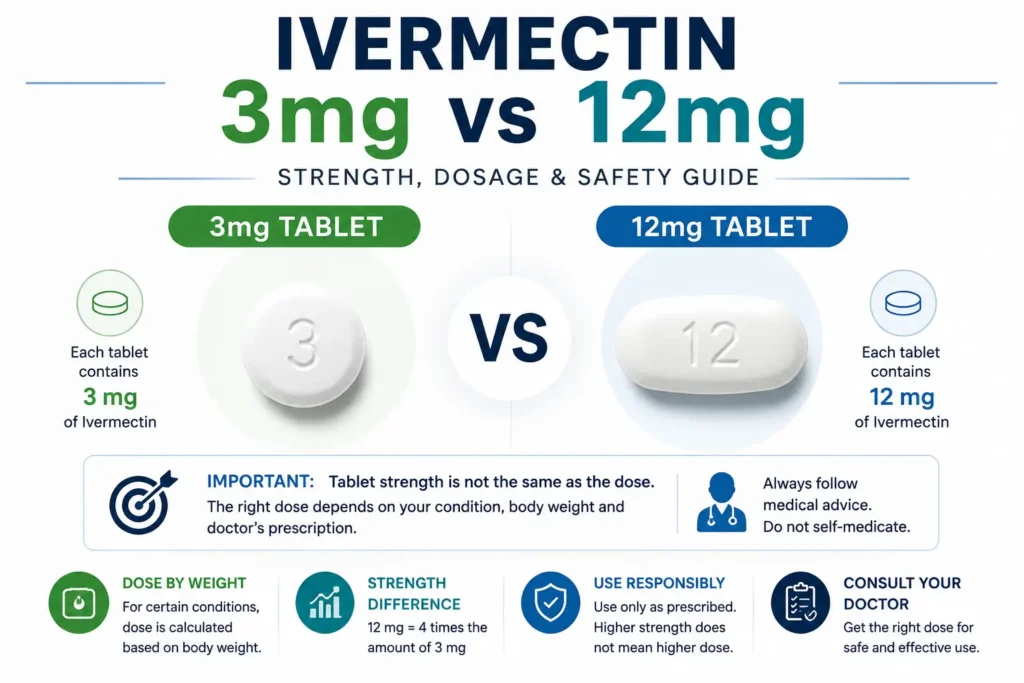
Tablet strength ≠ treatment regimen.
The routine ivermectin dosage for uncomplicated strongyloidiasis is weight-based. Current U.S. labeling describes approximately 200 mcg/kg as a single oral dose.
Hyperinfection is different and may require repeated or prolonged treatment under specialist supervision.
Therefore, a person should never assume that taking one 12 mg tablet—or repeating 12 mg tablets independently—is an appropriate treatment for hyperinfection.
For general ivermectin dosing information, see our Ivermectin Dosage Guide.
How Is Strongyloides Hyperinfection Diagnosed?
Diagnosis may require several types of testing.
Healthcare professionals may investigate:
- Stool samples
- Sputum samples
- Larvae in respiratory specimens
- Serologic testing
- Blood tests
- Imaging
- Other organ-specific investigations
Diagnosis can be difficult because the parasite may not be detected consistently in routine stool testing.
In severe disease, larvae may be found in specimens from the respiratory tract or other affected areas.
Can a Stool Test Miss Strongyloides?
Yes.
A single stool examination may not reliably detect chronic Strongyloides infection.
This is one reason additional testing or repeated examination may sometimes be necessary when clinical suspicion is high.
Serologic testing can also be useful in appropriate situations, although interpretation can vary depending on the patient’s immune status and clinical circumstances.
Why Is Screening Important Before Immunosuppressive Treatment?
A person can carry Strongyloides for years without knowing it.
If they later receive significant immunosuppression, the infection may accelerate.
This is why screening or presumptive treatment may be considered for people with epidemiological risk factors before certain immunosuppressive therapies. CDC has specifically discussed screen-and-treat and presumptive treatment approaches in people at risk who are about to receive corticosteroids.
This is a clinical decision and depends on the person’s history and treatment circumstances.
Strongyloides and Corticosteroids
If someone has a history of living or travelling in a Strongyloides-endemic region, it can be important to tell their healthcare professional before starting corticosteroids or other significant immunosuppressive treatment.
This does not mean corticosteroids should be stopped or avoided when medically necessary.
Instead, it means the underlying Strongyloides risk should be appropriately assessed.
Can Hyperinfection Occur Years After Exposure?
Yes.
One of the unusual characteristics of Strongyloides is its ability to persist for a very long time through autoinfection.
CDC notes that hyperinfection can occur decades after the original exposure.
This is why a remote history of living in an endemic area can remain medically relevant many years later.
Can Strongyloides Hyperinfection Be Prevented?
In many cases, the most important prevention strategy is:
Identify and treat Strongyloides infection before significant immunosuppression occurs.
Other measures include:
- Appropriate screening when risk factors exist
- Treating confirmed infection
- Avoiding exposure to contaminated soil
- Wearing footwear
- Informing healthcare professionals about previous residence in endemic areas
Early recognition can be particularly important before corticosteroid treatment.
Strongyloides Hyperinfection and Other Infections
A major concern is secondary bacterial infection.
Because migrating larvae can carry bacteria from the gastrointestinal tract into other tissues, patients can develop serious bacterial infections.
This may include:
- Bloodstream infection
- Pneumonia
- Meningitis
- Sepsis
Treatment therefore may involve both antiparasitic therapy and management of associated bacterial infections, depending on the patient’s condition.
Ivermectin Safety in Severe Strongyloidiasis
Ivermectin is generally well tolerated when appropriately administered, but severe Strongyloides infection is a complex medical condition.
Treatment may occur alongside:
- Antibiotics
- Immunosuppressive medicines
- Other supportive treatments
- Intensive-care interventions
For a broader discussion of ivermectin adverse effects and precautions, see our Ivermectin Side Effects & Safety guide.
Ivermectin Drug Interactions
People being treated for hyperinfection may already be taking multiple medicines.
This makes medication review particularly important.
Healthcare professionals should consider the patient’s complete medication list before treatment.
For additional general information, see our Ivermectin Drug Interactions guide.
Strongyloides vs Hookworm
Strongyloides and hookworm are both soil-transmitted parasitic worms, but they behave differently.
| Strongyloides | Hookworm | |
|---|---|---|
| Parasite | Strongyloides stercoralis | Ancylostoma / Necator |
| Soil transmission | Yes | Yes |
| Autoinfection | Yes | No |
| Can persist for years? | Yes | Not in the same autoinfective way |
| Hyperinfection syndrome | Yes | No |
| Ivermectin | Established treatment | Not standard first-line treatment |
For more information about the distinction, see our Ivermectin for Hookworms article.
Strongyloides vs Scabies
Both can involve parasites and skin exposure, but they are completely different conditions.
Strongyloides:
- Parasitic roundworm
- Usually acquired through contaminated soil
- Can cause chronic infection
- Can develop into hyperinfection
- Ivermectin is an established treatment
Scabies:
- Caused by a microscopic mite
- Primarily spread through prolonged close contact
- Causes an itchy skin infestation
- Ivermectin may be used in selected circumstances
See our Ivermectin for Scabies guide for more information.
When Should You Seek Urgent Medical Care?
Seek urgent medical attention if someone with known or possible Strongyloides infection develops:
- Severe breathing difficulty
- Persistent fever
- Severe abdominal symptoms
- Confusion
- Rapid deterioration
- Signs of sepsis
- Severe weakness
- Neurological symptoms
Particular urgency is warranted when these symptoms occur in someone who has recently received corticosteroids or other immunosuppressive treatment.
Frequently Asked Questions
What is Strongyloides hyperinfection?
It is a severe form of Strongyloides infection in which the parasite’s normal life cycle becomes greatly accelerated, producing large numbers of larvae that can migrate beyond the intestine.
Is ivermectin used for Strongyloides hyperinfection?
Yes. Ivermectin is the principal antiparasitic treatment, but severe disease requires specialist-directed treatment rather than self-treatment with a routine dose.
Is Strongyloides hyperinfection dangerous?
Yes. It can cause disseminated infection, bacterial sepsis, pneumonia, meningitis and other life-threatening complications.
Can corticosteroids trigger Strongyloides hyperinfection?
Yes. Corticosteroids are the most commonly recognized medication-related trigger, and hyperinfection can occur regardless of the dose or duration of steroid exposure.
Can Strongyloides remain in the body for years?
Yes. Because of autoinfection, untreated infection can persist for years and potentially decades.
Is the normal ivermectin dose enough for hyperinfection?
Not necessarily. Hyperinfection requires a different, specialist-directed treatment strategy and may require repeated or prolonged ivermectin administration.
Can ivermectin 12 mg treat Strongyloides hyperinfection?
The tablet strength alone does not determine the treatment regimen. Severe infection requires medically supervised, weight- and condition-appropriate treatment.
Can Strongyloides cause breathing problems?
Yes. During hyperinfection, larvae can migrate through the lungs and cause significant respiratory disease.
Can Strongyloides cause sepsis?
Yes. Larval migration can facilitate bacterial translocation and lead to serious bloodstream infections and sepsis.
Should people be screened for Strongyloides before steroids?
People with relevant epidemiological risk factors may warrant screening or presumptive treatment before significant immunosuppression, depending on their clinical circumstances.
Key Takeaways
If you’re researching ivermectin for Strongyloides hyperinfection, remember:
- 🪱 Cause: Strongyloides stercoralis
- 🔄 Unique feature: Autoinfection can allow infection to persist for years
- ⚠️ Major trigger: Immunosuppression, especially corticosteroids
- 🚨 Hyperinfection: A potentially life-threatening medical emergency
- 💊 Ivermectin: Principal antiparasitic treatment
- 🔁 Severe disease: May require repeated or prolonged treatment
- 🦠 Major complication: Serious bacterial infection and sepsis
- 🫁 Lungs: Can become involved during hyperinfection
- 🔬 Diagnosis: May require multiple types of testing
- 🩺 Treatment: Requires urgent professional supervision
The key message is:
Strongyloides hyperinfection is not simply a stronger version of ordinary intestinal worms—it is a potentially life-threatening complication that requires urgent diagnosis and specialist-directed ivermectin treatment.
Related Ivermectin Guides
Continue exploring our Ivermectin educational series:
- Ivermectin Uses — overview of established and commonly discussed uses.
- Ivermectin Dosage Guide — general dosing principles and formulation information.
- Ivermectin Side Effects & Safety — safety and adverse-effect information.
- Ivermectin Drug Interactions — potential interaction considerations.
- Ivermectin for Strongyloidiasis — our main guide to Strongyloides infection.
- Ivermectin for Onchocerciasis — another established ivermectin indication.
- Ivermectin for Scabies — ivermectin and scabies treatment.
- Ivermectin for Hookworms — comparison with another soil-transmitted helminth.
- Ivermectin for Lice — ivermectin and lice treatment.
Medical Disclaimer
This article is provided for general educational and informational purposes only. It is not intended to diagnose, treat, cure or prevent any disease and should not replace advice from a qualified healthcare professional.
Ivermectin products differ in formulation, strength, route of administration, indication, dosage and regulatory status. Treatment of Strongyloides hyperinfection is a medical emergency and should be managed by qualified healthcare professionals. Never attempt to reproduce treatment regimens described for severe disease without medical supervision.
Authoritative References
CDC — Strongyloidiasis Information & Hyperinfection Guidance
CDC: Strongyloidiasis & Hyperinfection Information
CDC Emerging Infectious Diseases — Clinical Characteristics of Disseminated Strongyloidiasis
CDC: Clinical Characteristics of Disseminated Strongyloidiasis
CDC Emerging Infectious Diseases — Strongyloides Hyperinfection and Corticosteroids
CDC: Strongyloides Hyperinfection Syndrome
DailyMed — Ivermectin Tablets Prescribing Information
DailyMed: Ivermectin Tablets