Table of Contents
Ivermectin for onchocerciasis is one of the best-established uses of ivermectin.
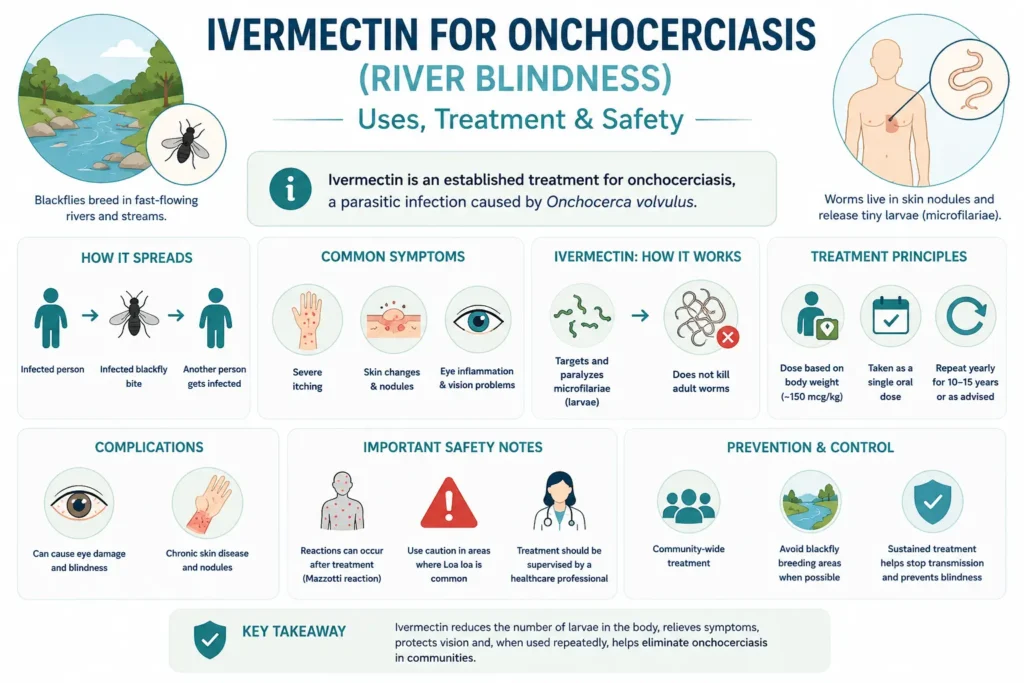
Onchocerciasis, commonly known as river blindness, is a parasitic disease caused by the filarial worm Onchocerca volvulus. It is transmitted through repeated bites from infected blackflies that breed near fast-flowing rivers and streams.
Ivermectin is specifically indicated for the treatment of onchocerciasis and plays a central role in global programs designed to control and eliminate the disease.
This guide explains what onchocerciasis is, how ivermectin works, treatment principles, symptoms, eye complications, safety considerations, prevention and why repeated treatment may be required.
Medical disclaimer: This article is for general educational purposes only. It is not individualized medical advice and should not replace advice from a qualified healthcare professional.
What Is Onchocerciasis?
Onchocerciasis is a parasitic infection caused by Onchocerca volvulus.
It is commonly called river blindness because the blackflies that transmit the parasite breed in rapidly flowing rivers and streams, and the infection can eventually cause serious eye disease and vision loss.
The disease primarily affects rural populations in sub-Saharan Africa and Yemen, with smaller endemic areas in parts of Latin America.
How Does Onchocerciasis Spread?
The infection is transmitted through repeated bites from infected Simulium blackflies.
The basic cycle is:
Infected person → Blackfly bite → Parasite develops inside fly → Infected fly bites another person → Infection continues
Inside the human body, the parasites develop into adult worms that can live in nodules beneath the skin and produce microscopic larvae called microfilariae.
What Are the Symptoms of Onchocerciasis?
Symptoms can vary depending on the duration and severity of infection.
Common manifestations include:
- Severe itching
- Skin inflammation
- Changes in skin texture or appearance
- Skin nodules
- Eye inflammation
- Visual impairment
- Potential permanent blindness
WHO describes onchocerciasis primarily as a skin and eye disease, with symptoms largely associated with inflammatory responses to the microfilariae.
Why Is It Called River Blindness?
The term river blindness comes from the disease’s connection with blackflies that breed in fast-flowing rivers and streams and its potential to cause severe eye disease and blindness.
The name can therefore be understood as:
River environment → Blackfly transmission → O. volvulus infection → Eye complications → Possible vision loss
Is Ivermectin Used for Onchocerciasis?
Yes.
Unlike some of the conditions people search for in relation to ivermectin, onchocerciasis is an established indication for ivermectin tablets.
Current U.S. prescribing information states that ivermectin tablets are indicated for treatment of onchocerciasis caused by Onchocerca volvulus.
WHO also identifies ivermectin as the core medicine used in large-scale treatment programs aimed at controlling and eliminating onchocerciasis.
For a broader overview of ivermectin’s uses, see our Ivermectin Uses guide.
How Does Ivermectin Work Against Onchocerciasis?
Ivermectin is primarily effective against the microfilariae, the immature forms of O. volvulus circulating in the body.
An important distinction is that current prescribing information states that ivermectin does not have activity against adult O. volvulus parasites.
This helps explain why treatment is repeated.
Adult worms can continue producing microfilariae for years, so controlling the infection requires repeated suppression of the larval population.
Does Ivermectin Kill Adult Onchocerca Worms?
No.
Ivermectin is effective against the microfilariae but does not directly eliminate adult Onchocerca volvulus worms.
The adult worms can remain in subcutaneous nodules and continue producing microfilariae.
This is one of the reasons ivermectin treatment may need to be repeated over an extended period.
Why Is Ivermectin Treatment Repeated?
Because ivermectin primarily targets the microfilariae rather than adult worms, repeated treatment helps keep the number of microfilariae low while the adult worm population gradually declines.
WHO recommends ivermectin treatment at least once yearly for 10–15 years in affected populations as part of onchocerciasis control and elimination strategies.
The actual treatment schedule for an individual depends on the clinical and public-health context.
Ivermectin Dosage for Onchocerciasis
Current U.S. prescribing information describes a single oral dose designed to provide approximately 150 micrograms/kg of ivermectin for onchocerciasis.
The prescribing information provides weight-based guidance rather than recommending that everyone take the same number of tablets.
For example, the current labeling provides tablet-count guidance for certain weight ranges.
Do not use a fixed tablet strength as a substitute for weight-based medical dosing.
For general information about ivermectin dosing and formulations, see our Ivermectin Dosage Guide.
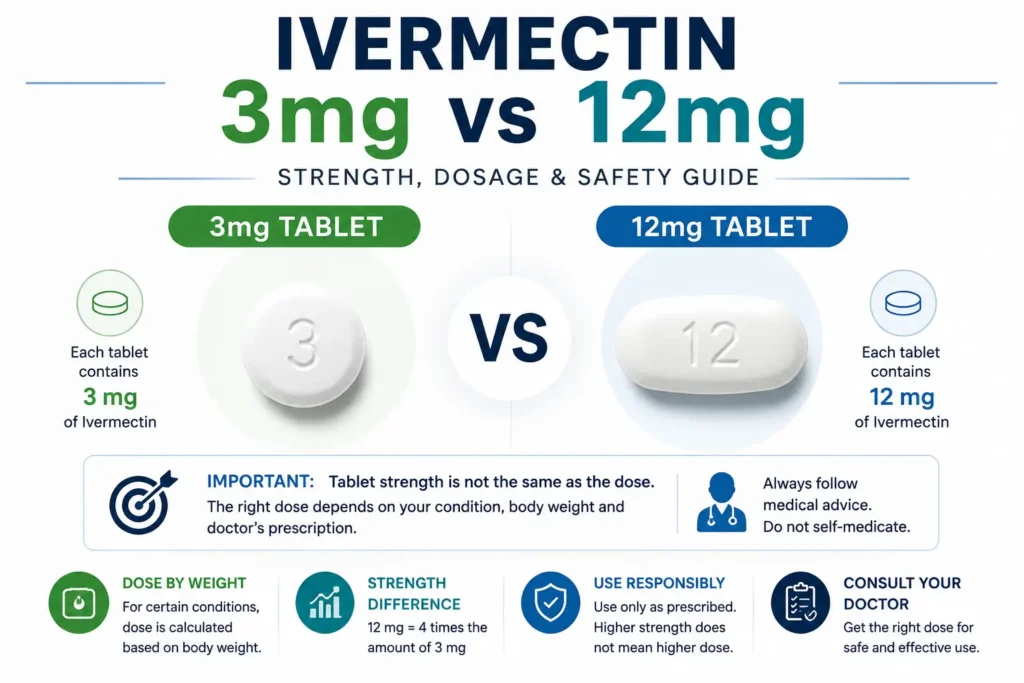
Ivermectin 12 mg for Onchocerciasis
A common search query is:
“Can ivermectin 12 mg treat river blindness?”
Ivermectin is indeed used for onchocerciasis, but the correct dose is determined according to body weight and treatment guidance, rather than simply taking a 12 mg tablet.
The current U.S. labeling for ivermectin tablets uses approximately 150 mcg/kg for onchocerciasis.
Therefore, people should not independently calculate or select their treatment based solely on tablet strength.
How Long Does Onchocerciasis Treatment Continue?
Treatment duration depends on the individual’s circumstances and the broader transmission environment.
For community-based elimination programs, WHO recommends ivermectin treatment at least annually for 10–15 years because adult worms can survive for many years and continue producing microfilariae.
This is different from a typical short course of medication used for many other infections.
Can Onchocerciasis Cause Blindness?
Yes.
One of the most serious complications of onchocerciasis is eye disease.
Inflammation associated with microfilariae can affect different parts of the eye and may eventually lead to:
- Visual impairment
- Eye inflammation
- Progressive vision loss
- Permanent blindness
WHO identifies visual impairment and permanent blindness among the major consequences of onchocerciasis.
Can Onchocerciasis Affect the Skin?
Yes.
Skin manifestations can include:
- Severe itching
- Inflammation
- Changes in skin texture
- Discoloration
- Skin thinning or other chronic changes
- Subcutaneous nodules
The skin symptoms are largely associated with inflammatory reactions to microfilariae and their death.
What Are Onchocerciasis Nodules?
Adult Onchocerca volvulus worms can live in subcutaneous nodules beneath the skin.
These nodules may sometimes be palpable.
The current ivermectin prescribing information notes that surgical removal of certain nodules, known as nodulectomy, may be considered in the management of individual patients because removing the nodules can eliminate adult parasites producing microfilariae.
Treatment decisions should be made by clinicians familiar with onchocerciasis.
Can Ivermectin Cure Onchocerciasis Completely?
Ivermectin is highly important for controlling the infection and reducing the microfilarial burden, but it does not directly kill adult worms.
This means that treatment is generally part of a longer-term strategy rather than a simple one-time cure for the entire parasite population.
In endemic areas, repeated treatment helps interrupt transmission and reduce disease burden over time.
Ivermectin and the Mazzotti Reaction
An important safety consideration in onchocerciasis treatment is the possibility of inflammatory reactions following treatment.
These reactions occur because ivermectin rapidly reduces microfilariae, and the body’s inflammatory response to dying microfilariae can produce symptoms.
The current prescribing information discusses Mazzotti-type reactions, which may include skin and systemic reactions and, in some circumstances, ophthalmological reactions.
This is one reason treatment should be medically supervised in people with known or suspected onchocerciasis.
Onchocerciasis and Loa loa
There is an especially important consideration in regions where Loa loa (African eye worm) and Onchocerca volvulus occur together.
WHO warns that treating individuals with high levels of Loa loa in the blood with ivermectin can sometimes result in severe adverse events. Treatment strategies therefore need to be adjusted in co-endemic areas.
This is not a situation where people should self-treat based on an online dosage guide.
Can Children Receive Ivermectin for Onchocerciasis?
Children may be included in onchocerciasis treatment programs when they meet the relevant eligibility criteria.
However, treatment should be determined according to age, body weight, local program guidance and clinical circumstances.
Current prescribing information includes clinical data in children aged 6–13 years with body weights of 17–41 kg.
Children should not be given ivermectin based simply on the availability of a particular tablet strength.
Ivermectin During Pregnancy
Pregnancy requires special consideration.
The safety of ivermectin during pregnancy has not been established to the same extent as in non-pregnant populations, and treatment decisions should be made by qualified healthcare professionals according to the clinical and public-health circumstances.
People who are pregnant or planning pregnancy should discuss ivermectin treatment with their healthcare provider rather than self-treating.
Ivermectin Side Effects
Ivermectin can cause adverse effects.
In onchocerciasis, some symptoms following treatment may be related to the body’s response to dying microfilariae rather than simply a direct drug effect. These reactions can include skin, systemic and eye-related symptoms.
For broader information about ivermectin safety, see our Ivermectin Side Effects & Safety guide.
Ivermectin Drug Interactions
People taking other medicines should inform their healthcare professional before receiving ivermectin.
The interaction profile can vary depending on the medicines being taken and the patient’s circumstances.
For additional information, see our Ivermectin Drug Interactions guide.
How Is Onchocerciasis Diagnosed?
Diagnosis may involve identifying evidence of Onchocerca volvulus infection.
Depending on the setting, healthcare professionals may use:
- Skin-snip examination
- Microscopic identification of microfilariae
- Examination of skin nodules
- Eye examination
- Other specialized diagnostic methods
Diagnosis can be particularly important before treatment in areas where Loa loa is also present because of the potential for severe reactions to ivermectin in people with high Loa loa microfilarial levels.
Can Onchocerciasis Be Prevented?
There is currently no vaccine that provides routine protection against onchocerciasis.
Prevention and elimination rely heavily on:
- Reducing blackfly transmission
- Community-based ivermectin treatment
- High treatment coverage
- Surveillance
- Vector-control measures where appropriate
WHO identifies large-scale ivermectin treatment as the core strategy for eliminating onchocerciasis.
Where Is Onchocerciasis Common?
More than 99% of people infected with onchocerciasis live in Africa, particularly in endemic areas of sub-Saharan Africa, with additional transmission occurring in Yemen and limited areas of Latin America.
The disease is particularly associated with communities living close to fast-flowing rivers and streams where blackflies breed.
Onchocerciasis vs Strongyloidiasis
Both conditions are caused by parasitic worms, but they are very different infections.
| Onchocerciasis | Strongyloidiasis | |
|---|---|---|
| Parasite | Onchocerca volvulus | Strongyloides stercoralis |
| Main transmission | Infected blackfly bites | Skin contact with contaminated soil |
| Major affected systems | Skin & eyes | Mainly intestinal tract |
| Ivermectin | Established treatment | Established treatment |
| Adult worms directly killed by ivermectin? | No | Treatment has a different mechanism/clinical context |
We’ve already covered strongyloidiasis in our separate Ivermectin for Strongyloidiasis guide.
Onchocerciasis vs Scabies
It is also useful to distinguish onchocerciasis from scabies.
Onchocerciasis:
- Caused by a filarial worm
- Spread by blackflies
- Primarily affects skin and eyes
- Ivermectin is an established treatment
Scabies:
- Caused by Sarcoptes scabiei mites
- Mainly spread through prolonged close skin contact
- Causes intense itching and rash
- Ivermectin may be used in selected treatment situations
See our Ivermectin for Scabies guide for more information.
When Should You Seek Medical Advice?
Professional medical evaluation is particularly important if you have:
- Persistent severe itching after living in or travelling to an endemic area
- Unexplained skin nodules
- Visual changes
- Eye inflammation
- A history of repeated exposure to blackflies
- Suspected onchocerciasis
- Possible exposure to Loa loa
- A need for ivermectin treatment
Vision changes should always be taken seriously.
Frequently Asked Questions About Ivermectin for Onchocerciasis
Does ivermectin treat onchocerciasis?
Yes. Ivermectin is an established treatment for onchocerciasis caused by Onchocerca volvulus.
What is river blindness?
River blindness is another name for onchocerciasis, a parasitic disease transmitted by infected blackflies that can cause severe skin disease and visual impairment.
Does ivermectin kill adult Onchocerca worms?
No. Ivermectin acts primarily against microfilariae and does not have activity against adult O. volvulus parasites.
What is the ivermectin dose for onchocerciasis?
Current U.S. prescribing information describes a single oral dose designed to provide approximately 150 mcg/kg, with treatment decisions made according to the applicable clinical guidance.
Can I take ivermectin 12 mg for river blindness?
Ivermectin treatment for onchocerciasis is weight-based. A person should not select a dose simply because a 12 mg tablet is available.
Why is ivermectin repeated for onchocerciasis?
Because ivermectin does not eliminate adult worms, which can continue producing microfilariae. Repeated treatment helps suppress the microfilarial population and contributes to transmission control.
Can onchocerciasis cause blindness?
Yes. Eye involvement can lead to visual impairment and, in severe cases, permanent blindness.
Can children receive ivermectin?
Children may receive ivermectin under appropriate treatment programs when they meet relevant eligibility requirements. Age, weight and clinical circumstances matter.
Is ivermectin safe during pregnancy?
Pregnancy requires individualized medical assessment. Do not self-treat suspected onchocerciasis during pregnancy.
What is a Mazzotti reaction?
It is an inflammatory reaction that can occur after treatment of filarial infections as the body responds to dying microfilariae. It can involve skin, systemic and eye-related symptoms.
Why is Loa loa important?
In areas where Loa loa and Onchocerca volvulus coexist, people with high Loa loa microfilarial levels can experience severe reactions after ivermectin. Special treatment strategies may therefore be required.
Key Takeaways
If you’re researching ivermectin for onchocerciasis, remember:
- 🪱 Cause: Onchocerca volvulus
- 🪰 Transmission: Infected blackfly bites
- 🌊 Blackflies: Breed around fast-flowing rivers and streams
- 👁️ Major complication: Eye disease and possible blindness
- 💊 Ivermectin: Established treatment
- 🔬 Main target: Microfilariae
- ❌ Adult worms: Not directly killed by ivermectin
- 🔄 Repeated treatment: Important for long-term control
- ⚠️ Loa loa: Requires special consideration in co-endemic areas
- 🩺 Treatment: Should be medically supervised
The key message is:
Ivermectin is a cornerstone of onchocerciasis treatment, but because it primarily targets microfilariae rather than adult worms, repeated treatment and appropriate medical/public-health supervision are essential.
Related Ivermectin Guides
Continue exploring our Ivermectin educational series:
- Ivermectin Uses — overview of established and commonly discussed uses.
- Ivermectin Dosage Guide — dosing principles and formulation considerations.
- Ivermectin Side Effects & Safety — safety and adverse-effect information.
- Ivermectin Drug Interactions — potential interaction considerations.
- Ivermectin for Strongyloidiasis — another established ivermectin indication.
- Ivermectin for Scabies — ivermectin and scabies treatment.
- Ivermectin for Lice — ivermectin and lice treatment.
- Ivermectin for Hookworms — ivermectin and hookworm-related searches.
- Ivermectin for Pinworms — ivermectin and pinworm-related searches.
- Ivermectin for Demodex Mites — Demodex, rosacea and ivermectin.
- Ivermectin for Rosacea — ivermectin and inflammatory rosacea lesions.
Medical Disclaimer
This article is provided for general educational and informational purposes only. It is not intended to diagnose, treat, cure or prevent any disease and should not replace advice from a qualified healthcare professional.
Ivermectin products differ in formulation, strength, route of administration, indication, dosage and regulatory status. Always follow the official product information applicable to your country and consult a qualified healthcare professional for individual medical advice.
Authoritative References
WHO — Onchocerciasis
WHO: Onchocerciasis Fact Sheet — Information on transmission, symptoms, ivermectin treatment and global elimination efforts.
WHO — Onchocerciasis Health Topic
WHO: Onchocerciasis Health Topic — Additional information on treatment and disease distribution.
DailyMed — Ivermectin Tablets
DailyMed: Ivermectin Tablets Prescribing Information — Current prescribing information covering the onchocerciasis indication, dosage and safety information.