Table of Contents
Ivermectin is best known as an antiparasitic medicine used against certain worms and other parasites. But how does ivermectin actually work?
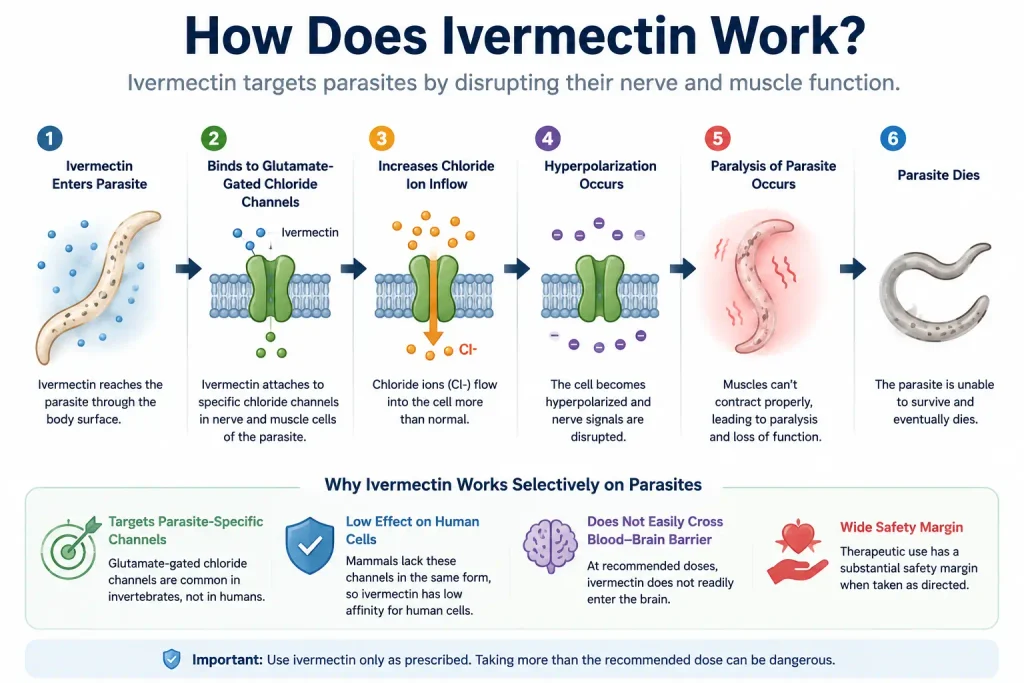
Its primary antiparasitic action involves glutamate-gated chloride channels, specialized channels found in the nervous and muscle systems of many invertebrate parasites. When ivermectin interacts with these channels, it increases chloride-ion flow, leading to hyperpolarization and disruption of normal nerve and muscle function. This can ultimately cause paralysis and death of susceptible parasites.
This mechanism helps explain why ivermectin can affect parasites while having a different effect on humans at therapeutic concentrations.
Medical disclaimer: This article is for educational purposes only and does not replace professional medical advice or the prescribing information applicable to a specific ivermectin product.
What Is Ivermectin?
Ivermectin belongs to a class of medicines known as macrocyclic lactones and was developed from compounds called avermectins produced by a soil-dwelling microorganism.
It has established antiparasitic activity against several parasites, including certain nematodes and arthropods.
Its mechanism is particularly interesting because ivermectin targets biological systems that are especially important in invertebrates.
How Does Ivermectin Work?
The simplest explanation is:
Ivermectin interferes with the parasite’s nervous and muscular function.
It does this primarily by interacting with glutamate-gated chloride channels (GluCl).
The process can be simplified as:
Ivermectin reaches the susceptible parasite
↓
Binds to glutamate-gated chloride channels
↓
Increases chloride-ion permeability
↓
Hyperpolarizes nerve and muscle cells
↓
Disrupts movement and other essential functions
↓
Paralysis and eventual death of susceptible parasites
This is the central mechanism behind ivermectin’s antiparasitic activity.
What Are Glutamate-Gated Chloride Channels?
To understand ivermectin, it helps to understand these channels.
Cells use specialized proteins called ion channels to control the movement of electrically charged particles across their membranes.
Glutamate-gated chloride channels are found in many invertebrates, including parasitic nematodes.
They help regulate important functions involving:
- Nerve signalling
- Muscle activity
- Movement
- Feeding
- Other physiological processes
Ivermectin binds to these channels at an allosteric site and increases their activity. Research has shown that ivermectin can stabilize the open state of these channels, allowing chloride ions to enter the cell.
What Happens When Ivermectin Activates These Channels?
Once ivermectin interacts with susceptible glutamate-gated chloride channels, chloride permeability increases.
This changes the electrical state of the parasite’s nerve or muscle cell.
The result is hyperpolarization.
In simple terms, the nerve or muscle cell becomes less capable of generating the normal electrical signals required for coordinated activity.
The parasite can consequently experience:
Reduced nerve activity → impaired movement → paralysis → loss of essential functions → death
The precise consequences depend on which tissues and channels are affected in the parasite.
Does Ivermectin Kill Parasites Directly?
Not in the same way as a chemical poison that simply destroys a parasite on contact.
Its primary mechanism is physiological disruption.
By interfering with ion channels involved in the parasite’s nervous and muscular systems, ivermectin can prevent the parasite from performing essential functions.
Research describes effects including:
- Reduced motility
- Impaired feeding
- Disruption of neuromuscular function
- Effects on reproduction or larval release in some parasites
How Does Ivermectin Affect Different Parasites?
One of the fascinating aspects of ivermectin is that its effects can vary depending on the parasite.
Nematodes
Nematodes are roundworms.
Ivermectin’s action on glutamate-gated chloride channels can interfere with their:
- Movement
- Feeding
- Neuromuscular activity
This mechanism is particularly important for several parasitic nematodes.
Microfilariae
In filarial infections such as onchocerciasis, ivermectin has a particularly strong effect against microfilariae.
It can produce a rapid and substantial reduction in the number of microfilariae.
Importantly, ivermectin’s effect on Onchocerca volvulus is not simply the same as killing every adult worm. Its activity is particularly important against the larval/microfilarial stage and can also interfere with microfilarial production or release.
Learn more:
Lice and Other Arthropods
Ivermectin can also affect certain arthropods.
In insects, ivermectin can interact with glutamate-gated chloride channels in nerve and muscle cells, disrupting normal neuromuscular activity. FDA review documents this mechanism specifically in relation to Pediculus humanus capitis, the human head louse.
Learn more:
What Happens to the Parasite’s Muscles?
This is one of the easiest ways to visualize ivermectin’s action.
Imagine the parasite’s nervous system as an electrical control network.
Its muscles depend on that network to coordinate:
Movement → feeding → attachment → reproduction and survival
Ivermectin disrupts the electrical signalling involved in these processes.
The resulting neuromuscular dysfunction can leave the parasite paralyzed.
This is why ivermectin’s mechanism is often described as causing paralysis followed by death of susceptible parasites.
Does Ivermectin Affect the Parasite’s Feeding?
It can.
Research has demonstrated that ivermectin’s effects on glutamate-gated chloride channels can interfere with pharyngeal pumping in nematodes.
The pharynx is involved in feeding.
When this function is disrupted, the parasite can lose the ability to feed normally.
So ivermectin’s effect isn’t limited to movement.
Depending on the parasite and the target tissue, it can interfere with several essential physiological functions.
Does Ivermectin Affect Parasite Reproduction?
In some parasites, yes.
Research on ivermectin’s mechanism describes effects involving reproductive tissues and the release of microfilariae in filarial parasites.
For Onchocerca volvulus, ivermectin can interfere with microfilarial production or release and has prolonged effects on microfilarial levels.
This is particularly important in understanding why ivermectin is valuable in controlling diseases such as onchocerciasis.
Why Is Ivermectin More Selective for Parasites?
A natural question is:
If ivermectin interferes with nerve signalling, why doesn’t it simply paralyze humans too?
One important reason is that the glutamate-gated chloride channels targeted by ivermectin are characteristic of invertebrates and are not found in mammals in the same form.
The FDA’s ivermectin labeling notes that mammals lack these glutamate-gated chloride channels and that avermectins have relatively low affinity for mammalian ligand-gated chloride channels at therapeutic concentrations.
This contributes to ivermectin’s selective antiparasitic activity.
Does Ivermectin Affect the Human Nervous System?
At sufficiently high concentrations, ivermectin can interact with other ligand-gated channels, including GABA-related receptors.
However, therapeutic use in humans has a substantial safety margin, partly because ivermectin does not readily cross the mature blood-brain barrier. FDA review information notes that the mature blood-brain barrier is relatively impermeable to ivermectin.
This is one reason using the appropriate dose and formulation is important.
Excessive exposure can still be dangerous.
What Is the Role of GABA?
Ivermectin can also interact with GABA-mediated signalling.
GABA is an inhibitory neurotransmitter.
At higher concentrations, ivermectin can modulate GABA-related receptors and other ligand-gated channels.
This is relevant to safety because the nervous system is highly sensitive to excessive disruption of inhibitory signalling.
It is another reason why taking more ivermectin than recommended is not a way to make treatment work faster.
Why Doesn’t Ivermectin Affect Humans the Same Way?
There are several factors involved.
1. Target selectivity
The main glutamate-gated chloride channels targeted by ivermectin are characteristic of invertebrates.
2. Blood-brain barrier
Ivermectin does not readily cross the mature human blood-brain barrier under normal circumstances.
3. Therapeutic concentrations
Ivermectin is used at concentrations intended to produce antiparasitic effects while maintaining an appropriate safety margin.
However:
Higher exposure can increase the risk of toxicity.
That is why ivermectin should be taken according to the appropriate medical guidance rather than adjusted independently.
How Does Ivermectin Work Against Scabies?
Scabies is caused by the mite Sarcoptes scabiei.
Ivermectin can affect susceptible mites through its activity on chloride channels and their nervous system.
However, the clinical timeline is different from the molecular mechanism.
The medicine can act against the parasite while itching and inflammation continue afterward.
This distinction is important:
Ivermectin’s molecular action
is not the same as
the time required for the skin to recover.
We have covered that distinction in detail in:
How Long Does Ivermectin Take to Work?
How Does Ivermectin Work Against Strongyloides?
Strongyloides stercoralis is a parasitic nematode.
Ivermectin’s action on nematode chloride channels interferes with the parasite’s neuromuscular function.
This contributes to its established role in treating strongyloidiasis.
However, uncomplicated strongyloidiasis and Strongyloides hyperinfection are very different clinical situations.
Learn more:
Ivermectin for Strongyloidiasis
and:
Ivermectin for Strongyloides Hyperinfection
How Does Ivermectin Work Against Head Lice?
Head lice are arthropods rather than nematode worms.
Ivermectin can still affect susceptible lice because their nervous and muscular systems contain relevant chloride channels.
FDA review material describes ivermectin’s interaction with glutamate-gated chloride channels in head lice, resulting in hyperpolarization and paralysis.
This is one reason ivermectin can have activity against lice even though lice are biologically different from intestinal worms.
Does Ivermectin Kill Adult Parasites and Eggs?
Not always.
This is an important distinction.
Ivermectin’s effect depends on:
- The parasite species
- Its developmental stage
- The target tissue
- The treatment regimen
- The formulation
For some parasites, ivermectin is particularly effective against larval stages rather than adult forms.
For example, in onchocerciasis, ivermectin is highly effective against microfilariae but does not simply eliminate all adult worms.
Therefore, we shouldn’t make a blanket statement that:
“Ivermectin kills all parasites and their eggs.”
That would be inaccurate.
Can Parasites Become Resistant to Ivermectin?
Resistance is biologically possible.
Research has identified mutations and other mechanisms affecting glutamate-gated chloride channels and drug transport that can alter ivermectin sensitivity in parasites.
However, resistance patterns vary by parasite and geographical setting.
This is one reason treatment should follow established clinical and public-health guidance rather than repeatedly increasing doses independently.
Does Ivermectin Work the Same Way for Every Condition?
No.
The underlying drug mechanism may be related, but the clinical effect differs by parasite and disease.
For example:
Strongyloidiasis
→ activity against parasitic nematodes
Onchocerciasis
→ strong activity against microfilariae
Head lice
→ activity against an arthropod parasite
Scabies
→ activity against mites
Different organisms have different biology, so the treatment outcome and clinical timeline can differ.
This is why our individual condition guides remain important.
Ivermectin Mechanism vs How Long It Takes to Work
These two topics are closely related but not the same.
Mechanism of action asks:
How does ivermectin affect the parasite?
Answer:
Ion-channel modulation → disrupted nerve/muscle function → paralysis and other physiological effects.
Clinical timeline asks:
When should the patient expect an observable result?
That depends on the parasite, formulation, treatment regimen and the body’s response.
For that question, see:
How Long Does Ivermectin Take to Work?
This distinction is important and prevents us from duplicating the previous article.
Does a Higher Ivermectin Dose Make the Mechanism Stronger?
Not in a simple “more is better” way.
The biological mechanism depends on ivermectin interacting with its molecular targets.
Increasing the amount taken does not mean the medicine will necessarily produce faster parasite elimination.
Higher exposure can instead increase the risk of adverse effects.
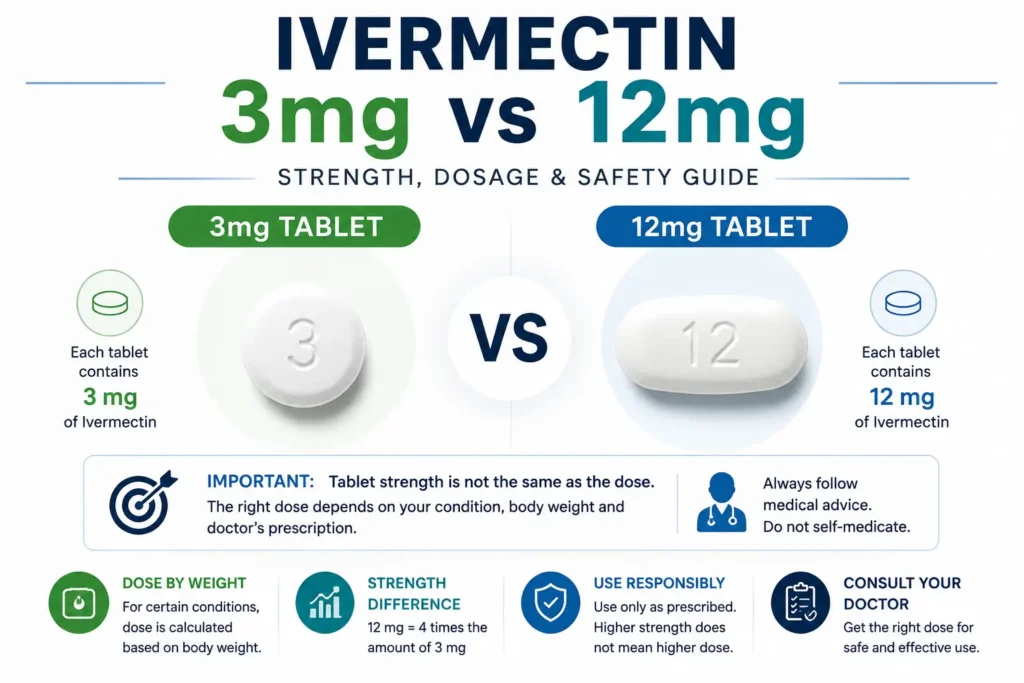
Therefore, tablet strength and mechanism of action are separate concepts.
For dosage information:
For tablet-strength information:
What Makes Ivermectin Different From Many Other Antiparasitic Medicines?
Ivermectin has a distinctive mechanism involving ligand-gated chloride channels.
Its activity against glutamate-gated chloride channels is particularly important for its effects on nematodes and arthropods.
This mechanism is one reason ivermectin has become an important medicine for several parasitic diseases.
It is also why understanding the parasite being treated is essential.
Frequently Asked Questions
How does ivermectin kill parasites?
Ivermectin primarily activates/modulates glutamate-gated chloride channels in susceptible invertebrate parasites, increasing chloride-ion permeability and disrupting nerve and muscle function. This can lead to paralysis and death.
Does ivermectin paralyze parasites?
Yes. Disruption of chloride-channel signalling can cause neuromuscular paralysis in susceptible parasites.
Does ivermectin kill parasite eggs?
Not necessarily. Its activity depends on the parasite and developmental stage. It should not be assumed to eliminate every parasite stage.
How does ivermectin work on worms?
In susceptible nematodes, ivermectin interferes with glutamate-gated chloride channels involved in nervous and muscular function. This can impair movement, feeding and other essential processes.
How does ivermectin work on lice?
Ivermectin can interact with glutamate-gated chloride channels in lice, disrupting neuromuscular function and causing paralysis.
How does ivermectin work on scabies mites?
It acts on susceptible mites through mechanisms involving their nervous and neuromuscular systems. Clinical improvement, however, may take longer than the initial biological action.
Why is ivermectin relatively selective for parasites?
Its main antiparasitic target, glutamate-gated chloride channels, is characteristic of invertebrates, and ivermectin has relatively low affinity for mammalian ligand-gated chloride channels at therapeutic exposure.
Does ivermectin affect human nerves?
At therapeutic concentrations ivermectin has a favorable selectivity profile, but excessive exposure can affect the nervous system and cause serious toxicity.
Does ivermectin cross the blood-brain barrier?
Ivermectin does not readily cross the mature blood-brain barrier under normal circumstances.
Can parasites develop ivermectin resistance?
Resistance mechanisms have been documented in parasites, including mechanisms involving target-site changes and drug transport.
Does ivermectin work immediately?
The molecular action begins after the drug reaches its target, but the clinical timeline varies considerably by condition. See our How Long Does Ivermectin Take to Work?
Key Takeaways
🦠 Target
Ivermectin primarily targets glutamate-gated chloride channels in susceptible invertebrate parasites.
⚡ Effect
It increases chloride-ion permeability and disrupts nerve and muscle activity.
🪱 Result
Susceptible parasites can become paralyzed and eventually die.
🧬 Different parasites
The precise biological and clinical effects depend on the parasite and its developmental stage.
🧠 Human selectivity
Mammals lack the same glutamate-gated chloride channels, contributing to ivermectin’s selective antiparasitic action.
⚠️ Safety
Higher exposure can affect other nervous-system targets and increase toxicity risk.
⏱️ Important distinction
Mechanism of action is not the same as clinical treatment timeline.
Related Ivermectin Guides
- Ivermectin Educational Guide
- Ivermectin Uses
- Ivermectin Dosage Guide
- Ivermectin 3mg vs 12mg
- Ivermectin Side Effects & Safety
- Ivermectin Drug Interactions
- How Long Does Ivermectin Take to Work?
- Ivermectin for Strongyloidiasis
- Ivermectin for Strongyloides Hyperinfection
- Ivermectin for Onchocerciasis
- Ivermectin for Head Lice
- Ivermectin for Scabies
Internal-linking strategy for this article
This page should not become another dosage/product page.
Its primary role is:
Ivermectin Uses
↕
How Does Ivermectin Work?
↕
Condition-specific articles
And it should send readers who want different information toward:
Mechanism → How Long It Takes to Work
Mechanism → Dosage Guide
Mechanism → Safety
Mechanism → relevant condition
That keeps the search intents clean.
Authoritative References
FDA — Ivermectin Clinical Review
The FDA clinical review explains ivermectin’s mechanism of action, including its selective binding to glutamate-gated chloride channels, increased chloride permeability, hyperpolarization, and resulting paralysis of susceptible parasites.
Link: FDA — Ivermectin Clinical Review
DailyMed — Ivermectin Tablets
The official prescribing information describes ivermectin’s mechanism, selectivity for invertebrate chloride channels, and its limited penetration of the human blood-brain barrier.
Link: DailyMed — Ivermectin Tablets
PubMed — Ivermectin and Its Target Molecules
This peer-reviewed review examines ivermectin’s molecular targets and its effects on ion channels and receptors.
Link: PubMed — Ivermectin and Its Target Molecules
PMC — Ivermectin: An Anthelmintic, an Insecticide, and Much More
A detailed scientific review covering ivermectin’s interaction with glutamate-gated chloride channels and its effects on parasite nervous and muscular systems.
Link: PMC — Ivermectin: An Anthelmintic, an Insecticide, and Much More
PubMed — Molecular Mechanisms of Ivermectin
This review examines how ivermectin interacts with glutamate-gated chloride channels and other ligand-gated ion channels at the molecular level.