Table of Contents
When researching ivermectin tablets, one of the most common questions is about the difference between ivermectin 3mg vs 12mg.
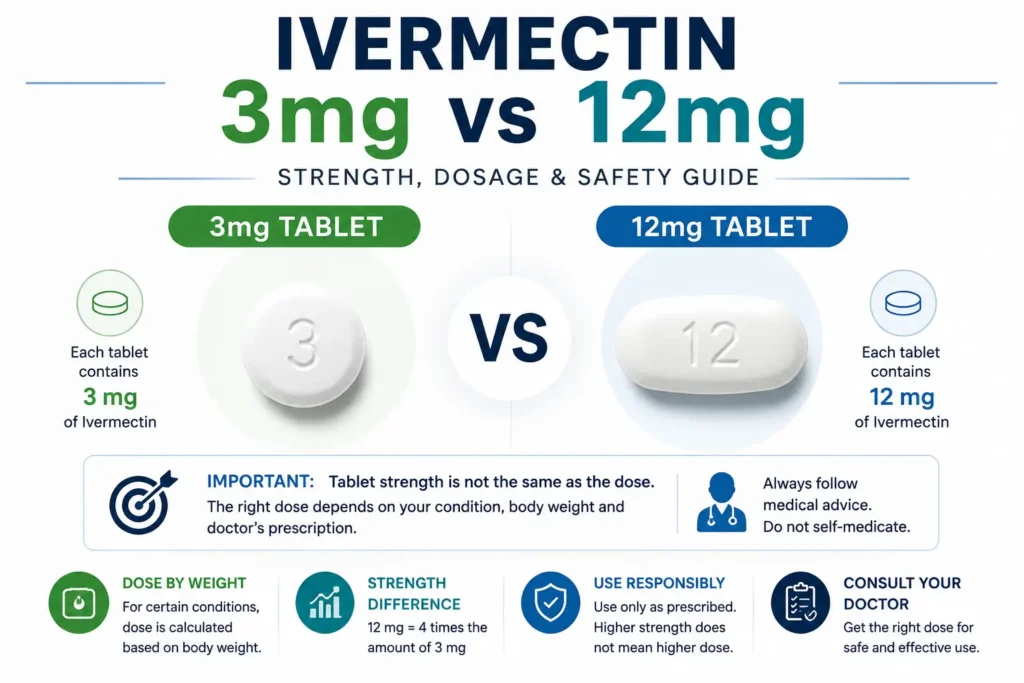
The numbers 3 mg and 12 mg refer to the amount of ivermectin contained in a tablet. However, tablet strength should not be confused with the dose that a person should take.
The appropriate ivermectin regimen depends on factors such as the medical condition being treated, body weight, patient characteristics, the specific product and the healthcare professional’s instructions.
This guide explains the difference between ivermectin 3 mg and 12 mg tablets, how tablet strength relates to dosing, and why choosing a higher-strength tablet does not automatically mean that it is more appropriate.
Important: This article is for educational purposes only. It is not a substitute for diagnosis or medical advice. Ivermectin should be used only according to appropriate medical guidance and the labeling applicable in your country.
What Does Ivermectin 3mg Mean?
An ivermectin 3 mg tablet contains 3 milligrams of ivermectin.
Some official ivermectin tablet labels, including current U.S. labeling, describe 3 mg tablets and provide weight-based dosage tables for specific indications. For example, the current DailyMed labeling for strongyloidiasis uses a weight-based regimen and expresses the dose using the number of 3 mg tablets.
This illustrates an important point:
The tablet strength is simply the amount of active ingredient contained in each tablet.
The number of tablets used for a particular medical indication is a separate question.
What Does Ivermectin 12mg Mean?
An ivermectin 12 mg tablet contains four times the amount of ivermectin found in a 3 mg tablet.
In simple mathematical terms:
12 mg = 4 × 3 mg
However, this does not mean that someone should automatically take one 12 mg tablet instead of four 3 mg tablets.
The appropriate dose depends on the indication, body weight, product labeling and professional medical guidance.
This distinction is particularly important when comparing products available in different countries because approved strengths, formulations, labeling and indications can vary by market.
Ivermectin 3mg vs 12mg: What’s the Difference?
| Feature | Ivermectin 3mg | Ivermectin 12mg |
|---|---|---|
| Active ingredient | Ivermectin | Ivermectin |
| Strength per tablet | 3 mg | 12 mg |
| Relative strength | 1× | 4× the amount per tablet |
| Tablet count for a prescribed dose | May require multiple tablets | May require fewer tablets depending on the prescribed dose |
| Appropriate dose | Depends on indication and patient factors | Depends on indication and patient factors |
| Should strength be selected independently? | No | No |
| Main consideration | Prescribed dose and product labeling | Prescribed dose and product labeling |
The most important takeaway is:
3 mg and 12 mg describe tablet strength, not automatically the correct dose for an individual.
Does a 12mg Tablet Mean a Higher Dose?
Not necessarily.
A 12 mg tablet contains more ivermectin than a 3 mg tablet, but the appropriate total dose still depends on the clinical situation.
For example, official ivermectin labeling for certain parasitic infections uses body-weight-based dosing. For strongyloidiasis, one current DailyMed label describes approximately 200 micrograms per kilogram as a single oral dose, with a table showing the corresponding number of 3 mg tablets for different weight ranges.
For onchocerciasis, the same labeling uses approximately 150 micrograms per kilogram.
This demonstrates why simply asking whether “3 mg or 12 mg is better” can be misleading.
The more appropriate question is:
What dose and formulation are appropriate for the specific medical indication and patient?
Ivermectin Dosage and Body Weight
For certain approved indications, ivermectin dosing is calculated according to body weight.
For example, current DailyMed labeling for strongyloidiasis lists the following dosing guidance using 3 mg tablets:
| Body Weight | Number of 3 mg Tablets |
|---|---|
| 15–24 kg | 1 tablet |
| 25–35 kg | 2 tablets |
| 36–50 kg | 3 tablets |
| 51–65 kg | 4 tablets |
| 66–79 kg | 5 tablets |
| ≥80 kg | 200 mcg/kg |
These figures come from the current official labeling for that specific indication and should not be interpreted as a general dosing table for every use of ivermectin.
This is why tablet strength alone cannot determine an individual’s appropriate dose.
For a deeper educational explanation, see our Ivermectin dosage guide.
Why Tablet Strength and Dose Are Different
These two terms are often used interchangeably, but they mean different things.
Tablet strength
This refers to the quantity of active ingredient contained in one tablet.
For example:
3 mg tablet → 3 mg ivermectin per tablet
12 mg tablet → 12 mg ivermectin per tablet
Dose
The dose refers to the amount of medicine intended to be taken according to the medical indication and patient-specific instructions.
Therefore:
Tablet strength ≠ prescribed dose
A healthcare professional may prescribe a particular total amount based on factors such as:
- Medical indication
- Body weight
- Age
- Medical history
- Other medicines
- Relevant contraindications or precautions
- The approved product labeling
MedlinePlus advises patients to take ivermectin exactly as directed and not to take more or less than prescribed.
Can Four 3mg Tablets Be Considered the Same as One 12mg Tablet?
From a simple arithmetic perspective:
4 × 3 mg = 12 mg
But that does not automatically mean the products are interchangeable.
The actual pharmaceutical product may differ in:
- Manufacturer
- Formulation
- Excipients
- Tablet characteristics
- Regulatory approval
- Market-specific labeling
- Approved indications
- Quality specifications
Therefore, patients should not independently substitute one product or strength for another simply based on the milligram calculation.
For healthcare professionals, importers and buyers, the relevant product documentation should always be reviewed before considering a product equivalent or substitutable.
When Is Ivermectin 3mg Used?
Ivermectin 3 mg tablets are an established tablet strength in official labeling for certain approved indications.
For example, current U.S. labeling includes 3 mg tablets for specific parasitic infections and provides dosing information based on body weight.
The number of tablets depends on the prescribed dose.
This means that a 3 mg tablet can be useful when the required dose is appropriately delivered using that strength.
When Is Ivermectin 12mg Used?
Availability of 12 mg ivermectin tablets varies by country, manufacturer and regulatory market.
Where a 12 mg formulation is legally marketed and appropriately labeled, it represents a higher amount of ivermectin per tablet than a 3 mg formulation.
However, the existence of a 12 mg formulation does not mean that 12 mg is an appropriate dose for every person or every condition.
Before using or supplying a particular strength, it is important to verify:
- Product registration
- Applicable local regulations
- Manufacturer documentation
- Approved indications
- Strength and formulation
- Certificate of Analysis where relevant
- Packaging and labeling requirements
Ivermectin 3mg vs 12mg: Which Is Better?
There is no universal answer.
Neither strength is automatically “better.”
The appropriate strength depends on the required dose and the specific product that has been prescribed or authorized for the relevant use.
For an individual patient, the decision should be based on medical guidance.
For a pharmaceutical buyer or importer, the decision may additionally involve:
- Regulatory requirements
- Market authorization
- Product registration
- Manufacturer qualification
- Documentation
- Packaging requirements
- MOQ
- Supply availability
This distinction is particularly important for international pharmaceutical procurement.
Important Safety Considerations
Ivermectin should not be treated as a medicine where taking a larger tablet automatically produces a better result.
Using an inappropriate dose can expose a person to unnecessary risk.
Official information also highlights the importance of considering medical history and other medicines. MedlinePlus advises patients to tell their doctor or pharmacist about other medicines, vitamins and supplements they are taking or planning to take.
Important principles include:
1. Do not self-select the strength
Do not choose 3 mg or 12 mg simply because one tablet appears more convenient.
2. Do not assume that a higher strength is better
12 mg contains more ivermectin per tablet than 3 mg, but that does not establish that it is more appropriate.
3. Follow the applicable product labeling
Different markets may have different approved formulations, indications and labeling.
4. Avoid veterinary ivermectin products for human use
Human and veterinary products may have different formulations and labeling. Products intended for animals should not be substituted for human medicines.
5. Check for interactions and precautions
Patients should inform healthcare professionals about other medicines and supplements they use.
Common Mistakes When Comparing Ivermectin 3mg and 12mg
Mistake 1: Assuming 12 mg is always better
Higher strength does not automatically mean greater suitability.
Mistake 2: Treating tablet strength as the prescribed dose
A 12 mg tablet simply contains 12 mg of ivermectin.
Mistake 3: Ignoring body weight
For some approved indications, ivermectin dosing is weight-based.
Mistake 4: Using information from one indication for another
Ivermectin dosing is not necessarily identical across different conditions.
Mistake 5: Comparing products only by milligrams
Regulatory status, formulation, manufacturer and labeling also matter.
Frequently Asked Questions
Is ivermectin 12mg four times stronger than ivermectin 3mg?
A 12 mg tablet contains four times as much ivermectin as a 3 mg tablet.
However, “four times stronger” can be misleading because the appropriate dose depends on the medical indication and patient-specific factors.
Is ivermectin 12mg the same as taking four 3mg tablets?
Mathematically, four 3 mg tablets contain 12 mg of ivermectin.
However, different products are not automatically interchangeable simply because their total milligram amount is the same.
Does ivermectin dosage depend on weight?
For certain approved indications, yes. Current DailyMed labeling provides weight-based dosing tables for strongyloidiasis and onchocerciasis.
Can I choose between ivermectin 3mg and 12mg myself?
The appropriate strength should not be selected solely on the basis of convenience or tablet size. Follow professional medical advice and the applicable product labeling.
Is ivermectin 12mg available everywhere?
No. Availability, regulatory status, approved formulations and labeling can vary between countries.
Where can I learn more about ivermectin?
For a broader overview covering ivermectin uses, safety and important information, see our Ivermectin educational guide.
Ivermectin 12mg Product Information
For buyers researching the availability of ivermectin 12 mg formulations, product specifications should be evaluated separately from general medical information.
Our Ivermectin 12 mg Tablet Product Information page provides information about the product and export enquiry process.
For international buyers, product availability and documentation should always be assessed according to the destination country’s regulatory requirements.
Final Takeaway
The key difference between ivermectin 3mg vs 12mg is the amount of ivermectin contained in each tablet.
A 3 mg tablet contains 3 mg of ivermectin, while a 12 mg tablet contains 12 mg.
But the most important point is that tablet strength does not by itself determine the appropriate dose.
For certain approved indications, ivermectin dosing is based on factors such as body weight and the specific condition being treated. Official labeling provides indication-specific dosing information, while MedlinePlus advises patients to follow their prescribed directions carefully.
For patients, the appropriate strength should be determined through qualified medical guidance.
For pharmaceutical buyers and importers, the evaluation should additionally include product registration, regulatory requirements, manufacturer documentation, quality specifications and destination-market requirements.