
Table of Contents
Ivermectin dosage is not the same for every person or every medical condition.
For certain approved oral uses, ivermectin dosing is calculated according to body weight. The appropriate regimen can also depend on the condition being treated, the formulation and strength of the medicine, the patient’s medical history and the prescribing information applicable in the country where the medicine is used.
This guide explains how ivermectin dosage is determined, how weight-based dosing works, the difference between tablet strength and prescribed dose, and important safety considerations.
Important: This article is for general educational purposes only. It is not a personalized dosing recommendation or a substitute for medical advice. Do not start, stop or change ivermectin treatment based only on information found online. Always follow the instructions provided by a qualified healthcare professional and the applicable product information.
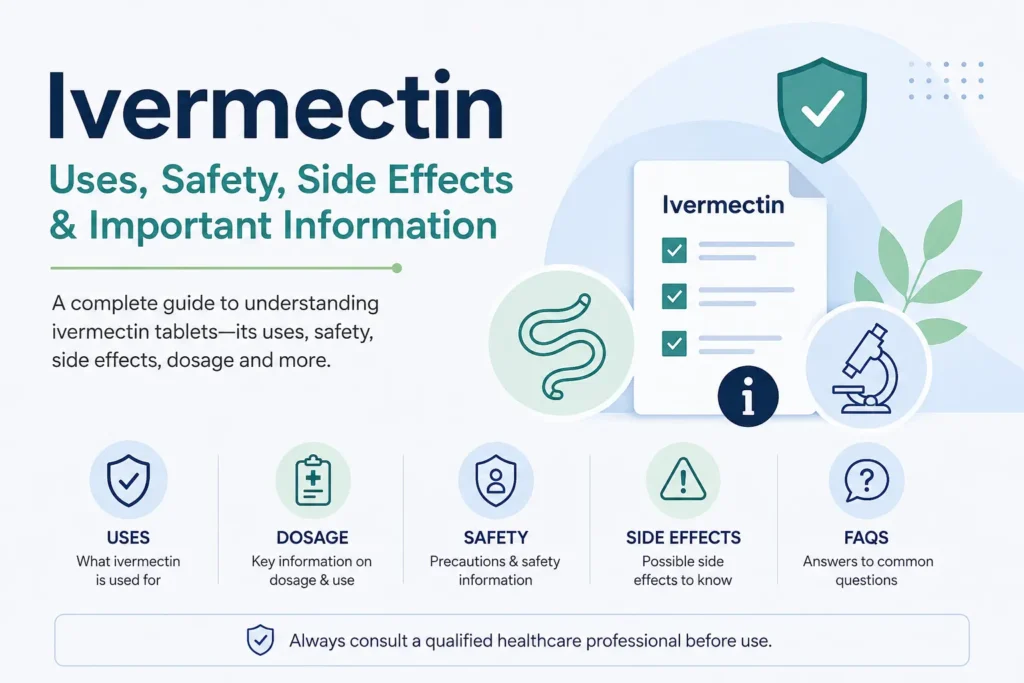
For a broader overview of ivermectin, see our Ivermectin: Uses, Safety, Side Effects & Important Information guide.
How Is Ivermectin Dosage Determined?
There is no single ivermectin dosage that applies to everyone.
For established oral uses, healthcare professionals may consider:
- The medical condition being treated
- Body weight
- Age
- Medical history
- Other medicines being taken
- The formulation and tablet strength
- Applicable prescribing information
- Local regulatory requirements
For example, current U.S. prescribing information recommends an oral dose designed to provide approximately 200 micrograms per kilogram of body weight for strongyloidiasis and approximately 150 micrograms per kilogram for onchocerciasis.
This demonstrates why the question “How many ivermectin tablets should I take?” cannot be answered safely without knowing the medical indication and relevant patient factors.
Is Ivermectin Dosage Based on Body Weight?
For certain approved indications, yes.
Current U.S. prescribing information provides weight-based dosing tables for ivermectin tablets for strongyloidiasis and onchocerciasis. These tables are based on 3 mg tablets and are specific to those particular indications.
However, a weight-based table should not be treated as a universal ivermectin dosage calculator.
The same body weight can correspond to different dosing requirements depending on the condition being treated.
This is an important distinction when researching ivermectin dosage online.
Ivermectin Dosage for Strongyloidiasis
For intestinal strongyloidiasis, current U.S. prescribing information recommends a single oral dose designed to provide approximately 200 mcg/kg of body weight.
The official prescribing information provides the following guidance using 3 mg tablets:
| Body Weight | Number of 3 mg Tablets |
|---|---|
| 15–24 kg | 1 tablet |
| 25–35 kg | 2 tablets |
| 36–50 kg | 3 tablets |
| 51–65 kg | 4 tablets |
| 66–79 kg | 5 tablets |
| ≥80 kg | 200 mcg/kg |
This table is specific to the labeled treatment of strongyloidiasis and should not be used as a general dosing chart for other conditions.
The prescribing information also recommends follow-up stool examinations to verify eradication of the infection.
Ivermectin Dosage for Onchocerciasis
For onchocerciasis, current U.S. prescribing information recommends a single oral dose designed to provide approximately 150 mcg/kg of body weight.
The corresponding 3 mg tablet table is:
| Body Weight | Number of 3 mg Tablets |
|---|---|
| 15–25 kg | 1 tablet |
| 26–44 kg | 2 tablets |
| 45–64 kg | 3 tablets |
| 65–84 kg | 4 tablets |
| ≥85 kg | 150 mcg/kg |
Again, this table is specific to the treatment of onchocerciasis and should not be interpreted as a universal ivermectin dosing recommendation.
The prescribing information notes that retreatment intervals can differ depending on whether treatment is being provided through mass distribution programs or for individual patients.
Why Does Ivermectin Dosage Differ Between Conditions?
One of the most important things to understand about ivermectin is that the medical indication matters.
For example:
- Strongyloidiasis: approximately 200 mcg/kg
- Onchocerciasis: approximately 150 mcg/kg
These differences are reflected in current prescribing information.
Therefore, body weight alone does not determine the appropriate ivermectin dosage.
A person should not select a dose simply by finding their weight on an online table.
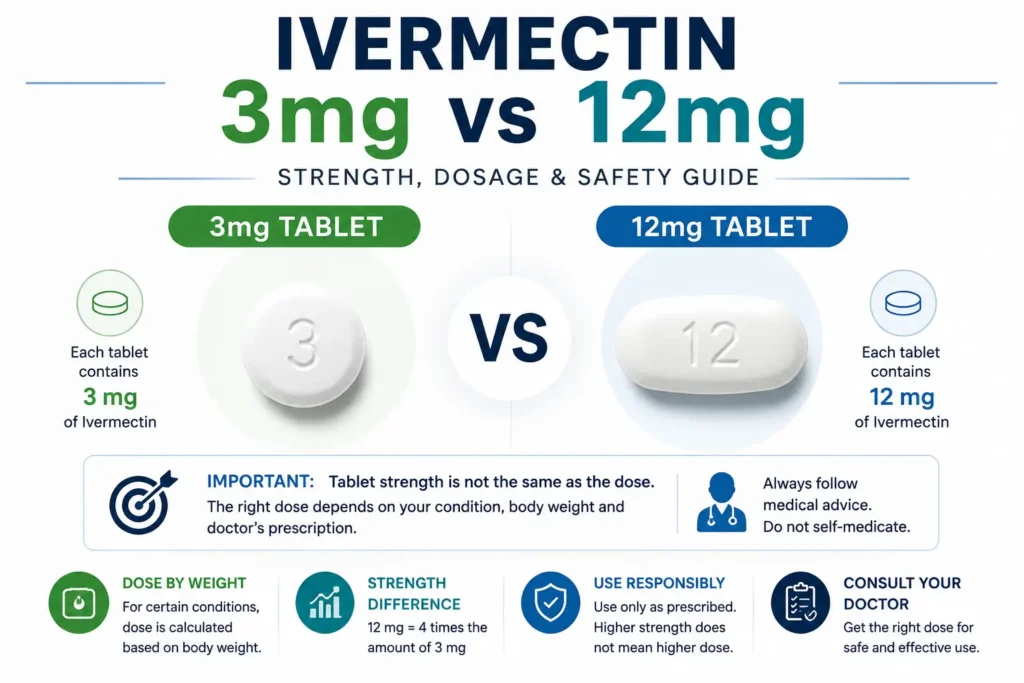
Ivermectin 3mg vs 12mg: Does Tablet Strength Change the Dose?
Tablet strength and prescribed dose are two different concepts.
A 3 mg tablet contains 3 mg of ivermectin.
A 12 mg tablet contains 12 mg of ivermectin.
Therefore:
12 mg = four times the amount of ivermectin contained in a 3 mg tablet.
However, this does not mean that one 12 mg tablet is automatically interchangeable with four 3 mg tablets for every patient or indication.
The appropriate formulation and strength depend on the product, medical indication, applicable labeling and professional guidance.
For a detailed comparison, read our Ivermectin 3mg vs 12mg: Key Differences, Strength & Safety Guide.
Ivermectin Dosage by Weight: What You Should Know
Searching for “ivermectin dosage by weight” can produce many online charts and calculators.
However, these should be approached carefully.
A weight-based dosage table is meaningful only when you also know:
- Which condition is being treated?
- Which formulation is being used?
- Which tablet strength is being used?
- Which country’s approved product information applies?
- What patient-specific factors need to be considered?
For example, the official 3 mg tablet labeling uses different weight-based tables for strongyloidiasis and onchocerciasis.
Therefore:
Weight is an important factor in some ivermectin dosing regimens, but weight alone does not determine the correct dose.
How Many Ivermectin Tablets Should Be Taken?
There is no single answer that applies to everyone.
The number of tablets depends on the prescribed dose and the strength of the particular tablet.
For example, the current U.S. labeling for certain indications uses 3 mg tablets and provides specific tablet counts for different weight ranges.
This is why patients should not decide the number of tablets based solely on:
- Body weight
- Someone else’s prescription
- An online calculator
- A social media post
- A product strength
- Another person’s treatment
MedlinePlus specifically advises patients to take ivermectin exactly as directed and not to take more or less or take it more frequently than prescribed.
How Should Oral Ivermectin Be Taken?
For the oral ivermectin tablets covered by the current U.S. prescribing information discussed in this article, the tablets are taken on an empty stomach with water.
MedlinePlus similarly states that oral ivermectin is usually taken as a single dose on an empty stomach with water, although treatment schedules can differ depending on the condition.
Patients should follow the instructions provided with their specific medicine and prescription.
Do not change the timing or frequency simply because you believe a different schedule might work better.
Does Ivermectin Dosage Depend on Age?
Age can be an important consideration when medicines are prescribed, but age alone does not provide enough information to determine an ivermectin dose.
Healthcare professionals may consider:
- Age
- Body weight
- Medical condition
- Other medicines
- Medical history
- Product labeling
For children, weight and the specific indication can be particularly important.
Parents and caregivers should not use an online ivermectin dosage chart to independently determine a child’s dose.
Ivermectin Dosage for Children
The suitability of ivermectin for a child depends on the specific medicine, indication, age, body weight and applicable prescribing information.
Some oral ivermectin products are used in pediatric patients for particular indications and weight ranges, while other formulations and uses have different requirements.
This is why parents should consult a qualified healthcare professional rather than calculating a child’s dose independently.
Do not give a child ivermectin prescribed for another person.
Ivermectin Dosage for Adults
Adults do not necessarily receive one standard ivermectin dose.
For certain approved oral uses, dosing can still be based on body weight and the medical condition being treated.
For example, current U.S. labeling uses approximately 200 mcg/kg for strongyloidiasis and approximately 150 mcg/kg for onchocerciasis.
Therefore, the term “adult ivermectin dosage” by itself is incomplete without specifying the indication and relevant product information.
Can the Ivermectin Dose Be Repeated?
The answer depends on the medical condition and treatment plan.
For strongyloidiasis, current U.S. prescribing information describes a single oral dose and notes that additional doses are generally not necessary, while follow-up stool examinations are recommended.
For onchocerciasis, retreatment may be considered at different intervals depending on the treatment setting and individual circumstances.
This illustrates why ivermectin should not be taken repeatedly simply because symptoms continue.
A healthcare professional should determine whether additional treatment is appropriate.
What Happens If You Take More Ivermectin Than Recommended?
Taking more ivermectin than directed can be dangerous.
Excessive ivermectin exposure can cause serious adverse effects, including neurological symptoms.
The safest approach is to never increase the dose independently.
If you believe you have taken substantially more ivermectin than directed, seek appropriate medical assistance.
For more information about potential adverse reactions, see our Ivermectin Side Effects: Common Reactions, Safety & Important Precautions guide.
Ivermectin Dosage and Drug Interactions
The appropriate ivermectin regimen may also depend on other medicines being taken.
Patients should tell their doctor or pharmacist about:
- Prescription medicines
- Over-the-counter medicines
- Vitamins
- Supplements
- Herbal products
MedlinePlus specifically advises patients to provide this information to their healthcare professional before taking ivermectin.
Do not assume that a previously used ivermectin dose remains appropriate if your other medicines or health circumstances have changed.
Common Ivermectin Dosage Mistakes to Avoid
1. Assuming there is one standard dose
Ivermectin dosage can vary according to the medical indication.
2. Using weight alone
Body weight is important for some regimens, but it is not the only factor.
3. Confusing tablet strength with dose
A 12 mg tablet contains 12 mg of ivermectin, but that does not mean 12 mg is the correct dose for every person.
4. Copying someone else’s prescription
A dose prescribed for another patient may not be appropriate for you.
5. Repeating a dose without professional guidance
Persistent symptoms do not automatically mean that another dose is required.
6. Using an online dosage calculator as a prescription
Online calculators cannot replace professional assessment.
7. Using veterinary ivermectin
Veterinary products should not be substituted for medicines intended for human use.
Ivermectin Dosage and Food
For the oral ivermectin tablets covered by the current U.S. prescribing information discussed here, the instructions specify taking the tablets on an empty stomach with water.
However, product instructions can differ depending on the formulation and market.
Therefore, always follow the instructions supplied with the specific medicine and the advice of your healthcare professional.
Ivermectin Dosage and 12mg Tablets
People searching for “ivermectin 12 mg dosage” should understand an important distinction.
A 12 mg tablet contains 12 mg of ivermectin, but the existence of a 12 mg tablet does not establish that 12 mg is the appropriate dose for every condition or patient.
The approved product information for a particular formulation should be reviewed before determining how that product is intended to be used.
For more information about the difference between strengths, see our Ivermectin 3mg vs 12mg guide.
Ivermectin Dosage and COVID-19
Ivermectin dosage information for approved antiparasitic uses should not be interpreted as a recommendation to use ivermectin for COVID-19.
The FDA has not authorized or approved ivermectin for preventing or treating COVID-19 in humans.
Therefore, an ivermectin dosage table for an established parasitic infection should not be repurposed as a COVID-19 treatment recommendation.
Frequently Asked Questions About Ivermectin Dosage
Is ivermectin dosage based on body weight?
For certain approved oral uses, yes. Current prescribing information provides weight-based dosing for strongyloidiasis and onchocerciasis.
However, body weight alone does not determine the appropriate dose.
What is the standard ivermectin dosage?
There is no single standard dosage for every condition. The appropriate regimen depends on the indication, product and patient-specific factors.
How much ivermectin should I take based on my weight?
Do not determine a personal dose from an online chart alone. Official dosing tables are specific to particular indications and formulations. A healthcare professional should determine the appropriate regimen.
Is ivermectin dosage different for different conditions?
Yes. For example, current U.S. prescribing information specifies approximately 200 mcg/kg for strongyloidiasis and approximately 150 mcg/kg for onchocerciasis.
Is ivermectin 12 mg the same as four 3 mg tablets?
From a simple amount calculation, four 3 mg tablets contain 12 mg of ivermectin. However, different products and strengths should not automatically be considered interchangeable.
Can I take ivermectin more often if symptoms continue?
Do not increase the frequency or repeat doses without professional guidance. MedlinePlus specifically advises taking ivermectin exactly as directed.
Should ivermectin be taken with food?
For the oral ivermectin tablets covered by the U.S. prescribing information discussed here, the instructions specify taking them on an empty stomach with water.
Follow the instructions for your specific product.
Can children take ivermectin?
Ivermectin may be used in certain pediatric circumstances depending on the product, indication and body weight. A healthcare professional should determine whether it is appropriate.
What if I accidentally take too much ivermectin?
Excessive exposure can be dangerous. Seek appropriate medical assistance if you believe you have taken substantially more than directed.
Final Takeaway
Ivermectin dosage is not one-size-fits-all.
For certain approved oral uses, dosing is calculated according to body weight and the medical condition being treated. Current official labeling demonstrates that even two different parasitic infections can have different weight-based dosing recommendations.
The most important principles are:
- Do not choose a dose based on tablet strength alone.
- Do not use body weight alone to self-calculate treatment.
- Do not copy another person’s prescription.
- Do not repeat doses without appropriate guidance.
- Follow the instructions provided for the specific product.
- Tell your healthcare professional about other medicines and supplements.
- Never substitute veterinary ivermectin for human medicine.
MedlinePlus advises patients to take ivermectin exactly as directed and not to take more or less than prescribed.
For more information, explore our Ivermectin educational guide and related articles below.
Related Ivermectin Information
Ivermectin: Uses, Safety, Side Effects & Important Information
A broader educational overview of ivermectin, its uses and important safety considerations.
Ivermectin 3mg vs 12mg: Key Differences, Strength & Safety Guide
Understand the difference between tablet strength and prescribed dose.
Ivermectin Side Effects: Common Reactions, Safety & Important Precautions
Learn about common reactions, serious side effects, interactions and precautions.
Important Medical Disclaimer
Disclaimer: This article is provided for general educational and informational purposes only. It is not intended to provide medical diagnosis, treatment or individualized medical advice. Ivermectin products differ by formulation, strength, manufacturer, indication and regulatory approval. Always follow applicable product information and the advice of a qualified healthcare professional. Do not use veterinary medicines in humans. Product availability and regulatory requirements vary by country.
Authoritative References
DailyMed – Ivermectin Tablets — Official prescribing information including indication-specific dosing and weight-based tables.
MedlinePlus – Ivermectin Drug Information — Patient-oriented information about use and administration.