
Table of Contents
Scabies is a contagious skin infestation caused by microscopic mites called Sarcoptes scabiei. It commonly causes intense itching and a characteristic rash, and it can affect people of all ages.
Ivermectin for scabies is an established treatment option in many clinical settings and is recommended by international and national health authorities in appropriate circumstances. However, its regulatory status differs between countries.
In the United States, oral ivermectin is not FDA-approved specifically for scabies, although CDC clinical guidance includes oral ivermectin as a treatment option.
This article explains how ivermectin fits into scabies treatment, how it differs from topical treatments, who may need special consideration, and why professional diagnosis is important.
Medical disclaimer: This article is for educational purposes only. It does not provide individualized treatment or dosing advice. Scabies treatment should be selected by a qualified healthcare professional based on the patient’s age, weight, pregnancy status, medical history, medications and type of infestation.
What Is Scabies?
Scabies is a parasitic infestation of the skin caused by the human itch mite, Sarcoptes scabiei var. hominis.
The mites burrow into the upper layer of the skin and lay eggs. The resulting immune reaction can cause intense itching and a rash. Typical areas include the spaces between the fingers and toes, wrists, buttocks, breasts, waist and genital area.
In infants and young children, the rash can be more widespread and may involve areas such as the palms, soles and scalp. Older adults can also experience less typical distributions.
Scabies spreads primarily through prolonged, close skin-to-skin contact.
Because someone can have an early infestation without obvious symptoms, transmission may occur before the person realizes they have scabies.
What Is Ivermectin?
Ivermectin is an antiparasitic medicine used against several types of parasites.
Its established human uses include certain parasitic infections, while different topical ivermectin formulations have other indications. The FDA, for example, identifies oral ivermectin tablets as approved for certain parasitic worms and some topical ivermectin products for head lice and certain skin conditions.
Ivermectin has also become an important medicine in global public-health programs for certain neglected tropical diseases.
Scabies is another condition for which oral ivermectin may be used under appropriate clinical or public-health guidance.
Is Ivermectin Used for Scabies?
Yes.
Oral ivermectin is used as a treatment option for scabies in appropriate circumstances.
The CDC’s clinical-care guidance lists oral ivermectin among treatment options for classic scabies. The CDC notes that oral ivermectin is not FDA-approved for scabies in the United States, but clinical evidence supports its effectiveness compared with topical treatment options.
WHO also identifies oral ivermectin as an effective treatment for scabies and notes that it is approved for scabies in several countries.
Therefore, the correct way to describe ivermectin for scabies is:
Ivermectin may be used for scabies treatment in appropriate patients, but regulatory approval varies by country.
How Does Ivermectin Work Against Scabies?
Ivermectin acts on the nervous and muscular systems of susceptible parasites.
For scabies, the medicine helps eliminate the mites responsible for the infestation.
However, ivermectin has limited activity against mite eggs. This is one reason treatment may involve a second dose or additional treatment depending on the clinical protocol being followed.
This is also why simply taking one dose and immediately assuming that every symptom will disappear can lead to confusion.
Treatment success depends on the correct diagnosis, appropriate treatment schedule and prevention of reinfestation.
Ivermectin vs Permethrin for Scabies
Both oral ivermectin and topical permethrin are used for scabies.
The choice depends on several factors, including:
- Severity of infestation
- Patient age and body weight
- Pregnancy status
- Medical history
- Other medicines being taken
- Ability to apply topical treatment correctly
- Availability of treatment
- Local treatment guidelines
The CDC identifies permethrin 5% cream as a first-line treatment for classic scabies and also lists oral ivermectin as a treatment option.
WHO similarly identifies topical scabicides such as permethrin as primary treatment options and recognizes oral ivermectin as an effective treatment in appropriate settings.
The important point
Ivermectin and permethrin are not simply interchangeable products.
A healthcare professional should determine which approach is appropriate.
When Might Oral Ivermectin Be Considered for Scabies?
Oral ivermectin may be considered in circumstances where systemic treatment is appropriate.
It can be particularly useful when:
- A patient has difficulty applying topical treatment correctly
- There are large numbers of affected people in an outbreak
- Scabies is difficult to control using topical treatment alone
- Treatment of crusted scabies requires systemic therapy
- A healthcare professional determines that oral therapy is appropriate
The CDC includes oral ivermectin among treatment options for classic scabies and recommends combining oral ivermectin with topical treatment for crusted scabies.
Treatment decisions should always be individualized.
Ivermectin for Crusted Scabies
Crusted scabies, sometimes called Norwegian scabies, is a severe form of infestation characterized by thick, crusted skin lesions.
It is considerably more contagious than ordinary scabies and can occur particularly in people with weakened immune systems or other conditions that affect their ability to control the infestation.
Treatment of crusted scabies is more intensive than treatment of uncomplicated scabies.
The CDC recommends using oral ivermectin together with a topical scabicide for crusted scabies. There is no single universally agreed dosing schedule for every case; experts may use different schedules depending on disease severity.
This is an important situation where self-treatment is particularly inappropriate.
A person with suspected crusted scabies should receive medical evaluation promptly.
Ivermectin Dosage for Scabies
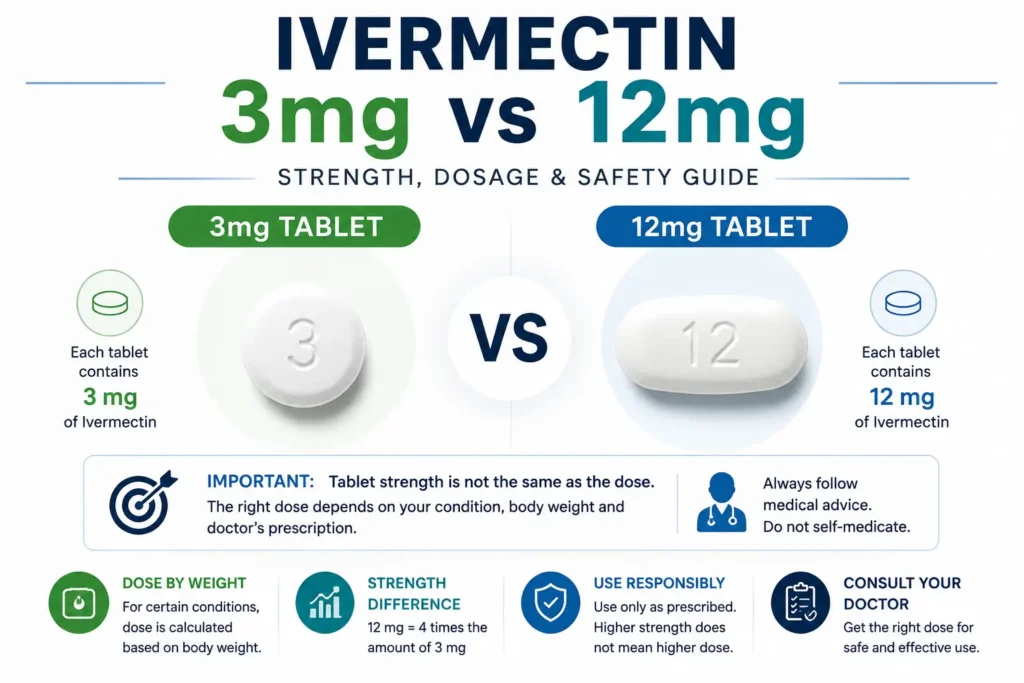
Ivermectin dosing for scabies is generally weight-based, rather than simply choosing a tablet strength.
For classic scabies, the CDC describes oral ivermectin at 200 micrograms per kilogram per dose, with two doses given 7–14 days apart.
However, this information should not be interpreted as a personal dosing recommendation.
The appropriate regimen can vary according to:
- Age
- Body weight
- Type of scabies
- Severity
- Pregnancy status
- Other medical conditions
- Other medicines
- Local treatment guidelines
For more information about ivermectin dosing principles, see our Ivermectin Dosage Guide.
Why Is a Second Ivermectin Dose Sometimes Needed?
One important characteristic of ivermectin treatment is that it has limited ovicidal activity, meaning it does not reliably eliminate all mite eggs.
New mites can therefore hatch after the initial treatment.
For classic scabies, CDC guidance recommends a second oral ivermectin dose 7–14 days after the first.
The exact treatment schedule should follow the healthcare professional’s instructions.
Do not independently repeat doses simply because itching continues.
Does Itching Continue After Ivermectin Treatment?
Yes, itching can continue even after successful treatment.
WHO notes that itching commonly becomes more intense for one to two weeks after effective treatment.
This happens because the immune system can continue reacting to material left behind by the mites.
Therefore:
Persistent itching does not automatically mean treatment has failed.
However, continued symptoms, new burrows, new lesions or visible live mites should be assessed by a healthcare professional.
Ivermectin for Scabies in Children
Children require particular caution.
The safety of ivermectin in children weighing less than 15 kg (33 lb) has not been established according to CDC guidance.
WHO likewise states that ivermectin should not be used in children weighing less than 15 kg until more safety information is available.
Parents should therefore not calculate an ivermectin dose for a child themselves.
A pediatric healthcare professional should determine the appropriate treatment.
Ivermectin for Scabies During Pregnancy
Pregnancy is another important situation requiring medical supervision.
WHO states that the safety of ivermectin in pregnant women has not been established and recommends that it should not be used during pregnancy until more safety data are available.
Therefore, someone who is pregnant or may be pregnant should tell their healthcare professional before starting scabies treatment.
Topical treatment options may be preferred depending on the individual’s circumstances and applicable guidelines.
Can Ivermectin Be Used While Breastfeeding?
The decision should be made with a healthcare professional.
The appropriate treatment depends on the mother’s health, the infant’s age and health, the specific formulation and the available clinical guidance.
Do not assume that a medicine is appropriate during breastfeeding simply because it is commonly used in adults.
Ivermectin and Other Medicines
Drug interactions are another reason professional assessment is important.
The CDC notes that treatment selection can take into account potential interactions involving ivermectin, including interactions with medicines such as azithromycin, trimethoprim/sulfamethoxazole and cetirizine.
Anyone taking regular medicines should provide their healthcare professional with a complete list of:
- Prescription medicines
- Non-prescription medicines
- Vitamins
- Supplements
- Herbal products
For a more detailed discussion, see our Ivermectin Drug Interactions Guide.
Can Ivermectin Treat Scabies by Itself?
The answer depends on the type and circumstances of the infestation.
For uncomplicated scabies, oral ivermectin can be an effective treatment option.
For crusted scabies, however, CDC guidance recommends combining oral ivermectin with a topical scabicide.
This is why treatment should not be reduced to:
“Take ivermectin and the scabies will disappear.”
Successful treatment also involves controlling transmission and addressing household contacts and environmental factors.
Treating Household Contacts
One of the biggest challenges with scabies is reinfestation.
Someone can have an early infestation without symptoms and still transmit the mites.
WHO recommends treating household members at the same time as the diagnosed individual to reduce the risk of ongoing transmission.
This is particularly important when several people in the same household have itching or a compatible rash.
A healthcare professional can advise which contacts require treatment.
Washing Clothes, Bedding and Personal Items
Scabies mites generally survive only for a limited period away from human skin.
WHO recommends washing and drying clothing and bedding that has been in contact with an affected person, using hot water and appropriate drying methods where possible. Items that cannot be washed can be sealed in a plastic bag for a period of time.
This environmental approach is part of preventing reinfestation.
However, excessive cleaning or fumigation of the entire home is generally unnecessary for ordinary scabies.
What About Scabies Creams?
Topical treatments remain an important part of scabies management.
The CDC identifies permethrin 5% cream as a first-line treatment for classic scabies in the United States.
Other topical treatments may be used depending on country, availability and patient circumstances.
This is why someone searching for “ivermectin cream for scabies” should be careful about assuming that every topical ivermectin product is designed for scabies.
The formulation and approved indication matter.
Is Ivermectin Cream the Same as Ivermectin Tablets?
No.
Ivermectin exists in different formulations designed for different routes of administration.
For example, certain topical ivermectin formulations are approved for conditions such as head lice and rosacea, while oral ivermectin tablets have specific approved indications.
A topical ivermectin product should not automatically be substituted for oral ivermectin, and an oral tablet should not be applied to the skin.
Always follow the labeling for the specific product.
Is Ivermectin FDA-Approved for Scabies?
Not in the United States for oral ivermectin.
The CDC specifically states that oral ivermectin is not FDA-approved for treatment of scabies, although it is included in CDC clinical guidance as a treatment option.
This is an example of an important regulatory distinction:
Clinical use and regulatory approval are not always identical.
FDA-approved human uses for oral ivermectin include intestinal strongyloidiasis and onchocerciasis, while certain topical ivermectin products have other approved indications.
WHO states that oral ivermectin is approved for scabies in several countries.
Therefore, always check the regulatory status applicable to your country.
Is Ivermectin Effective Against Scabies?
Evidence and clinical guidance support ivermectin as an effective treatment option for scabies.
WHO describes oral ivermectin as highly effective, while CDC guidance notes that oral ivermectin and topical permethrin have similar efficacy for cure of classic scabies.
However, effectiveness depends on:
- Correct diagnosis
- Appropriate treatment
- Correct timing of repeat treatment when indicated
- Treating relevant household contacts
- Preventing reinfestation
- Following professional instructions
No treatment should be judged solely by whether itching disappears immediately.
Ivermectin for Scabies: What You Should Not Do
Avoid:
- Taking ivermectin without confirming that you actually have scabies
- Choosing a dose based only on tablet strength
- Using veterinary ivermectin products
- Repeating doses because itching continues without medical advice
- Using topical ivermectin products that are not indicated for scabies
- Ignoring other household members who may be infected
- Assuming every itchy rash is scabies
The FDA specifically warns that animal ivermectin products are different formulations from those intended for humans and should not be used by people.
When Should You See a Doctor?
Medical evaluation is particularly important if:
- You are unsure whether the rash is scabies
- The patient is an infant or young child
- The patient weighs less than 15 kg
- You are pregnant
- You have a weakened immune system
- The skin has thick crusts
- There are signs of bacterial infection
- Treatment has not worked
- Symptoms continue or worsen
- Multiple household members are affected
WHO notes that redness, pus or crusting may indicate secondary bacterial infection, while crusted scabies is a severe and highly infectious form of the disease.
Ivermectin for Scabies: Key Takeaways
| Question | Key point |
|---|---|
| Is ivermectin used for scabies? | Yes, in appropriate clinical circumstances. |
| Is oral ivermectin FDA-approved for scabies in the U.S.? | No. |
| Is it recommended by CDC as a treatment option? | Yes. |
| Is it approved for scabies in some countries? | Yes. |
| Is ivermectin suitable for everyone? | No. |
| Can children under 15 kg use it? | Safety has not been established. |
| Can it be used during pregnancy? | WHO advises against its use during pregnancy until more safety data are available. |
| Does one dose always eliminate scabies? | No. Treatment may require repeat dosing because ivermectin has limited activity against eggs. |
| Is oral ivermectin the same as topical ivermectin? | No. |
| Does itching disappear immediately? | Not necessarily; itching can persist for 1–2 weeks after effective treatment. |
Frequently Asked Questions About Ivermectin for Scabies
What is ivermectin used for in scabies?
Ivermectin is an oral antiparasitic treatment option for scabies in appropriate patients. Its use and regulatory approval vary by country.
Is ivermectin better than permethrin for scabies?
Neither should be considered universally “better.” Both are effective options, and treatment selection depends on the patient, infestation and clinical circumstances. CDC guidance identifies both oral ivermectin and topical permethrin as treatment options.
How long does ivermectin take to work for scabies?
The mites may be eliminated before itching completely disappears. WHO notes that itching can remain or become worse for 1–2 weeks following effective treatment.
Why is ivermectin repeated for scabies?
Ivermectin has limited activity against mite eggs, so a second treatment may be needed after newly hatched mites emerge.
Can ivermectin treat crusted scabies?
Yes, oral ivermectin is used as part of treatment for crusted scabies, but CDC guidance recommends combining it with a topical scabicide.
Can children take ivermectin for scabies?
Children require special consideration. CDC and WHO state that the safety of ivermectin in children weighing less than 15 kg has not been established.
Can pregnant women take ivermectin for scabies?
WHO states that safety during pregnancy has not been established and recommends that ivermectin should not be used during pregnancy until more safety information is available.
Is ivermectin FDA-approved for scabies?
Oral ivermectin is not FDA-approved for scabies in the United States, although the CDC includes it as a treatment option.
Can ivermectin prevent scabies from spreading?
Treatment programs can help control transmission, but preventing spread also involves treating relevant household contacts and addressing clothing and bedding according to public-health guidance.
Can I use ivermectin for any itchy rash?
No. Many skin conditions can cause itching. A healthcare professional should determine whether the symptoms are actually caused by scabies.
Can I use veterinary ivermectin for scabies?
No. Veterinary ivermectin products are formulated and approved for animals and should not be substituted for human medicines.
Final Takeaway
Ivermectin is an established treatment option for scabies in appropriate circumstances, but it is not suitable for everyone and its regulatory status varies between countries.
The CDC includes oral ivermectin as a treatment option for classic scabies, while noting that it is not FDA-approved for scabies in the United States. WHO recognizes oral ivermectin as an effective treatment and states that it is approved for scabies in several countries.
The most important considerations are:
Correct diagnosis → appropriate treatment → correct formulation → appropriate patient → prevention of reinfestation.
Anyone with suspected scabies, particularly children, pregnant women, people with significant medical conditions or people with severe/crusted disease, should seek professional medical guidance.
Related Ivermectin Guides
For readers who want to understand ivermectin more broadly:
Ivermectin Uses: Approved Medical Uses & Indications
Ivermectin Side Effects & Safety Guide
Ivermectin Drug Interactions Guide
Medical Disclaimer
This article is intended for general educational and informational purposes only. It is not intended to diagnose, treat, cure or prevent any disease or to replace advice from a qualified healthcare professional. Ivermectin products differ in formulation, strength, indication and regulatory status. Always consult an appropriate healthcare professional and follow the official product information applicable in your country.
Authoritative References
CDC — Clinical Care of Scabies
CDC Clinical Care of Scabies
WHO — Scabies
WHO Scabies Information
WHO — Scabies Fact Sheet
WHO Scabies Fact Sheet
FDA — Ivermectin and COVID-19
FDA Ivermectin Information