
Table of Contents
Ivermectin uses vary depending on the formulation, medical condition, dosage and regulatory approval in a particular country.
Ivermectin is an antiparasitic medicine that has been used in human healthcare for several decades. In the United States, oral ivermectin tablets are FDA-approved for certain parasitic infections, including intestinal strongyloidiasis and onchocerciasis. Certain topical ivermectin formulations have also been approved for conditions such as rosacea and head lice.
However, the term “ivermectin uses” is often misunderstood because different formulations have different indications, and approval status can vary between countries.
This guide explains what ivermectin is used for, which uses are established in official medical labeling, and which commonly discussed uses should not be confused with approved indications.
Important: This article is for general educational purposes only. It is not a diagnosis or personalized treatment recommendation. Always consult a qualified healthcare professional and refer to the applicable product information in your country before using any medicine.
What Is Ivermectin?
Ivermectin is an antiparasitic medicine belonging to the avermectin class.
It has activity against certain parasites and is used in several human-health applications depending on the formulation and indication.
Oral ivermectin tablets and topical ivermectin products are not interchangeable. Their approved uses, strengths, routes of administration and directions can differ significantly.
For example, current U.S. labeling for ivermectin tablets identifies intestinal strongyloidiasis and onchocerciasis as indications, while ivermectin cream 1% is indicated for inflammatory lesions of rosacea.
What Is Ivermectin Used For?
The answer depends on the formulation and country.
In the United States, FDA information identifies the following human uses for ivermectin:
Oral ivermectin tablets
- Intestinal strongyloidiasis
- Onchocerciasis
Certain topical ivermectin formulations
- Head lice
- Inflammatory lesions of rosacea
Other countries may have different approved indications, formulations or regulatory requirements.
Therefore, it is better to ask:
“Which ivermectin formulation is being used for which medical condition?”
rather than assuming that all ivermectin products have the same uses.
Ivermectin for Strongyloidiasis
One of the established uses of oral ivermectin is the treatment of intestinal strongyloidiasis.
Strongyloidiasis is a parasitic infection caused by Strongyloides stercoralis.
The current U.S. prescribing information for ivermectin tablets specifically indicates treatment of intestinal (nondisseminated) strongyloidiasis.
The condition can be particularly important in people who have lived in or travelled to areas where the parasite is common.
The World Health Organization describes strongyloidiasis as a soil-transmitted helminth infection caused by Strongyloides stercoralis.
Important distinction
The term strongyloidiasis covers a parasitic infection, but ivermectin treatment should not be assumed to be appropriate for every possible clinical presentation.
The official tablet labeling specifically refers to intestinal, nondisseminated infection.
A healthcare professional should determine the diagnosis and appropriate treatment.
Ivermectin for Onchocerciasis
Another established use of oral ivermectin is onchocerciasis, commonly known as river blindness.
Onchocerciasis is caused by the parasitic worm Onchocerca volvulus and is transmitted through repeated bites from infected blackflies that breed near rapidly flowing rivers.
The current U.S. prescribing information indicates ivermectin tablets for treatment of onchocerciasis.
Ivermectin primarily targets the microfilariae, or immature forms of the parasite.
Importantly, the official labeling notes that ivermectin does not have activity against adult Onchocerca volvulus parasites.
This distinction is important when explaining what ivermectin does and does not do in onchocerciasis.
Ivermectin and River Blindness
Because onchocerciasis is also called river blindness, people sometimes search for:
- ivermectin for river blindness
- ivermectin onchocerciasis
- ivermectin for Onchocerca volvulus
- ivermectin parasite treatment
These searches relate to the established antiparasitic use described above.
The World Health Organization identifies ivermectin as the core medicine used in population-based treatment strategies for eliminating onchocerciasis. WHO recommends treatment at least annually in affected programs, with treatment strategies adjusted in areas where Loa loa is also present.
This is an important distinction between individual medical treatment and public-health mass drug administration programs.
Ivermectin for Head Lice
Certain topical ivermectin formulations have also been approved for the treatment of head lice.
For example, the FDA approved ivermectin lotion 0.5% for topical treatment of head lice in patients 6 months of age and older.
This is a topical formulation specifically designed for external use.
It should not be confused with oral ivermectin tablets used for parasitic infections.
The FDA-approved head-lice lotion is intended for use on the scalp and dry hair according to its labeling.
Ivermectin for Rosacea
Ivermectin is also used in certain topical formulations for inflammatory lesions of rosacea.
Current U.S. labeling for ivermectin cream 1% indicates it for the treatment of inflammatory lesions of rosacea.
The topical cream is intended for application to affected facial areas and is not intended for oral, ophthalmic or intravaginal use.
Again, this is a good example of why the phrase “ivermectin medicine” is not enough to determine how the product should be used.
The formulation and route of administration matter.
Ivermectin for Other Parasitic Infections
Ivermectin has activity against several parasites and is used in various public-health and medical settings.
However, activity against a parasite does not automatically mean that every ivermectin product is approved for treating that infection in every country.
For example, WHO describes ivermectin as part of certain preventive chemotherapy strategies for lymphatic filariasis, often in combination with other medicines and in specific epidemiological settings.
These public-health programs should not be confused with an individual deciding to take ivermectin without diagnosis or medical guidance.
Ivermectin and Lymphatic Filariasis
Lymphatic filariasis is another parasitic disease for which ivermectin can form part of population-level treatment strategies in certain settings.
WHO describes combinations involving ivermectin and albendazole in countries where onchocerciasis is also endemic.
The exact treatment strategy depends on the epidemiological setting and national or international public-health guidance.
Therefore, information about ivermectin used in mass drug administration should not automatically be interpreted as an individual prescription.
Does Ivermectin Treat All Parasites?
No.
Ivermectin is active against certain parasites, but it should not be considered a universal antiparasitic medicine.
Different parasites have different biology, life cycles and susceptibility to medicines.
Even when ivermectin has activity against a particular parasite, the appropriate formulation, dose, duration and treatment strategy may differ.
This is why diagnosis is important before selecting treatment.
Ivermectin for COVID-19
This is one of the most important areas to clarify.
Ivermectin is not FDA-approved or authorized for the treatment or prevention of COVID-19 in people.
The FDA states that ivermectin tablets are approved for certain parasitic infections, while some topical forms have other approved uses. The FDA has not authorized or approved ivermectin for preventing or treating COVID-19.
Therefore, information about ivermectin’s approved antiparasitic uses should not be interpreted as evidence that it should be used for COVID-19.
Ivermectin and Veterinary Uses
Ivermectin is also used in veterinary medicine, but veterinary ivermectin products are not the same as human medicines.
The FDA notes that some animal ivermectin products are approved for specific animal parasites and are formulated for particular animal species.
Human beings should not substitute veterinary ivermectin products for medicines intended for human use.
The formulation, concentration, inactive ingredients, labeling and dosing instructions may differ.
Oral vs Topical Ivermectin: Why the Difference Matters
One of the most common misunderstandings about ivermectin is treating all formulations as though they were the same.
They are not.
| Formulation | Example established use |
|---|---|
| Oral ivermectin tablets | Intestinal strongyloidiasis |
| Oral ivermectin tablets | Onchocerciasis |
| Topical ivermectin lotion | Head lice |
| Topical ivermectin cream | Inflammatory lesions of rosacea |
These examples are based on current U.S. FDA information and labeling. Other countries may have different approved formulations and indications.
The important takeaway:
Do not assume that a topical ivermectin product can be taken orally, or that an oral tablet can be used as a topical product.
Follow the instructions for the specific medicine.
Ivermectin Uses and Dosage
The appropriate ivermectin dosage depends on the medical indication, formulation and patient-specific factors.
For example, current U.S. labeling for oral ivermectin tablets provides different weight-based dosing recommendations for strongyloidiasis and onchocerciasis.
This means that there is no single universal answer to:
“How much ivermectin should I take?”
The medical condition matters.
For a detailed explanation of weight-based dosing and tablet strengths, see our Ivermectin Dosage Guide.
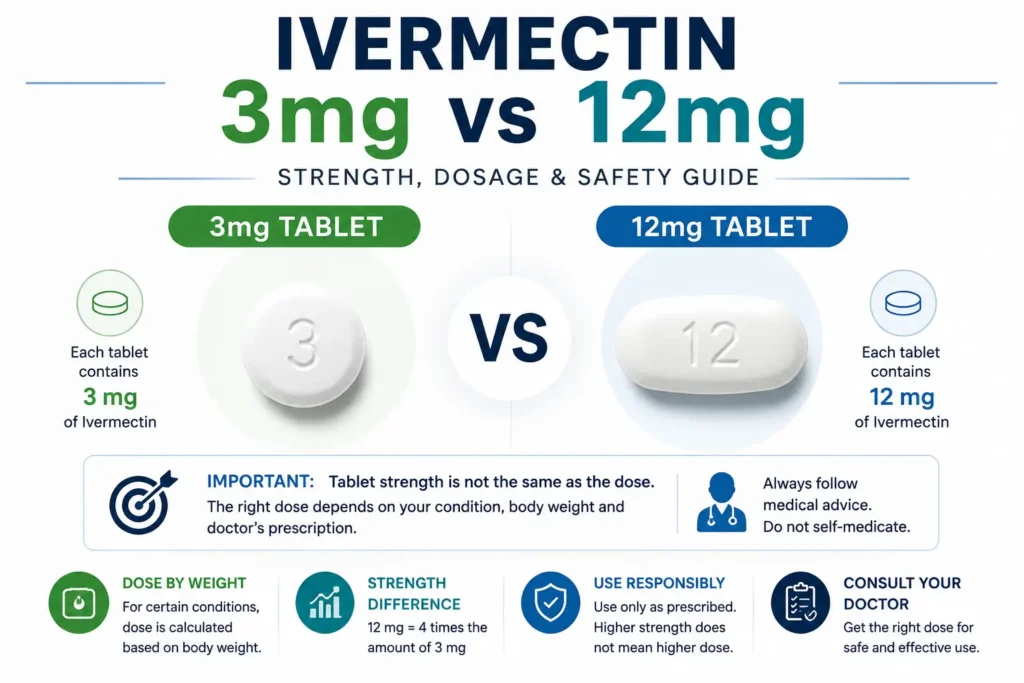
Ivermectin Uses and Tablet Strength
Ivermectin tablets can be available in different strengths depending on the product and market.
A tablet’s strength does not determine its medical indication by itself.
For example, the official U.S. tablet labeling provides dosing guidance using 3 mg tablets for specific indications.
This is why people should not choose a tablet strength simply based on the condition they believe they have.
For more information, see our Ivermectin 3mg vs 12mg Guide.
Ivermectin Uses and Safety
Even when ivermectin is being used for an established indication, safety remains important.
Potential concerns can include:
- Incorrect dosing
- Drug interactions
- Allergic reactions
- Adverse effects
- Use of an inappropriate formulation
- Use of veterinary products
- Incorrect treatment of an undiagnosed condition
The FDA warns that taking large doses of ivermectin can be dangerous and that ivermectin can interact with other medicines, including blood thinners.
For more information, see our Ivermectin Side Effects & Safety Guide and Ivermectin Drug Interactions Guide.
Ivermectin and Drug Interactions
People taking other medicines should tell their healthcare professional before using ivermectin.
The current ivermectin prescribing information includes a warning regarding rare increases in INR reported when ivermectin was co-administered with warfarin.
Other medicines, supplements and health products should also be disclosed so that a healthcare professional can assess the complete medication profile.
Do not assume that ivermectin is compatible with every medicine simply because both products are commonly used.
Can Ivermectin Be Used Without a Diagnosis?
It is not advisable to choose ivermectin simply because symptoms appear similar to a condition that ivermectin can treat.
Symptoms such as:
- Itching
- Skin changes
- Digestive symptoms
- Fatigue
- Rash
can have many possible causes.
A healthcare professional may need to establish the underlying cause before recommending treatment.
The presence of a symptom does not automatically mean ivermectin is appropriate.
Can Ivermectin Be Used for Skin Conditions?
Certain topical ivermectin products are approved for specific skin-related indications.
For example, ivermectin cream 1% is indicated in the United States for inflammatory lesions of rosacea.
However, this does not mean that oral ivermectin tablets should be used for every skin condition.
Nor does it mean that topical ivermectin products are appropriate for every rash or skin infection.
The diagnosis and specific formulation matter.
Can Ivermectin Be Used for Scabies?
Ivermectin is discussed in medical literature and clinical practice in relation to scabies, and oral ivermectin may be used in certain clinical circumstances and jurisdictions.
However, approval and treatment recommendations vary by country and patient circumstances.
Therefore, we should not present oral ivermectin as universally approved for scabies.
Anyone with suspected scabies should obtain appropriate medical assessment and follow the treatment guidance applicable to their location.
Why Ivermectin Uses Differ by Country
Medicines are regulated by national or regional authorities.
A medicine may be:
- Approved for a particular indication
- Approved in a particular formulation
- Approved only for certain age groups
- Available by prescription
- Available without prescription in some markets
- Used under different public-health programs
Therefore, an ivermectin use described as approved in one country should not automatically be assumed to have the same regulatory status elsewhere.
For international medicine information, always check the relevant national regulatory authority and product labeling.
What Ivermectin Is NOT Approved For
It is equally important to understand what ivermectin is not approved for.
The FDA specifically states that ivermectin is not approved or authorized for COVID-19 prevention or treatment.
Similarly, people should not assume that ivermectin is appropriate for:
- Every viral infection
- Every bacterial infection
- Every parasite
- Every skin condition
- Unexplained symptoms
- Weight loss
- General wellness
An online claim that ivermectin has been “used for” something is not the same as an official indication.
Ivermectin for Weight Loss
Ivermectin should not be presented as a weight-loss medicine.
The established human indications described by the FDA relate to specific parasitic infections and certain topical conditions, not weight management.
If someone is looking for treatment options for weight management, they should discuss evidence-based options with a qualified healthcare professional.
Ivermectin Uses: Key Points to Remember
The most important points are:
- Ivermectin is an antiparasitic medicine.
- Oral ivermectin tablets have established uses for certain parasitic infections.
- In the United States, oral tablets are FDA-approved for intestinal strongyloidiasis and onchocerciasis.
- Certain topical formulations are approved for conditions such as head lice and rosacea.
- Different formulations are not interchangeable.
- Dosage depends on the indication and formulation.
- Country-specific regulatory approval can differ.
- Veterinary ivermectin products should not be substituted for human medicines.
- Ivermectin is not FDA-approved or authorized for COVID-19 treatment or prevention.
- A healthcare professional should determine whether ivermectin is appropriate for an individual’s medical situation.
Frequently Asked Questions About Ivermectin Uses
What is ivermectin mainly used for?
Ivermectin is an antiparasitic medicine. In the United States, oral ivermectin tablets are FDA-approved for intestinal strongyloidiasis and onchocerciasis. Certain topical formulations have other approved uses, including head lice and rosacea.
What parasites does ivermectin treat?
Approved uses depend on the formulation and country. U.S. oral tablet labeling includes intestinal Strongyloides stercoralis infection and onchocerciasis caused by Onchocerca volvulus.
Is ivermectin used for skin conditions?
Certain topical ivermectin products are approved for specific skin conditions. In the United States, ivermectin cream 1% is indicated for inflammatory lesions of rosacea.
Is ivermectin used for head lice?
Yes. The FDA approved ivermectin lotion 0.5% for topical treatment of head lice in patients 6 months of age and older.
Is ivermectin used for scabies?
Ivermectin may be used for scabies in certain clinical circumstances and jurisdictions, but its regulatory status and recommended use vary. It should not be treated as a universally approved indication.
Is ivermectin used for COVID-19?
The FDA has not authorized or approved ivermectin for preventing or treating COVID-19.
Is ivermectin a general-purpose antiparasitic medicine?
No. Ivermectin is active against certain parasites, but not every parasitic infection is treated with ivermectin.
Can ivermectin be used for weight loss?
Ivermectin is not an approved weight-loss medicine.
Are ivermectin tablets and ivermectin cream the same?
They contain the same active ingredient but are different formulations designed for different routes of administration and indications. They should not be treated as interchangeable.
Does ivermectin dosage depend on the condition?
Yes. For certain oral indications, official labeling provides different dosing regimens depending on the condition and body weight.
Can I use ivermectin based only on my symptoms?
No. Symptoms can have many possible causes. A healthcare professional should determine whether ivermectin is appropriate.
Does ivermectin have the same approved uses in every country?
No. Medicine approvals and labeling can differ between countries.
Final Takeaway
Ivermectin has several established medical uses, but its use depends heavily on the formulation, indication and regulatory status.
In the United States, oral ivermectin tablets are FDA-approved for intestinal strongyloidiasis and onchocerciasis, while certain topical formulations are approved for head lice and rosacea.
Other ivermectin uses may occur in specific countries, clinical circumstances or public-health programs, but those should not automatically be described as universally approved uses.
The safest approach is to identify:
The condition → the appropriate formulation → the applicable product information → the appropriate treatment plan.
For related information, explore our ivermectin dosage, side-effect, safety and interaction guides below.
Related Ivermectin Guides
Ivermectin Educational Guide
Read the Ivermectin Educational Guide
Ivermectin Dosage Guide
Read the Ivermectin Dosage Guide
Ivermectin 3mg vs 12mg
Read the Ivermectin 3mg vs 12mg Guide
Ivermectin Side Effects & Safety
Read the Ivermectin Side Effects & Safety Guide
Ivermectin Drug Interactions
Read the Ivermectin Drug Interactions Guide
Medical Disclaimer
This article is provided for general educational and informational purposes only. It is not intended to provide medical diagnosis, treatment or individualized medical advice. Ivermectin products differ by formulation, strength, manufacturer, indication and regulatory approval. Approval status may vary by country. Always consult a qualified healthcare professional and refer to the applicable official product information before using any medicine. Never substitute veterinary ivermectin products for medicines intended for human use.
Authoritative References
FDA — Ivermectin and COVID-19
FDA: Ivermectin and COVID-19
DailyMed — Ivermectin Tablets
DailyMed: Ivermectin Tablets
FDA — Ivermectin Lotion for Head Lice
FDA: Ivermectin Lotion for Head Lice
DailyMed — Ivermectin Cream
DailyMed: Ivermectin Cream
WHO — Onchocerciasis
WHO: Onchocerciasis
WHO — Strongyloidiasis
WHO: Strongyloidiasis