Table of Contents
Ivermectin for lice is a topic that can be confusing because ivermectin is available in both topical and oral forms, and its role depends on the type of lice infestation.
Lice are tiny parasitic insects that live on humans and feed on blood. The three main types are:
- Head lice
- Body lice
- Pubic lice
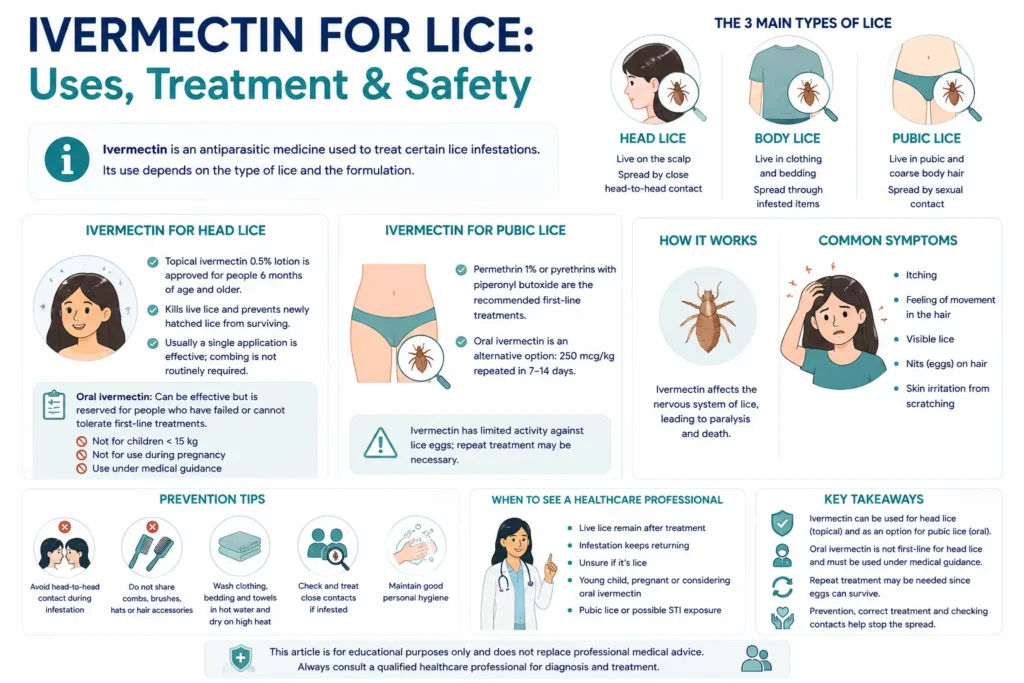
Ivermectin has an established role in treating certain lice infestations, particularly topical ivermectin for head lice. Oral ivermectin may also be used in selected situations, but it is not the routine first-line treatment for every type of lice infestation.
This guide explains how ivermectin is used for lice, the differences between head and pubic lice, treatment options, safety considerations, prevention and when medical advice may be appropriate.
Medical disclaimer: This article is for general educational purposes only. It is not individualized medical advice and should not replace advice from a qualified healthcare professional.
What Are Lice?
Lice are small parasitic insects that live on humans and feed on blood.
Depending on the species, they can live on:
- The scalp
- Clothing and body hair
- Pubic and other coarse body hair
Lice are different from fleas, ticks and mites, and different types of lice require different treatment approaches.
The Three Main Types of Human Lice
| Type | Common location | Main transmission |
|---|---|---|
| Head lice | Scalp and hair | Close head-to-head contact |
| Body lice | Clothing and body | Infested clothing/bedding |
| Pubic lice | Pubic and coarse body hair | Usually sexual contact |
It is important to identify the type of lice before choosing a treatment.
Ivermectin for Head Lice
Topical ivermectin 0.5% lotion is an established treatment option for head lice.
CDC states that ivermectin lotion 0.5% is approved for people 6 months of age and older. It can kill live lice and appears to prevent newly hatched lice from surviving, even though it does not directly kill the eggs.
One advantage of topical ivermectin is that a single application may be effective in many patients, and routine nit combing is not required with this particular treatment.
How Does Ivermectin Work Against Head Lice?
Ivermectin acts on the nervous system of susceptible parasites.
For topical head-lice treatment, the medicine is applied directly to the hair and scalp according to the product instructions.
Its activity helps eliminate live lice and can reduce the ability of newly hatched lice to survive.
Can Oral Ivermectin Treat Head Lice?
Yes, but it is not the usual first-line option.
CDC’s clinical guidance notes that oral ivermectin can be effective against head lice when given as a single 200 microgram/kg or 400 microgram/kg dose, with a repeat dose 9–10 days later in the regimens described by CDC. However, CDC also states that oral ivermectin should be used only in people who have failed or cannot tolerate first-line medications.
There are important restrictions:
- It should not be used in children weighing less than 15 kg
- It should not be used during pregnancy
- Treatment should be determined by a healthcare professional
Ivermectin 12 mg for Head Lice
People sometimes search specifically for “ivermectin 12 mg for lice.”
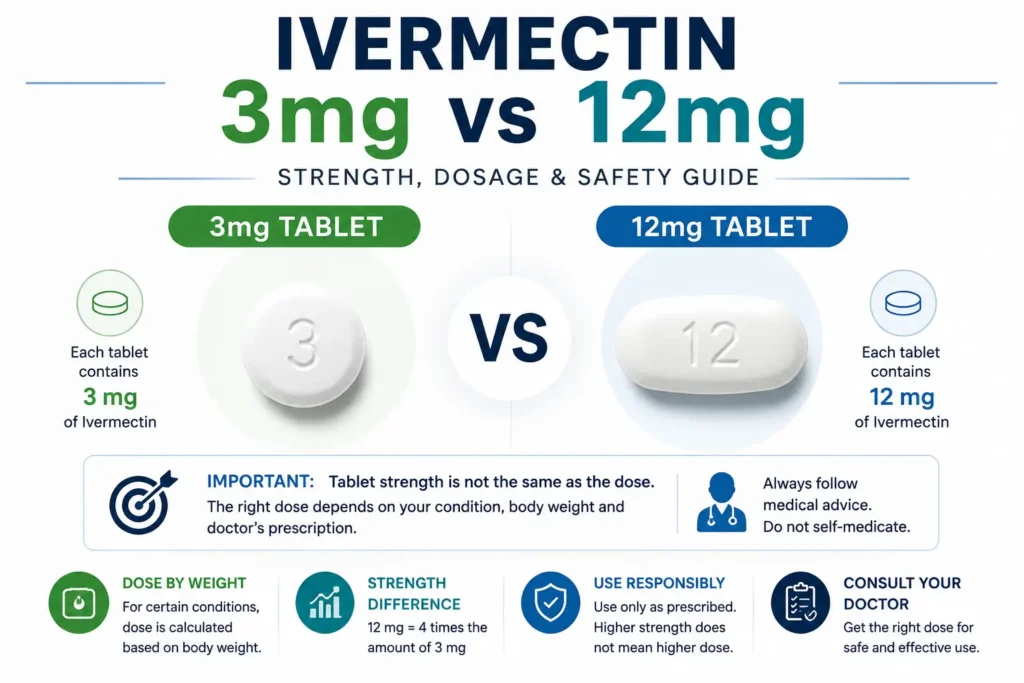
The important point is that tablet strength and treatment dose are not the same thing.
Oral ivermectin treatment, when considered for head lice, is based on body weight rather than simply taking a particular tablet strength.
Therefore, a person should not independently decide to take a 12 mg tablet based on an online article.
For general information about ivermectin dosing and tablet strengths, see our:
Ivermectin for Pubic Lice
Pubic lice, sometimes called crab lice, are different from head lice.
They usually live in pubic hair but can also affect other coarse body hair.
CDC recommends permethrin 1% or pyrethrins with piperonyl butoxide as standard treatments for pubic lice.
However, CDC’s clinical treatment guideline lists oral ivermectin as an alternative regimen for pubic lice, at 250 micrograms/kg repeated in 7–14 days.
Ivermectin has limited activity against lice eggs, which is why repeat treatment can be necessary.
Topical vs Oral Ivermectin for Lice
| Topical ivermectin | Oral ivermectin | |
|---|---|---|
| Head lice | Yes | Selected cases |
| Pubic lice | Can be used in certain products | Alternative regimen |
| First-line for every lice infection? | No | No |
| Requires weight-based dosing? | No | Yes |
| Appropriate for pregnancy? | Depends on product | Not recommended for head-lice use |
| Children under 15 kg | Product-specific | Should not be used orally for head lice |
The exact treatment depends on the type of lice, the patient’s age and weight, pregnancy status, previous treatment and applicable product information.
What About Body Lice?
Body lice are different from head lice and pubic lice.
They primarily live and lay eggs in clothing and bedding, moving onto the body to feed.
Treatment therefore focuses heavily on:
- Washing clothing
- Washing bedding
- Improving personal hygiene
- Changing into clean clothing
Ivermectin should not automatically be considered the treatment for every body-lice infestation.
How Do Head Lice Spread?
Head lice primarily spread through direct head-to-head contact.
They can occasionally spread through recently shared items such as:
- Hairbrushes
- Combs
- Hats
- Bedding
However, head lice do not survive long away from a human host. CDC considers the risk of acquiring head lice from furniture, carpets or other objects to be relatively small.
How Do Pubic Lice Spread?
Pubic lice are usually transmitted through close sexual contact.
They can also occasionally spread through shared clothing or bedding.
People diagnosed with pubic lice should inform recent sexual partners and should be evaluated for other sexually transmitted infections.
What Are the Symptoms of Lice?
Common symptoms include:
- Itching
- Feeling of movement in the hair
- Visible lice
- Visible nits (eggs)
- Skin irritation from scratching
With pubic lice, itching is often concentrated around the genital region.
Some people may have an infestation without immediately noticing significant symptoms.
How Are Head Lice Diagnosed?
The most reliable approach is to identify a live crawling louse.
Nits can sometimes be confused with:
- Dandruff
- Hair-product residue
- Dirt
- Other particles attached to hair
If there is uncertainty about the diagnosis, professional evaluation can help prevent unnecessary treatment.
Does Ivermectin Kill Lice Eggs?
This depends on the formulation.
For topical ivermectin 0.5%, CDC states that it kills lice but does not kill eggs, although it appears to prevent newly hatched lice from surviving.
Oral ivermectin also has limited ovicidal activity, meaning eggs may survive.
This is one reason repeat treatment may be recommended in some oral ivermectin regimens.
Why Can Lice Come Back After Treatment?
A continuing infestation does not necessarily mean that the medicine was ineffective.
Possible reasons include:
- Eggs survived the initial treatment
- Treatment instructions were not followed correctly
- The person became reinfested
- Another household member still has lice
- The lice have developed resistance to the treatment
CDC specifically identifies misdiagnosis, incorrect treatment, resistance and reinfestation as possible reasons for treatment failure.
Should the Whole Family Be Treated?
Not automatically.
For head lice, CDC recommends checking household members and close contacts and treating people who are actually infested. People who share a bed with the infested person may also need treatment depending on the circumstances.
Simply treating everyone without checking may result in unnecessary exposure to lice medicines.
How Can Head Lice Be Prevented?
Helpful measures include:
- Avoid prolonged head-to-head contact during an active infestation
- Don’t share combs or brushes
- Don’t share hats or hair accessories
- Check close household contacts
- Follow treatment instructions carefully
For recently used clothing and bedding, CDC recommends machine washing and drying on high heat where appropriate.
Do You Need to Deep-Clean Your House?
Usually, no.
Head lice depend on humans for survival and do not live for long away from the scalp.
CDC states that the risk of getting head lice from carpets, furniture or other objects is very small. Routine vacuuming of areas where the person sat or lay can be sufficient; fumigant sprays and fogs should not be used because they can be toxic.
Ivermectin Safety for Lice Treatment
Ivermectin can cause side effects, and the risk depends on the formulation and route of administration.
Possible effects can include:
- Dizziness
- Nausea
- Headache
- Skin irritation
- Itching
- Other medication-specific reactions
Topical ivermectin and oral ivermectin should not be treated as interchangeable products.
For more information, see our:
Ivermectin Side Effects & Safety Guide
Ivermectin and Drug Interactions
People taking multiple medicines should inform their healthcare professional before using oral ivermectin.
The CDC’s scabies guidance, for example, notes potential interactions involving ivermectin with certain medicines.
For a broader overview, see our:
Ivermectin Drug Interactions Guide
Ivermectin for Lice in Children
Children require particular attention when choosing lice treatment.
Topical ivermectin 0.5% is approved for head lice in children 6 months and older, according to CDC’s clinical guidance.
However, oral ivermectin should not be used for head lice in children weighing less than 15 kg.
Parents should consult a healthcare professional before treating very young children.
Ivermectin for Lice During Pregnancy
Pregnancy requires special consideration.
CDC’s head-lice clinical guidance advises against oral ivermectin for head lice during pregnancy.
For pubic lice, CDC recommends other treatments for pregnant women, including permethrin or pyrethrin-based treatments, rather than relying on oral ivermectin.
Always consult a healthcare professional before treating lice during pregnancy.
Can Ivermectin Be Used for Resistant Lice?
Resistance to some lice medicines has been reported.
When a treatment fails, however, it is important to determine why before simply repeating or switching medicines.
Possible reasons include:
- Incorrect diagnosis
- Incorrect application
- Reinfection
- Resistance
- Eggs surviving the treatment
CDC advises against repeatedly applying lice medicines without professional guidance.
Ivermectin for Lice vs Other Parasites
Ivermectin is used for several different parasitic conditions, but treatment regimens vary significantly.
For example:
Head lice → topical ivermectin may be an option.
Pubic lice → oral ivermectin is an alternative regimen in CDC guidance.
Strongyloidiasis → oral ivermectin is an established treatment.
Onchocerciasis → oral ivermectin is an established treatment.
Scabies → oral ivermectin is also used in specific circumstances.
This is why the diagnosis and parasite involved should always determine the treatment.
When Should You See a Healthcare Professional?
Seek professional advice if:
- You are unsure whether you actually have lice
- Treatment has failed
- Live lice remain after appropriate treatment
- A young child is affected
- The infestation keeps returning
- You are pregnant
- You are considering oral ivermectin
- Pubic lice are suspected
- There may have been exposure to a sexually transmitted infection
For pubic lice, CDC recommends evaluation for other sexually transmitted infections.
Frequently Asked Questions About Ivermectin for Lice
Can ivermectin treat head lice?
Yes. Topical ivermectin 0.5% is an established treatment for head lice in people aged 6 months and older. Oral ivermectin may also be effective but is generally reserved for people who have failed or cannot tolerate first-line treatments.
Can ivermectin 12 mg treat lice?
Oral ivermectin dosing is based on body weight, not simply tablet strength. Do not self-select a 12 mg tablet for lice treatment.
Is ivermectin the first treatment for head lice?
No. CDC lists several over-the-counter and prescription options. Topical ivermectin is one option, while oral ivermectin is generally reserved for selected cases.
Does ivermectin kill lice eggs?
Ivermectin has limited activity against eggs. Topical ivermectin does not kill the eggs but appears to prevent newly hatched lice from surviving.
Can oral ivermectin be used for pubic lice?
Yes. CDC’s STI treatment guideline lists oral ivermectin as an alternative regimen for pubic lice, with repeat treatment after 7–14 days.
Can children take oral ivermectin for lice?
CDC advises against oral ivermectin for head lice in children weighing less than 15 kg. Topical ivermectin 0.5% is approved for head lice from 6 months of age.
Can pregnant women take ivermectin for lice?
Oral ivermectin should not be used for head lice during pregnancy according to CDC guidance. Pregnancy-specific treatment should be discussed with a healthcare professional.
Can head lice live on furniture?
They can temporarily fall onto objects, but head lice do not survive long away from a human host. The risk of acquiring lice from furniture and carpets is considered very small.
Do pets spread head lice?
No. Human head lice live on humans; pets do not get or spread human head lice.
Can lice come back after treatment?
Yes. Reinfestation, surviving eggs, incorrect treatment or resistance can all contribute to continued infestation.
Key Takeaways
If you’re searching for ivermectin for lice, remember:
- 🪲 Lice are parasitic insects
- 🧑🦱 Head lice: topical ivermectin 0.5% is an established option
- 💊 Oral ivermectin: may be considered in selected head-lice cases
- ⚠️ Oral treatment: should be medically supervised
- 🦀 Pubic lice: oral ivermectin is an alternative regimen in CDC guidance
- 🥚 Eggs: ivermectin has limited ovicidal activity
- 🔄 Repeat treatment: may be necessary depending on the treatment
- 👶 Children: age and weight matter
- 🤰 Pregnancy: requires special treatment considerations
- 🧼 Prevention: check close contacts and follow hygiene measures
The key message is:
Ivermectin can have a role in lice treatment, but the correct formulation, route and treatment schedule depend on the type of lice and the individual patient.
Related Ivermectin Guides
Continue exploring our Ivermectin educational series:
- Ivermectin Uses — overview of established and commonly discussed uses.
- Ivermectin Dosage Guide — general information about dosing and tablet strengths.
- Ivermectin Side Effects & Safety — safety and adverse-effect information.
- Ivermectin Drug Interactions — medicines and factors requiring additional caution.
- Ivermectin for Strongyloidiasis — ivermectin’s established role in intestinal strongyloidiasis.
- Ivermectin for Onchocerciasis — ivermectin and river blindness.
- Ivermectin for Pinworms — why ivermectin is not a standard pinworm treatment.
- Ivermectin for Hookworms — understanding ivermectin’s role in hookworm-related searches.
- Ivermectin for Ringworm — why ringworm is a fungal infection rather than a worm infection.
I’ve deliberately placed the contextual internal links inside the article, not just in the related section — particularly to the dosage and safety articles. That’s the linking pattern we should continue using.
Medical Disclaimer
This article is provided for general educational and informational purposes only. It is not intended to diagnose, treat, cure or prevent any disease and should not replace advice from a qualified healthcare professional.
Ivermectin products differ in formulation, strength, indication, dosage and regulatory status. Always follow the official product information applicable to your country and consult a qualified healthcare professional for individual medical advice.
Authoritative References
CDC — Clinical Care of Head Lice
CDC: Clinical Care of Head Lice
CDC — Treatment of Head Lice
CDC: Treatment of Head Lice
CDC — Treatment of Pubic Lice
CDC: Treatment of Pubic Lice
CDC — Ectoparasitic Infections Treatment Guidelines
CDC: Ectoparasitic Infections Treatment Guidelines
DailyMed — Ivermectin Tablets
DailyMed: Ivermectin Tablets