Table of Contents
When people hear the word “ringworm,” it is easy to assume that the condition is caused by a worm. However, ringworm is actually a fungal infection affecting the skin, scalp or nails.
Because ivermectin is an antiparasitic medicine, some people search for “ivermectin for ringworm” when looking for treatment options.
The important distinction is:
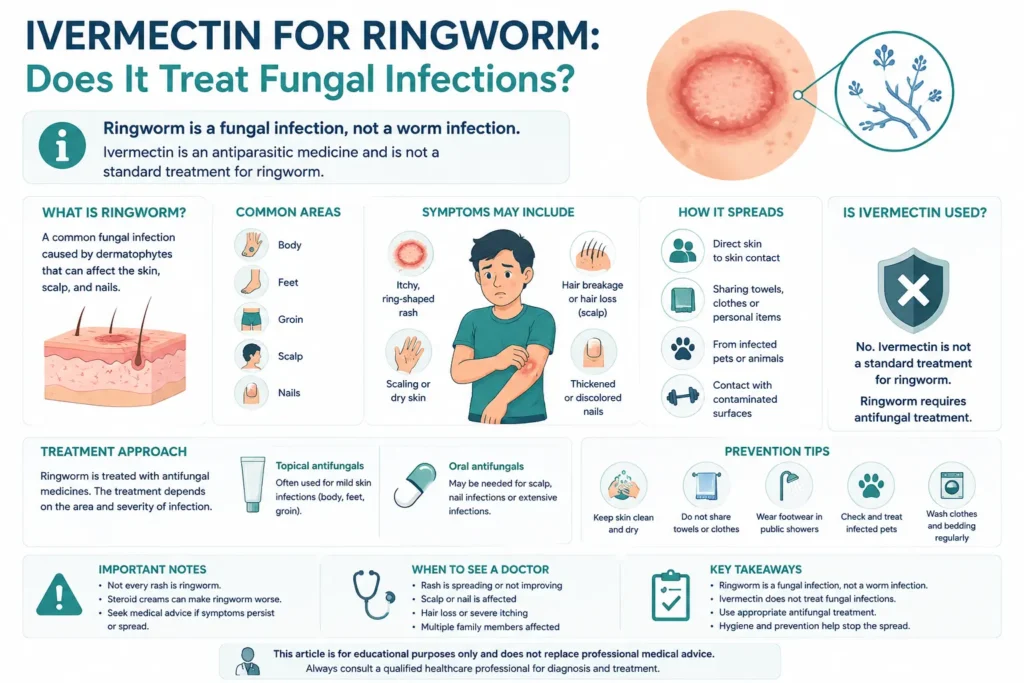
Ivermectin is not a standard treatment for ringworm. Ringworm requires appropriate antifungal treatment.
This guide explains what ringworm is, why ivermectin is not the usual treatment, how ringworm spreads, symptoms, treatment approaches, prevention and when professional medical advice may be needed.
Medical disclaimer: This article is for general educational purposes only. It is not individualized medical advice and should not replace consultation with a qualified healthcare professional.
What Is Ringworm?
Ringworm is a fungal infection, despite its name.
It is caused by fungi called dermatophytes, which can infect the:
- Skin
- Scalp
- Feet
- Groin
- Nails
The medical name depends on the location of the infection. For example:
- Tinea corporis — ringworm of the body
- Tinea pedis — athlete’s foot
- Tinea cruris — jock itch
- Tinea capitis — scalp ringworm
CDC describes ringworm as a common fungal infection of the skin, scalp and nails.
Why Is It Called Ringworm?
The name comes from the ring-shaped appearance that some skin infections produce.
A typical skin infection may appear as:
- An itchy rash
- A circular or ring-shaped patch
- Scaly skin
- Redness or discoloration
- A more noticeable edge around the affected area
However, not every fungal infection looks like a perfect ring.
Skin conditions such as eczema, psoriasis and other rashes can look similar, which is why proper diagnosis can be important. CDC notes that testing may help ensure the correct treatment is selected.
Is Ringworm Caused by a Worm?
No.
This is the most important misconception to clear up.
Ringworm = fungal infection
Ivermectin = antiparasitic medicine
They are completely different categories.
Current U.S. ivermectin tablet labeling identifies intestinal strongyloidiasis and onchocerciasis as indications. Ringworm is not among those labeled indications.
Does Ivermectin Treat Ringworm?
Generally, no.
Ivermectin is designed to act against susceptible parasites, while ringworm is caused by fungi.
Therefore, ivermectin is not a standard treatment for dermatophyte infections such as ringworm.
Using an antiparasitic medicine simply because a condition has the word “worm” in its name is not appropriate.
The correct treatment depends on identifying what is actually causing the skin condition.
What Is Used to Treat Ringworm?
Ringworm is treated with antifungal medicines.
The treatment depends on:
- Location of the infection
- Extent of the infection
- Severity
- Age
- Whether the scalp or nails are affected
- Whether the infection has responded to previous treatment
Some forms of skin ringworm can be treated with topical antifungal medicines, while infections involving the scalp or certain extensive infections may require prescription antifungal treatment.
A healthcare professional can determine the most appropriate option.
Ringworm Treatment by Location
| Location | General treatment approach |
|---|---|
| Body | Often topical antifungal treatment |
| Feet | Often topical antifungal treatment |
| Groin | Often topical antifungal treatment |
| Scalp | Usually requires professional evaluation and oral antifungal treatment |
| Nails | May require longer-term antifungal treatment |
The treatment approach can vary considerably depending on the infection.
For this reason, it is better not to assume that a cream that worked for one fungal infection will automatically work for another.
Can Ringworm Affect the Scalp?
Yes.
Scalp ringworm is called tinea capitis.
It is particularly common among children and can cause:
- Scaly patches
- Itching
- Hair breakage
- Areas of hair loss
- Inflamed areas of the scalp
Scalp ringworm generally requires medical evaluation and prescription antifungal treatment, rather than simply applying a topical cream.
Can Ringworm Affect the Nails?
Yes.
Fungal nail infections can cause nails to:
- Become thicker
- Change color
- Become brittle
- Break more easily
Nail infections can be more difficult to treat than superficial skin infections and may require professional diagnosis and longer treatment.
How Does Ringworm Spread?
Ringworm can spread relatively easily.
Transmission can occur through:
- Direct skin-to-skin contact
- Contact with infected animals
- Shared towels
- Clothing
- Sports equipment
- Other contaminated objects or surfaces
CDC notes that ringworm can spread between people, pets and through shared surfaces or personal items.
Can Pets Spread Ringworm?
Yes.
Dogs, cats and other animals can carry dermatophyte fungi and potentially transmit them to people.
If someone develops a suspicious rash after contact with an infected pet, both the person and animal may need appropriate evaluation.
Washing hands after handling pets is one useful preventive measure.
Common Symptoms of Ringworm
Symptoms vary depending on where the infection occurs.
Skin
- Itching
- Scaly patches
- Ring-shaped rash
- Dry or irritated skin
Feet
- Itching or burning
- Peeling skin
- Cracking between toes
Groin
- Itchy rash
- Scaling
- Irritated skin
Scalp
- Scaling
- Itching
- Hair breakage
- Hair loss
Nails
- Thickening
- Discoloration
- Brittle or damaged nails
CDC notes that ringworm can affect the scalp, skin and nails and may have different appearances depending on the location.
Why Diagnosis Matters
Not every circular or itchy rash is ringworm.
Other conditions can produce similar symptoms.
A healthcare professional may examine the affected area and, when necessary, take a skin scraping, nail sample or other specimen for testing.
Correct diagnosis helps ensure that the appropriate treatment is used.
Do Not Use Steroid Creams for Suspected Ringworm Without Advice
This is an important safety point.
Some rash creams contain corticosteroids because steroids can reduce redness and itching.
However, CDC specifically warns that steroid creams can make ringworm infections worse.
If you have an unexplained rash that could be ringworm, speak with a healthcare professional before using a steroid-containing cream.
Ivermectin vs Antifungal Treatment
| Ivermectin | Ringworm treatment | |
|---|---|---|
| Medicine category | Antiparasitic | Antifungal |
| Targets | Certain parasites | Fungi |
| Standard ringworm treatment? | No | Yes |
| Used for certain parasitic infections? | Yes | Not applicable |
| Appropriate for ringworm? | Not a standard treatment | Yes, when appropriately diagnosed |
Current U.S. ivermectin labeling identifies intestinal strongyloidiasis and onchocerciasis, while CDC identifies antifungal medicines as the treatment approach for ringworm.
What About Ivermectin 12 mg for Ringworm?
A common online search is:
“Can ivermectin 12 mg treat ringworm?”
The answer is that you should not use ivermectin 12 mg as a self-treatment for ringworm.
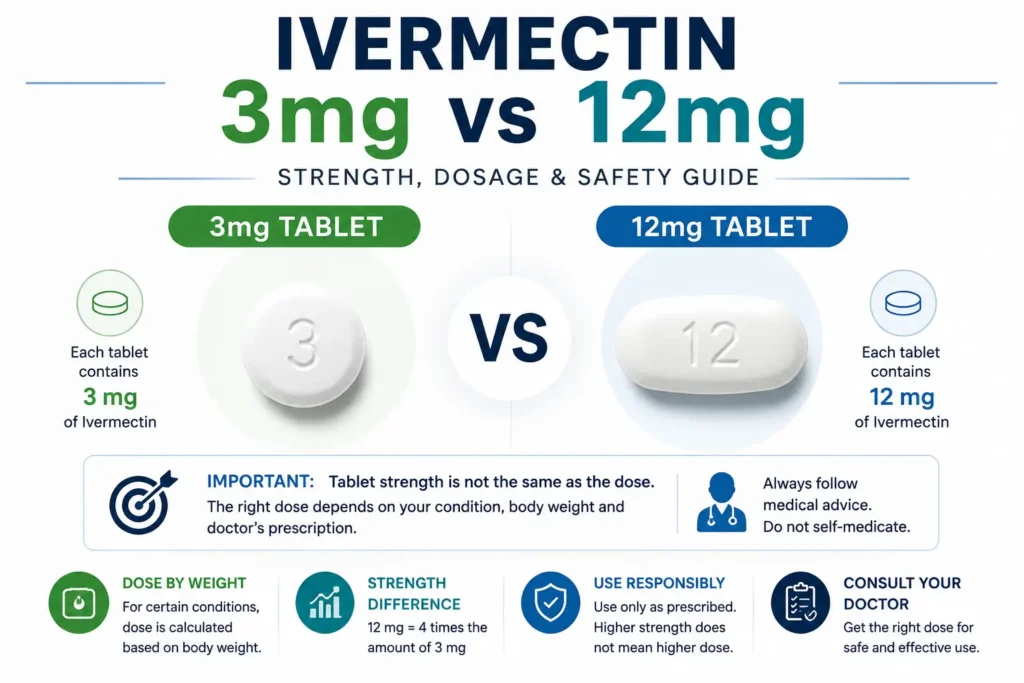
The strength of a tablet does not determine whether the medicine is suitable for a particular infection.
Ivermectin tablets have specific labeled indications, including intestinal strongyloidiasis and onchocerciasis. Ringworm is a fungal infection and requires an antifungal treatment approach.
Can Ringworm Go Away on Its Own?
It is not advisable to simply assume that a suspected fungal infection will disappear without treatment.
Some infections may remain localized, while others can spread to additional areas of the body or to other people.
Appropriate treatment can also reduce the risk of ongoing transmission.
How Can Ringworm Be Prevented?
Simple hygiene measures can reduce the risk of spreading ringworm.
Helpful habits:
- Keep skin clean and dry
- Wash hands regularly
- Avoid sharing towels
- Avoid sharing clothing and personal items
- Keep sports equipment clean
- Wear protective footwear in communal showers
- Wash clothes and bedding regularly
- Wash hands after handling animals
- Seek veterinary advice if a pet has a suspected fungal infection
CDC recommends keeping skin clean and dry and avoiding sharing personal items such as towels and clothing.
Can Ringworm Spread Between Family Members?
Yes.
Because ringworm can spread through direct contact and shared objects, several members of a household can become infected.
If multiple people develop similar symptoms, professional evaluation can help identify the source and appropriate treatment.
Ringworm and Athlete’s Foot
Athlete’s foot is a type of ringworm infection.
Its medical name is tinea pedis.
It commonly affects the feet and may cause:
- Itching
- Peeling
- Cracking
- Burning
- Scaling between the toes
So when someone searches for a treatment for athlete’s foot, they are also dealing with a form of dermatophyte fungal infection.
Ringworm and Jock Itch
Jock itch is another form of ringworm.
Its medical name is tinea cruris.
It commonly affects the groin area and can produce an itchy, scaly rash.
Again, the appropriate treatment is antifungal, not ivermectin.
What If Ringworm Does Not Improve?
If symptoms don’t improve with appropriate treatment, professional evaluation is recommended.
Possible reasons include:
- Incorrect diagnosis
- Incomplete treatment
- Reinfection
- Infection in a difficult-to-treat location
- Antifungal resistance
CDC has highlighted increasing concern around antifungal-resistant dermatophyte infections, including Trichophyton indotineae, which has been reported in South Asia and other regions.
This makes accurate diagnosis and appropriate treatment increasingly important.
When Should You See a Healthcare Professional?
Consider professional evaluation if:
- The rash is spreading
- The scalp is affected
- Hair loss is occurring
- Nails are affected
- The rash keeps returning
- Several family members are affected
- A pet may be infected
- The rash does not improve with appropriate treatment
- You are unsure whether the condition is actually ringworm
Frequently Asked Questions About Ivermectin for Ringworm
Is ringworm actually caused by a worm?
No. Ringworm is a fungal infection caused by dermatophytes.
Can ivermectin treat ringworm?
Ivermectin is not a standard treatment for ringworm. Ringworm requires an appropriate antifungal treatment approach.
Can I take ivermectin 12 mg for ringworm?
You should not self-treat ringworm with ivermectin 12 mg. Ivermectin tablets have specific antiparasitic indications and ringworm is a fungal infection.
What medicine treats ringworm?
Treatment depends on the location and severity. Some skin infections can be treated with topical antifungal medicines, while scalp and certain other infections may require prescription treatment.
Can ringworm affect the scalp?
Yes. Scalp ringworm, or tinea capitis, can cause scaling, itching, hair breakage and hair loss.
Can ringworm affect nails?
Yes. Fungal nail infections can cause thickened, discolored or brittle nails.
Can pets spread ringworm?
Yes. Infected animals can transmit dermatophyte fungi to people.
Can steroid creams make ringworm worse?
Yes. CDC specifically advises against using steroid creams on rashes that could be ringworm because they can worsen the infection.
Is athlete’s foot a type of ringworm?
Yes. Athlete’s foot is a form of ringworm called tinea pedis.
Is jock itch a type of ringworm?
Yes. Jock itch is tinea cruris, another form of ringworm.
Key Takeaways
If you’re searching for ivermectin for ringworm, remember:
- 🍄 Ringworm is a fungal infection
- 🪱 It is NOT caused by a worm
- 💊 Ivermectin is an antiparasitic medicine
- ❌ Ivermectin is not a standard ringworm treatment
- 🧴 Ringworm requires appropriate antifungal treatment
- 🧑⚕️ Diagnosis can matter because other rashes can look similar
- ⚠️ Steroid creams can worsen ringworm
- 🐕 Pets can spread fungal infections
- 🧼 Good hygiene helps reduce transmission
The simple rule is:
Ringworm → antifungal treatment, not antiparasitic treatment.
Related Ivermectin Guides
Continue exploring our Ivermectin educational series:
- Ivermectin Uses — overview of established and commonly discussed uses.
- Ivermectin Dosage Guide — general information about ivermectin dosing.
- Ivermectin Side Effects & Safety — safety and adverse-effect information.
- Ivermectin Drug Interactions — medicines and factors requiring additional caution.
- Ivermectin for Strongyloidiasis — ivermectin’s established role in intestinal strongyloidiasis.
- Ivermectin for Onchocerciasis — ivermectin and river blindness.
- Ivermectin for Pinworms — why ivermectin is not a standard pinworm treatment.
- Ivermectin for Hookworms — understanding ivermectin’s role in hookworm-related searches.
For WordPress, make the article titles themselves clickable rather than displaying the full URLs.
Medical Disclaimer
This article is provided for general educational and informational purposes only. It is not intended to diagnose, treat, cure or prevent any disease and should not replace advice from a qualified healthcare professional.
Ivermectin and antifungal medicines differ in formulation, strength, indication, dosage and regulatory status. Always follow the official product information applicable to your country and consult a qualified healthcare professional for individual medical advice.
Authoritative References
CDC — Ringworm Basics
CDC: Ringworm Basics
CDC — Protect Yourself From Ringworm
CDC: Ringworm Prevention Information
CDC — Antifungal-Resistant Dermatophytosis
CDC: Antifungal-Resistant Dermatophytosis
DailyMed — Ivermectin Tablets
DailyMed: Ivermectin Tablets