Table of Contents
Ivermectin for Demodex mites is a topic that often comes up when people experience rosacea, facial redness, bumps or irritation.
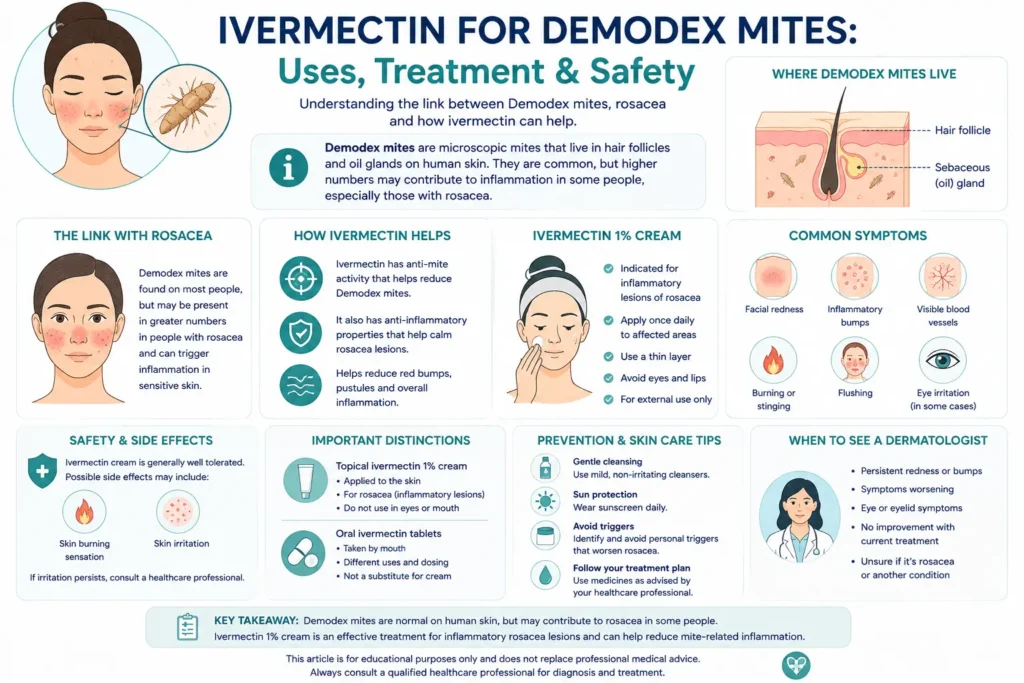
Demodex are microscopic mites that normally live on human skin. They are too small to see without magnification and are commonly found on the face. However, people with rosacea may have higher numbers of these mites, and researchers believe they may contribute to inflammation in some individuals.
Ivermectin is an antiparasitic medicine with activity against mites. Topical ivermectin 1% cream is also an established treatment for inflammatory lesions of rosacea. The U.S. prescribing information directs application once daily to affected facial areas.
This guide explains Demodex mites, their relationship with rosacea, how ivermectin fits into treatment, safety considerations and when professional evaluation may be appropriate.
Medical disclaimer: This article is for general educational purposes only. It is not individualized medical advice and should not replace consultation with a qualified healthcare professional.
What Are Demodex Mites?
Demodex are microscopic mites that live in human hair follicles and sebaceous glands.
Two species are commonly associated with humans:
- Demodex folliculorum
- Demodex brevis
Small numbers of Demodex mites can be present on healthy skin without causing noticeable problems.
The presence of Demodex mites therefore does not automatically mean that someone has a skin disease.
Are Demodex Mites Normal?
Yes.
Demodex mites are found on many people’s skin, particularly around areas such as:
- Eyelids
- Eyebrows
- Nose
- Cheeks
- Forehead
- Other areas containing hair follicles and sebaceous glands
The American Academy of Dermatology notes that Demodex mites live on nearly everyone’s skin. However, they may occur in greater numbers in people with rosacea.
Can Demodex Mites Cause Rosacea?
The relationship is more complicated than simply saying “Demodex causes rosacea.”
Rosacea is a multifactorial inflammatory skin condition.
Demodex mites may contribute to inflammation in some people, particularly when their numbers become elevated, but they are not considered the sole cause of rosacea.
Other factors can include:
- Immune-system responses
- Environmental triggers
- Sun exposure
- Heat
- Certain foods and beverages
- Skin-barrier changes
- Other inflammatory mechanisms
This distinction is important when discussing ivermectin and Demodex.
What Does Demodex Overgrowth Look Like?
An increased Demodex population may be associated with symptoms such as:
- Facial redness
- Small inflammatory bumps
- Pimple-like lesions
- Burning or stinging
- Rough or irritated skin
- Flushing
- Eye or eyelid symptoms in some cases
However, these symptoms are not specific to Demodex.
Acne, rosacea, dermatitis and other skin conditions can produce similar symptoms.
Ivermectin for Demodex Mites
Ivermectin has activity against mites, which is one reason it is relevant to Demodex-related skin conditions.
However, the important regulatory distinction is:
Ivermectin 1% cream is indicated for the treatment of inflammatory lesions of rosacea, rather than being labeled simply as a treatment for “Demodex infestation.”
The American Academy of Dermatology lists ivermectin cream among topical treatments used for inflammatory, acne-like breakouts associated with rosacea.
So the most accurate way to understand its role is:
Demodex may contribute to rosacea → ivermectin 1% cream is an established rosacea treatment → its anti-mite activity may be one part of its therapeutic effect.
How Does Ivermectin Work?
Ivermectin acts on susceptible parasites and mites by affecting their nervous-system function.
For rosacea, ivermectin also has anti-inflammatory effects, which may contribute to improvement in inflammatory skin lesions.
The exact contribution of Demodex reduction versus ivermectin’s anti-inflammatory activity in rosacea is more complex than simply saying the medicine “kills the mites.”
Ivermectin 1% Cream for Rosacea
The current U.S. prescribing information states that ivermectin cream 1% is indicated for inflammatory lesions of rosacea.
The labeled directions are:
- Apply to affected facial areas once daily
- Use a thin layer
- Avoid the eyes and lips
- Do not use the cream orally
- Do not use it ophthalmically or intravaginally
The exact product instructions should always be followed.
For our broader discussion of ivermectin and rosacea, see:
Is Ivermectin Cream the Same as Ivermectin Tablets?
No.
This is an important distinction.
Ivermectin cream
- Topical
- Applied to the skin
- 1% cream is indicated for inflammatory rosacea lesions
Oral ivermectin
- Taken by mouth
- Has different indications and dosing considerations
- Should not be substituted for topical ivermectin without professional guidance
The two formulations should not be treated as interchangeable.
For general information about ivermectin strengths and dosing, see our:
Can Ivermectin 12 mg Treat Demodex?
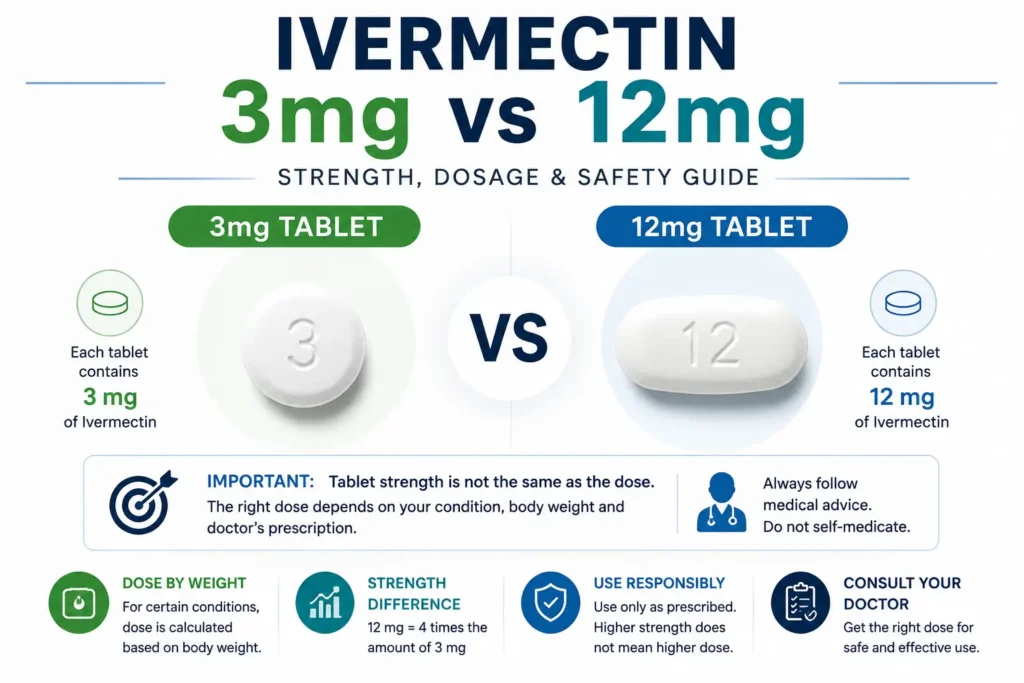
This is a common question because ivermectin 12 mg tablets are available in some markets.
However, a 12 mg tablet should not be considered a substitute for ivermectin 1% cream used for rosacea.
The route of administration, formulation, concentration and intended indication are different.
Someone should not take oral ivermectin simply because they believe Demodex mites are responsible for facial symptoms.
A healthcare professional should determine whether Demodex, rosacea or another skin condition is actually involved.
What Are the Symptoms of Rosacea?
Rosacea can produce a variety of facial symptoms, including:
- Persistent facial redness
- Flushing
- Visible small blood vessels
- Inflammatory bumps
- Pimple-like lesions
- Burning or stinging
- Sensitive skin
Some people may also develop eye symptoms.
Because rosacea can look similar to other skin conditions, professional diagnosis can be useful.
Can Demodex Affect the Eyes?
Yes.
Demodex mites can be associated with eyelid and eyelash problems in some people.
Symptoms may include:
- Eyelid irritation
- Itching
- Redness
- Crusting around eyelashes
- A gritty sensation
- Eye discomfort
However, eye symptoms can have many causes.
Persistent or painful eye symptoms should be evaluated by an appropriate healthcare professional.
Do not apply ivermectin cream directly into the eyes. The prescribing information specifically states that ivermectin cream is not for ophthalmic use.
Does Everyone With Rosacea Have Too Many Demodex Mites?
No.
Demodex mites are naturally present on human skin.
Having Demodex mites does not automatically mean that they are responsible for a person’s symptoms.
The AAD notes that researchers have found higher numbers of these mites in people with rosacea, but their exact role in causing inflammation is still part of the broader understanding of rosacea.
Does Ivermectin Cure Rosacea Permanently?
Rosacea is generally considered a chronic condition that can fluctuate over time.
Ivermectin can help control inflammatory lesions, but that does not necessarily mean that rosacea has been permanently eliminated.
Symptoms can return, particularly when triggers or underlying inflammatory factors remain.
This is why rosacea management may involve:
- Appropriate medication
- Skin-care measures
- Sun protection
- Trigger identification
- Long-term dermatological management
How Long Does Ivermectin Take to Work?
Response can vary between individuals.
Some people may notice improvement before others, and treatment generally needs to be used consistently according to the prescribed instructions.
Do not assume that a lack of immediate improvement means that the treatment has failed.
If symptoms are not improving or are getting worse, consult a healthcare professional rather than repeatedly changing treatments yourself.
Ivermectin Cream Side Effects
Ivermectin cream is generally well tolerated, but side effects can occur.
The current U.S. prescribing information lists skin burning sensation and skin irritation among the most common adverse reactions reported in clinical trials, each occurring in no more than 1% of patients.
Other symptoms or unexpected reactions should be discussed with a healthcare professional.
For a broader overview, see:
Ivermectin Side Effects & Safety
Ivermectin and Other Medicines
If you are using other medicines or treatments for rosacea, tell your healthcare professional.
This is particularly important if you are using:
- Other topical medicines
- Prescription skin treatments
- Oral medicines
- Treatments around the eyes
For broader information about potential interactions involving ivermectin, see:
Can You Prevent Demodex Mites?
Because Demodex mites are naturally found on human skin, the goal is not necessarily to eliminate every mite.
Instead, treatment focuses on managing the skin condition when Demodex is believed to be contributing to inflammation.
General skin-care measures may include:
- Gentle cleansing
- Avoiding harsh scrubs
- Avoiding irritating skin products
- Using appropriate moisturizers
- Protecting skin from excessive sun exposure
- Following a dermatologist’s treatment plan
Should You Try to Remove Demodex Mites Yourself?
No.
Demodex mites are microscopic and naturally occur on human skin.
Aggressive scrubbing, excessive cleansing or harsh chemicals can damage the skin barrier and potentially worsen irritation.
If you suspect Demodex-related rosacea, professional diagnosis is a much better approach than attempting to physically remove mites.
Can Demodex Be Diagnosed?
A healthcare professional may diagnose rosacea based primarily on the appearance and history of the skin.
In certain situations, microscopic examination or other testing may be considered.
However, simply finding Demodex mites does not automatically prove that they are causing the symptoms because these mites can be present on healthy skin as well.
Ivermectin vs Other Rosacea Treatments
Ivermectin is only one of several treatment approaches for rosacea.
Depending on the type of rosacea and symptoms, dermatologists may consider:
- Ivermectin cream
- Metronidazole
- Azelaic acid
- Other topical treatments
- Oral anti-inflammatory medicines
- Treatments directed at persistent facial redness
The AAD lists ivermectin, metronidazole and other options for different manifestations of rosacea.
Therefore, the best treatment depends on the specific type and severity of rosacea, rather than simply the presence of Demodex mites.
Can Demodex Mites Cause Acne?
Demodex mites are sometimes associated with acne-like facial eruptions.
However, Demodex is not the same thing as acne.
Acne is a separate skin condition involving factors such as clogged pores, oil production, inflammation and bacterial activity.
If you have persistent facial bumps, it is better to determine the underlying condition rather than assuming that Demodex is responsible.
When Should You See a Dermatologist?
Professional evaluation is especially useful if:
- Facial redness persists
- Inflammatory bumps keep returning
- Your skin burns or stings frequently
- Symptoms are worsening
- Your eyes or eyelids are affected
- You are unsure whether you have rosacea
- Previous treatments have not worked
- You are considering oral ivermectin
A dermatologist can distinguish rosacea from acne, dermatitis, fungal infections and other skin conditions that may look similar.
Frequently Asked Questions About Ivermectin for Demodex Mites
Does ivermectin kill Demodex mites?
Ivermectin has activity against mites, and its anti-mite activity is one reason it is relevant to Demodex-associated rosacea. However, ivermectin 1% cream is officially indicated for inflammatory lesions of rosacea, rather than being labeled specifically as a standalone Demodex treatment.
Is Demodex the cause of rosacea?
Not necessarily. Demodex mites may contribute to inflammation in some people with rosacea, particularly when present in greater numbers, but rosacea has multiple contributing factors.
What ivermectin is used for Demodex?
Topical ivermectin 1% cream is used for inflammatory lesions of rosacea. It should be used according to the applicable prescribing information and professional medical advice.
Can I take ivermectin 12 mg for Demodex?
Do not self-treat suspected Demodex problems with ivermectin 12 mg tablets. Oral and topical ivermectin are different formulations with different uses and dosing considerations.
How often is ivermectin cream applied for rosacea?
Current U.S. prescribing information directs application to affected facial areas once daily.
Can ivermectin cream be used around the eyes?
Ivermectin cream should not be applied into the eyes. The prescribing information specifically states that it is not for ophthalmic use.
Can Demodex mites live on healthy skin?
Yes. Demodex mites commonly live on human skin, and their presence alone does not mean that someone has a disease.
Can Demodex mites cause facial itching?
They may be associated with inflammatory skin symptoms in some people, but facial itching can have many causes and should not automatically be attributed to Demodex.
Can ivermectin cure rosacea permanently?
Ivermectin can help control inflammatory rosacea lesions, but rosacea is a chronic condition and symptoms may recur.
Is ivermectin cream the same as oral ivermectin?
No. Topical ivermectin cream and oral ivermectin are different formulations and should not be substituted for one another without medical guidance.
Key Takeaways
If you’re researching ivermectin for Demodex mites, remember:
- 🔬 Demodex: microscopic mites naturally found on human skin
- 🌹 Rosacea: Demodex may contribute to inflammation in some people
- 💊 Ivermectin 1% cream: established treatment for inflammatory rosacea lesions
- 🧴 Application: current U.S. labeling specifies once-daily facial application
- ❌ Not the same as oral ivermectin: formulations should not be interchanged
- 👁️ Eyes: do not apply ivermectin cream into the eyes
- 🩺 Diagnosis: persistent facial or eye symptoms deserve professional evaluation
- 🔄 Rosacea: treatment controls symptoms but does not necessarily permanently eliminate the condition
The key message is:
Demodex mites may play a role in rosacea, but treating “mites” is not the same as treating every case of rosacea.
Related Ivermectin Guides
We’ve now built the internal linking directly into the article, but this section can also serve as the final navigation point for readers:
- Ivermectin Uses — overview of established and commonly discussed uses.
- Ivermectin Dosage Guide — dosing principles and formulation considerations.
- Ivermectin Side Effects & Safety — safety and adverse-effect information.
- Ivermectin Drug Interactions — potential interaction considerations.
- Ivermectin for Rosacea — more detailed information about ivermectin and rosacea.
- Ivermectin for Lice — ivermectin and different types of lice.
- Ivermectin for Strongyloidiasis — established use in intestinal strongyloidiasis.
- Ivermectin for Onchocerciasis — ivermectin and river blindness.
Medical Disclaimer
This article is provided for general educational and informational purposes only. It is not intended to diagnose, treat, cure or prevent any disease and should not replace advice from a qualified healthcare professional.
Ivermectin products differ in formulation, strength, route of administration, indication, dosage and regulatory status. Always follow the official product information applicable to your country and consult a qualified healthcare professional for individual medical advice.
Authoritative References
American Academy of Dermatology — Rosacea Causes
The AAD explains the potential relationship between Demodex mites and rosacea and emphasizes that multiple factors may contribute to the condition.
American Academy of Dermatology — Rosacea Diagnosis & Treatment
The AAD includes ivermectin cream among topical treatment options for inflammatory rosacea lesions.
DailyMed — Ivermectin Cream 1%
Current U.S. prescribing information states that ivermectin cream 1% is indicated for inflammatory lesions of rosacea and is applied once daily to affected facial areas.