
Table of Contents
Rosacea is a common inflammatory skin condition that can cause facial redness, flushing, bumps and pimples, and other changes to the skin.
Ivermectin cream 1% is one of the topical medicines used to manage the inflammatory lesions associated with rosacea. In the United States, ivermectin cream 1% is indicated for the treatment of inflammatory lesions of rosacea and is applied to affected facial areas once daily.
It is important to understand that ivermectin cream is different from oral ivermectin tablets. They have different formulations, routes of administration and medical uses.
This guide explains what ivermectin cream is used for, how it fits into rosacea treatment, what to know about its application and safety, and when professional medical advice is appropriate.
Medical disclaimer: This article is intended for general educational purposes only. It does not provide individualized medical advice, diagnosis or treatment recommendations. Always follow the official labeling for the specific product and consult a qualified healthcare professional when appropriate.
What Is Rosacea?
Rosacea is a chronic skin condition that primarily affects the face.
It can have different patterns and may involve:
- Facial redness
- Flushing
- Persistent facial color changes
- Small red bumps
- Pus-filled bumps
- Burning or stinging sensations
- Visible small blood vessels
- Thickening of the skin in some cases
Not everyone with rosacea experiences the same symptoms.
The American Academy of Dermatology explains that treatment is generally tailored to the specific signs and symptoms a person experiences. Gentle skin care, trigger management and sun protection can also form part of a rosacea management plan.
What Is Ivermectin Cream?
Ivermectin cream is a topical formulation containing ivermectin 1%.
The current U.S. prescribing information states that ivermectin cream 1% is indicated for the treatment of inflammatory lesions of rosacea.
It is designed to be applied directly to affected areas of the face.
Ivermectin cream is not intended for oral, ophthalmic or intravaginal use.
Is Ivermectin Used for Rosacea?
Yes.
Topical ivermectin is an established treatment option for inflammatory lesions associated with rosacea.
The American Academy of Dermatology lists ivermectin cream among FDA-approved topical treatments used for the acne-like inflammatory breakouts that can occur with rosacea.
The National Rosacea Society also lists topical ivermectin among FDA-approved treatment options for inflammatory papules and pustules associated with rosacea.
However, ivermectin cream is not intended to treat every manifestation of rosacea.
For example, persistent facial redness, flushing and visible blood vessels may require different treatment approaches.
What Type of Rosacea Does Ivermectin Cream Treat?
Ivermectin cream is primarily used for inflammatory lesions, including the bumps and pimples that can occur with rosacea.
The American Academy of Dermatology describes ivermectin as a topical treatment for acne-like inflammatory breakouts associated with rosacea.
The National Rosacea Society similarly identifies topical ivermectin as an option for inflammatory papules and pustules.
This distinction is important.
Ivermectin cream may be relevant when rosacea involves:
Inflammatory bumps → ✔
Inflammatory pustules → ✔
It may not directly address every rosacea symptom:
Persistent redness → may require another approach
Flushing → may require another approach
Visible blood vessels → may require another approach
Advanced skin thickening → may require specialist management
Rosacea treatment is therefore usually based on the person’s specific symptoms rather than a single medicine for everyone.
How Does Ivermectin Cream Work?
The precise mechanism by which ivermectin cream improves rosacea lesions is not fully known.
The current prescribing information specifically states that the mechanism of action of ivermectin cream in treating rosacea lesions is unknown.
Ivermectin is known to have antiparasitic and anti-inflammatory properties, and researchers have investigated its effects on inflammatory processes and Demodex mites associated with rosacea.
However, it is better to avoid oversimplifying the treatment as:
“Ivermectin treats rosacea because rosacea is caused by mites.”
That is not an accurate description of the condition.
Rosacea is a complex inflammatory skin disorder, and its causes and contributing factors are not fully understood.
Ivermectin Cream and Demodex Mites
Demodex mites are microscopic organisms that normally live on human skin.
Research has explored a possible relationship between increased Demodex density and some forms of rosacea.
Topical ivermectin has antiparasitic activity, and studies have investigated whether its effect on Demodex contributes to improvement in rosacea.
The National Rosacea Society has also reported research suggesting that topical ivermectin may affect both Demodex density and the bacterial composition of the skin.
However, the official prescribing information does not identify elimination of Demodex as the established mechanism of action for ivermectin cream. It states that the mechanism in rosacea is unknown.
Therefore, it is more accurate to describe ivermectin cream as a treatment for inflammatory rosacea lesions rather than as a simple “Demodex treatment.”
Ivermectin Cream 1% vs Ivermectin Tablets
This distinction is extremely important.
Ivermectin cream 1%
- Topical medicine
- Applied to the face
- Contains ivermectin at 1%
- Specifically indicated for inflammatory lesions of rosacea in the U.S.
- Applied once daily according to current labeling
Oral ivermectin tablets
- Taken by mouth
- Have different indications
- Have different dosing considerations
- Are not interchangeable with ivermectin cream
The current ivermectin cream label explicitly states that the cream is not for oral use.
Therefore, someone searching for “ivermectin 12 mg for rosacea” should not assume that an oral ivermectin tablet is equivalent to ivermectin 1% cream.
They are different formulations.
How Is Ivermectin Cream Applied?
Current U.S. labeling instructs patients to apply ivermectin cream to affected areas of the face once daily.
The label describes using a pea-sized amount for each affected facial area:
- Forehead
- Chin
- Nose
- Each affected cheek
The cream should be spread as a thin layer.
Avoid contact with the:
- Eyes
- Lips
Ivermectin cream is for topical skin use only.
Important
The information above describes the current U.S. product labeling. Instructions can vary between products and countries.
Always follow the official instructions accompanying the specific medicine being used.
How Long Does Ivermectin Take to Work for Rosacea?
Rosacea treatment usually requires patience.
In clinical trials, ivermectin cream showed greater improvement than vehicle cream beginning at around 4 weeks, with continued assessment through 12 weeks.
The National Rosacea Society has also reported that clinical effects were observed as early as approximately two weeks in studies, with continued improvement during treatment.
This means that someone should not necessarily conclude that the treatment has failed after only a few days.
Rosacea is a chronic condition, and treatment response can vary from person to person.
Is Ivermectin Cream Effective for Rosacea?
Clinical studies support ivermectin cream as an effective treatment for inflammatory lesions of rosacea.
The current U.S. prescribing information describes two randomized, vehicle-controlled clinical trials involving 1,371 adults with inflammatory lesions of rosacea. Ivermectin cream performed better than vehicle cream on measures including overall improvement and inflammatory lesion counts.
At week 12, approximately 38–40% of participants receiving ivermectin cream were rated clear or almost clear in the two pivotal trials, compared with approximately 12–19% in the vehicle groups.
These figures come from controlled clinical trials and should not be interpreted as a guarantee of an individual’s response.
Does Ivermectin Cure Rosacea?
No medicine should be described as permanently curing rosacea.
Rosacea is a chronic condition characterized by periods of improvement and flare-ups.
Treatment is generally aimed at controlling symptoms and reducing inflammatory lesions.
The National Rosacea Society notes that there is currently no cure for rosacea, although treatment can help reduce or control its different manifestations.
Therefore, a more accurate description is:
Ivermectin cream can help manage inflammatory lesions associated with rosacea.
Ivermectin for Rosacea vs Other Treatments
Ivermectin is one of several treatment options for rosacea.
Depending on the symptoms, a dermatologist may consider:
- Ivermectin cream
- Metronidazole
- Azelaic acid
- Brimonidine
- Oxymetazoline
- Doxycycline
- Minocycline
- Benzoyl peroxide formulations
- Laser or light-based treatments
The American Academy of Dermatology emphasizes that treatment should be tailored to the individual’s signs and symptoms.
For example:
Inflammatory bumps and pustules may respond to topical medicines such as ivermectin.
Persistent facial redness may require medicines such as brimonidine or oxymetazoline.
Visible blood vessels may sometimes be treated with laser or light-based procedures.
This is why identifying the particular rosacea pattern is important.
Ivermectin Cream vs Metronidazole
Both ivermectin and metronidazole are topical treatments used for inflammatory rosacea.
They are different medicines and work through different pharmacological mechanisms.
The choice between them can depend on:
- The patient’s symptoms
- Previous treatment response
- Skin sensitivity
- Other medical conditions
- Other medicines being used
- Dermatologist preference
- Local availability
There is no single treatment that is best for every person with rosacea.
Ivermectin Cream vs Azelaic Acid
Azelaic acid is another topical treatment used for inflammatory rosacea.
The American Academy of Dermatology lists both azelaic acid and ivermectin among FDA-approved topical options for acne-like inflammatory breakouts of rosacea.
A dermatologist may select one treatment over another based on the patient’s symptoms and treatment history.
In some situations, different therapies may be used sequentially or in combination.
Common Side Effects of Ivermectin Cream
The current U.S. prescribing information identifies skin burning sensation and skin irritation among the most common adverse reactions, each reported in no more than 1% of patients in the referenced controlled clinical trials.
Postmarketing reports have also included:
- Contact dermatitis
- Allergic dermatitis
If significant irritation, swelling, allergic symptoms or worsening skin reactions occur, seek medical advice.
Can Ivermectin Cream Be Used Around the Eyes?
Ivermectin cream should not be applied to the eyes.
The current label instructs users to avoid contact with the eyes and lips. It is also not intended for ophthalmic use.
If rosacea symptoms involve the eyes, eyelids or vision, professional medical assessment is important because ocular rosacea may require a different treatment approach.
Can Ivermectin Cream Be Used on the Lips?
No.
The current prescribing information specifically instructs users to avoid contact with the lips and states that ivermectin cream is not for oral use.
It should be used only as directed on affected areas of facial skin.
Ivermectin Cream During Pregnancy
If you are pregnant or planning to become pregnant, speak with a healthcare professional before using ivermectin cream.
The current label states that available data are insufficient to establish whether ivermectin cream is associated with a drug-related risk of major birth defects, miscarriage or adverse maternal or fetal outcomes.
This does not mean that a specific patient will necessarily experience harm. It means that the available evidence is insufficient to establish safety conclusively.
Treatment decisions during pregnancy should therefore be individualized.
Ivermectin Cream During Breastfeeding
The current prescribing information states that the presence of ivermectin in human milk following topical administration has not been evaluated.
It also notes that there is insufficient information to determine the effects on a breastfed infant.
Anyone who is breastfeeding should discuss treatment with a healthcare professional before using ivermectin cream.
Can Children Use Ivermectin Cream for Rosacea?
The current U.S. labeling states that the safety and effectiveness of ivermectin cream in pediatric patients have not been established.
Rosacea can occur in younger people, but treatment should be determined by an appropriately qualified healthcare professional.
Do not assume that an adult’s ivermectin cream regimen is appropriate for a child.
Ivermectin Cream and Other Medicines
The current prescribing information reports that, at therapeutic concentrations, ivermectin cream did not inhibit or induce several CYP450 enzymes in in-vitro studies.
However, anyone using other medicines should still tell their healthcare professional about:
- Prescription medicines
- Over-the-counter medicines
- Vitamins
- Herbal products
- Other topical treatments
This is particularly important if multiple products are being applied to the face.
Can Ivermectin Cream Be Used With Other Rosacea Treatments?
Sometimes.
Rosacea treatment can involve more than one approach depending on the symptoms.
The National Rosacea Society notes that different treatment approaches may be combined when necessary, while treatment should be tailored to the individual.
However, combining multiple topical medicines without professional guidance can increase skin irritation.
A dermatologist can determine whether combination therapy is appropriate.
Skin Care While Managing Rosacea
Medication is only one part of rosacea management.
The American Academy of Dermatology recommends incorporating:
- Gentle cleansing
- Moisturizing
- Sun protection
- Identification and avoidance of personal triggers
into a rosacea management plan.
Common triggers can include:
- Excessive heat
- Sun exposure
- Alcohol
- Spicy foods
- Emotional stress
- Hot beverages
However, triggers differ between individuals.
Keeping a simple record of flare-ups can help identify personal patterns.
What Should You Avoid When Using Ivermectin Cream?
Avoid:
- Applying it inside the eyes
- Applying it to the lips or inside the mouth
- Using it vaginally
- Taking it orally
- Using more than directed
- Applying it to unrelated skin conditions without medical advice
- Combining multiple irritating facial treatments without professional guidance
The current product label specifically states that ivermectin cream is for topical use and is not intended for oral, ophthalmic or intravaginal use.
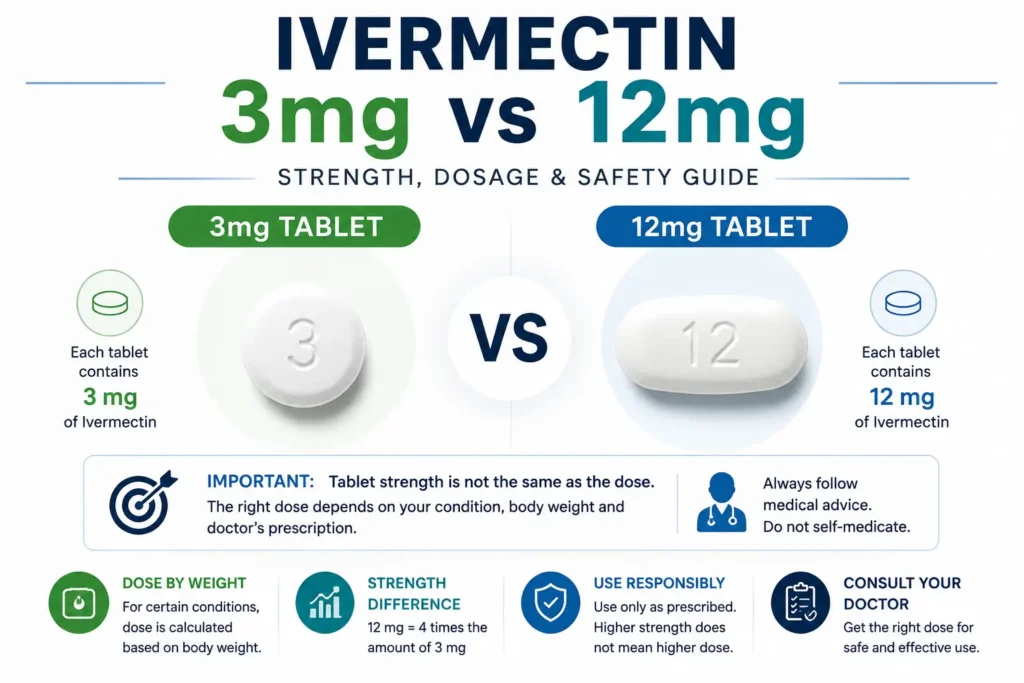
Ivermectin Cream vs Ivermectin 12 mg Tablets
This deserves a separate section because it is a common source of online confusion.
Ivermectin cream 1% is a topical formulation designed to be applied to facial skin.
Ivermectin 12 mg tablets are an oral formulation.
They are not equivalent simply because both contain ivermectin.
The cream contains ivermectin at a concentration of 1%, while oral tablets are measured by tablet strength. The current topical label specifies that ivermectin cream is not for oral use.
Therefore, someone should not take an ivermectin tablet simply because they are looking for an ivermectin treatment for rosacea.
The formulation and route of administration matter.
When Should You See a Dermatologist?
Professional evaluation is particularly useful if:
- You are unsure whether you have rosacea
- Facial redness is persistent or worsening
- You have recurrent inflammatory bumps
- Your eyes are affected
- You experience significant burning or irritation
- Your symptoms do not improve with treatment
- You have another skin condition that may resemble rosacea
- You are pregnant or breastfeeding
- You are considering combining several treatments
Rosacea can resemble other skin conditions, including acne and dermatitis.
A correct diagnosis helps ensure that the treatment is appropriate.
Frequently Asked Questions About Ivermectin for Rosacea
What is ivermectin cream used for?
Ivermectin cream 1% is indicated for the treatment of inflammatory lesions associated with rosacea.
Is ivermectin good for rosacea?
Topical ivermectin is an established treatment option for inflammatory lesions of rosacea. The American Academy of Dermatology lists it among topical treatments for acne-like inflammatory breakouts associated with rosacea.
Does ivermectin cream treat facial redness?
Ivermectin cream is specifically indicated for inflammatory lesions. Persistent facial redness may require a different treatment approach.
How often is ivermectin cream applied?
The current U.S. label instructs application to affected facial areas once daily.
How long does ivermectin take to work for rosacea?
Clinical trial data showed greater improvement than vehicle beginning around four weeks, with continued improvement during treatment.
Is ivermectin cream the same as ivermectin tablets?
No. Ivermectin cream is a topical formulation, while ivermectin tablets are taken orally. They are not interchangeable.
Can I use ivermectin 12 mg tablets for rosacea?
Do not substitute oral ivermectin tablets for topical ivermectin cream without professional medical guidance. The approved topical rosacea formulation is specifically designed for application to facial skin.
Does ivermectin cure rosacea permanently?
No. Rosacea is a chronic condition, and treatment is generally aimed at controlling its signs and symptoms rather than providing a permanent cure.
Can ivermectin cream be used around the eyes?
It should not be applied to the eyes. The product label specifically instructs users to avoid eye contact.
Can children use ivermectin cream for rosacea?
The current U.S. label states that safety and effectiveness in pediatric patients have not been established.
Can ivermectin cream be used during pregnancy?
Available data are insufficient to establish the risk profile during pregnancy. Anyone who is pregnant or planning pregnancy should discuss treatment with a healthcare professional.
What are the common side effects?
Skin burning sensation and skin irritation were among the most commonly reported adverse reactions in clinical trials, each occurring in no more than 1% of treated patients.
Is ivermectin cream available everywhere?
Availability, prescription status and approved indications can differ between countries. Always check the regulatory status and official product information applicable to your location.
Key Takeaways
Ivermectin cream 1% is an established topical treatment for inflammatory lesions of rosacea.
The most important points are:
- It is a topical formulation.
- It is applied to affected facial areas once daily according to current U.S. labeling.
- It is intended for inflammatory lesions associated with rosacea.
- It is not the same as oral ivermectin tablets.
- It should not be applied to the eyes or lips.
- Clinical improvement may take several weeks.
- Rosacea is a chronic condition and treatment does not necessarily represent a permanent cure.
- Pregnancy, breastfeeding and pediatric use require particular consideration.
- Gentle skin care, sun protection and trigger management can complement medical treatment.
If you have persistent or unexplained facial redness or inflammatory bumps, obtaining an appropriate diagnosis is an important first step.
Related Ivermectin Guides
For readers interested in learning more about ivermectin:
Ivermectin Uses: Medical Uses & Indications
Ivermectin for Scabies: Uses, Treatment & Important Information
Ivermectin for Head Lice: Uses, Treatment & Safety
Ivermectin Side Effects & Safety Guide
Ivermectin Drug Interactions Guide
Medical Disclaimer
This article is provided for general educational and informational purposes only. It is not intended to diagnose, treat, cure or prevent any disease and should not replace advice from a qualified healthcare professional.
Ivermectin products differ in formulation, concentration, route of administration, approved indications and regulatory status. Always follow the official product information applicable to your country and consult an appropriately qualified healthcare professional for individual medical advice.
Authoritative References
DailyMed — Ivermectin Cream 1% Prescribing Information
DailyMed: Ivermectin Cream 1%
American Academy of Dermatology — Rosacea: Diagnosis and Treatment
American Academy of Dermatology: Rosacea Treatment
National Rosacea Society — FDA-Approved Treatments for Rosacea
National Rosacea Society: FDA-Approved Rosacea Treatments
National Rosacea Society — Medical Therapy for Rosacea
National Rosacea Society: Medical Therapy for Rosacea