Table of Contents
Scabies is a contagious skin infestation caused by the microscopic mite Sarcoptes scabiei.
It commonly causes intense itching and a pimple-like rash, often becoming worse at night. Because ivermectin is active against certain parasites and mites, it is sometimes used as part of scabies treatment.
For classic scabies, CDC lists permethrin 5% cream or oral ivermectin among the recommended treatment options. Oral ivermectin is not FDA-approved for scabies in the United States, although CDC notes that it has similar efficacy to topical permethrin for cure.
This guide explains how ivermectin fits into scabies treatment, how scabies spreads, treatment considerations, safety, prevention and when medical evaluation is important.
Medical disclaimer: This article is for general educational purposes only. It is not individualized medical advice and should not replace advice from a qualified healthcare professional.
What Is Scabies?
Scabies is an infestation caused by the human itch mite, Sarcoptes scabiei.
The female mite burrows into the upper layers of the skin, where it lays eggs. The body’s immune response to the mites, eggs and their waste products contributes to the characteristic itching and rash.
Scabies can affect people of any age.
It can spread particularly easily where people have prolonged, close skin-to-skin contact.
What Does Scabies Look Like?
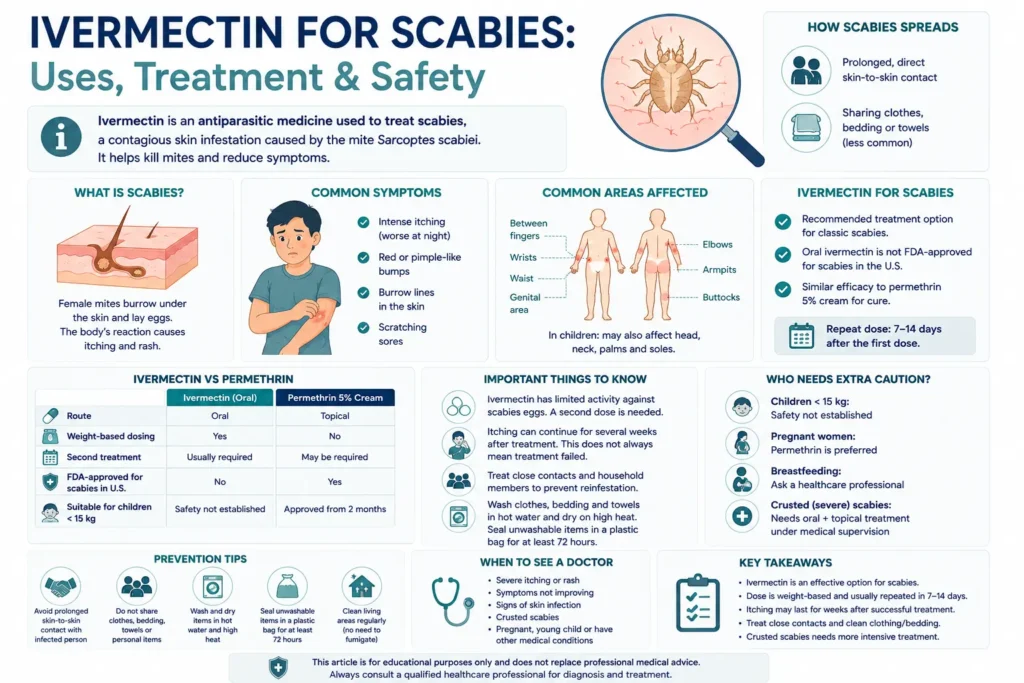
Common signs include:
- Intense itching
- Itching that is often worse at night
- Small red or pimple-like bumps
- Thin burrow lines in the skin
- Scratching-related sores
Common locations include:
- Between the fingers
- Wrists
- Elbows
- Waist
- Armpits
- Genital area
- Buttocks
In young children, scabies can also affect the head, neck, palms and soles.
How Does Scabies Spread?
Scabies usually spreads through prolonged, direct skin-to-skin contact.
It can spread between:
- Household members
- Partners
- Caregivers
- People living in crowded environments
Scabies can also spread through recently contaminated clothing, bedding or towels, although direct skin contact is an important route of transmission.
Is Ivermectin Used for Scabies?
Yes.
Unlike some of the other conditions we’ve covered in this series, oral ivermectin has a recognized role in scabies treatment.
CDC lists oral ivermectin as one of the recommended treatment options for classic scabies.
However, there is an important regulatory distinction:
Oral ivermectin is not FDA-approved for scabies in the United States.
Its use for scabies is therefore different from its FDA-approved uses for conditions such as intestinal strongyloidiasis and onchocerciasis.
For a broader explanation of ivermectin’s established uses, see our Ivermectin Uses guide.
How Does Ivermectin Work Against Scabies?
Ivermectin acts on the nervous system of susceptible parasites.
In scabies, its antiparasitic activity helps eliminate the mites responsible for the infestation.
However, ivermectin has limited activity against scabies eggs. This is one reason repeat treatment may be necessary.
Ivermectin Dosage for Scabies
CDC’s clinical guidance describes oral ivermectin for classic scabies as:
200 micrograms per kilogram of body weight per dose, with a second dose 7–14 days later.
The exact regimen should be determined by a healthcare professional.
The important point is that oral ivermectin dosing is weight-based.
It should not be assumed that everyone should simply take a particular tablet strength.
For more information about the principles behind ivermectin dosing and formulations, see our Ivermectin Dosage Guide.
Why Is a Second Dose Needed?
Scabies mites produce eggs, and ivermectin has limited activity against those eggs.
Therefore, a single dose may not eliminate newly developing mites.
A second treatment is used to help address mites that may emerge after the initial treatment. CDC recommends the second oral ivermectin dose 7–14 days after the first for classic scabies.
Ivermectin vs Permethrin for Scabies
Both oral ivermectin and topical permethrin are important scabies treatments.
| Oral Ivermectin | Permethrin 5% Cream | |
|---|---|---|
| Used for classic scabies | Yes | Yes |
| Route | Oral | Topical |
| Weight-based dosing | Yes | No |
| Second treatment | Usually required | May be required |
| FDA-approved for scabies in U.S. | No | Yes |
| Suitable for children <15 kg | Safety not established | Approved from 2 months |
CDC notes that oral ivermectin and topical permethrin have similar efficacy for cure of scabies.
The appropriate choice depends on factors such as age, weight, pregnancy, other medicines, treatment history and clinical circumstances.
Can Ivermectin 12 mg Treat Scabies?
This is an important search query because ivermectin 12 mg tablets are available in some markets.
However:
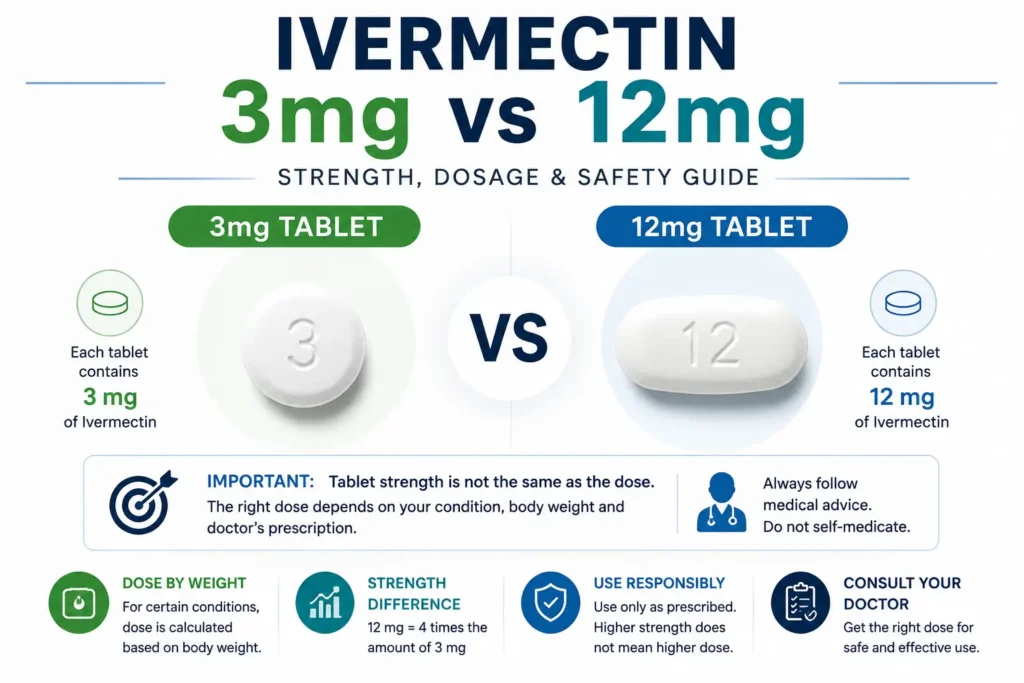
A 12 mg tablet should not automatically be taken as a scabies treatment.
The recommended oral ivermectin dose is weight-based, meaning the appropriate amount depends on the individual’s body weight.
For example, the number of tablets required cannot safely be determined simply from the tablet strength without considering the prescribed dose.
This is why oral ivermectin for scabies should be used under appropriate medical guidance.
Can Ivermectin Be Used for Severe or Crusted Scabies?
Yes, but crusted scabies is very different from ordinary scabies.
Crusted scabies can involve very large numbers of mites and is more contagious than classic scabies.
CDC recommends treating crusted scabies with both an oral and topical scabicide, rather than relying on ivermectin alone.
Treatment schedules can be considerably more intensive and should be supervised by experienced healthcare professionals.
A 2026 randomized clinical trial also investigated higher-dose ivermectin combined with permethrin for severe scabies, highlighting the importance of specialist-directed treatment rather than self-treatment.
What Is Crusted Scabies?
Crusted scabies is a severe form of infestation characterized by:
- Thick crusts
- Large numbers of mites
- Extensive skin involvement
- Very high contagiousness
It is more likely to occur in people with certain conditions affecting immune function or general health.
Because of its high mite burden, crusted scabies requires urgent professional management.
Does Ivermectin Kill Scabies Eggs?
Not reliably.
Ivermectin has limited ovicidal activity, meaning it does not reliably eliminate all scabies eggs.
This explains why repeat treatment is important in many oral ivermectin regimens.
It also explains why treating the person alone may not be enough if close contacts remain untreated or reinfection occurs.
Why Can Scabies Itching Continue After Treatment?
This is one of the most confusing aspects of scabies.
Even after successful treatment, itching can continue for several weeks because the skin can remain sensitive to mites and their remnants.
Therefore:
Continued itching does not automatically mean treatment has failed.
However, medical reassessment may be appropriate if:
- New burrows appear
- New pimple-like rashes develop
- Live mites are found
- Symptoms persist beyond the expected recovery period
CDC notes that retreatment may be necessary when itching continues beyond 2–4 weeks or new signs of infestation develop.
Can Scabies Come Back?
Yes.
Persistent or recurrent symptoms can result from:
- Reinfection
- Untreated household contacts
- Incorrect application of topical treatment
- Surviving mites or eggs
- Treatment resistance
- Misdiagnosis
CDC recommends evaluating close household and personal contacts because reinfection can occur when exposed individuals remain untreated.
Should Household Members Be Treated?
People who have had close personal, sexual or household contact with an infected person may need evaluation.
CDC recommends that people with relevant recent contact be examined and that those found to be infested receive treatment.
This is particularly important because someone can spread scabies before realizing they are infected.
What Should You Do With Bedding and Clothes?
Environmental measures are an important part of controlling transmission.
CDC recommends:
- Washing bedding
- Washing clothing
- Washing towels
- Using hot washing and drying cycles where appropriate
- Dry-cleaning items that cannot be washed
- Sealing unwashable items in a plastic bag for at least 72 hours
Scabies mites generally do not survive more than 2–3 days away from human skin.
Do You Need to Fumigate Your Home?
No.
CDC specifically advises against using insecticide sprays or fumigants to treat scabies.
These products can create unnecessary exposure and are not required to control a typical scabies infestation.
Ivermectin Safety
Oral ivermectin is generally well tolerated when used appropriately, but it can cause adverse effects and may interact with other medicines.
Because treatment for scabies is weight-based and may require repeat doses, medical supervision is important.
For a broader discussion of adverse effects and precautions, see our Ivermectin Side Effects & Safety guide.
Ivermectin Drug Interactions
CDC notes that treatment choice for scabies can be influenced by potential drug interactions involving ivermectin, including interactions with medicines such as:
- Azithromycin
- Trimethoprim/sulfamethoxazole
- Cetirizine
If you’re taking multiple medicines, tell your healthcare professional before using oral ivermectin.
See our Ivermectin Drug Interactions article for additional information.
Ivermectin for Scabies in Children
Children require special consideration.
CDC states that the safety of oral ivermectin has not been established in children weighing less than 15 kg. For infants and young children, permethrin is generally preferred in CDC guidance.
Do not give oral ivermectin to a young child based solely on the tablet strength available at home.
Ivermectin for Scabies During Pregnancy
Pregnancy requires individualized medical advice.
CDC notes that because data on ivermectin use in pregnancy are limited, permethrin is the preferred treatment for pregnant women with scabies.
Anyone who is pregnant and suspects scabies should discuss treatment with a healthcare professional.
Ivermectin and Breastfeeding
Treatment decisions during breastfeeding should also be individualized.
Because the available safety information differs depending on the medicine and treatment situation, consult a healthcare professional before choosing oral ivermectin.
How Is Scabies Diagnosed?
A healthcare professional may diagnose scabies by identifying:
- Burrows
- Mites
- Eggs
- Mite feces
Skin scrapings can be examined under a microscope, although CDC notes that this method has relatively low sensitivity. Dermoscopy and other examination techniques may also be used.
Because several skin conditions can cause itching and rashes, accurate diagnosis is valuable.
Can Scabies Be Confused With Other Skin Conditions?
Yes.
Scabies can sometimes resemble:
- Eczema
- Dermatitis
- Allergic reactions
- Other mite-related conditions
- Certain infections
This is particularly important when treatment doesn’t work as expected.
Persistent symptoms should not automatically lead to repeated ivermectin doses without reassessment.
When Should You See a Healthcare Professional?
Seek medical advice if:
- You suspect scabies
- The itching is severe
- New burrows continue appearing
- Treatment has failed
- Several household members are affected
- A young child is affected
- You are pregnant
- You have extensive crusting
- You are immunocompromised
- Skin sores appear infected
- You are considering oral ivermectin
Crusted scabies requires particularly prompt professional management because of its severity and contagiousness.
Frequently Asked Questions About Ivermectin for Scabies
Can ivermectin treat scabies?
Yes. Oral ivermectin is a recommended treatment option for classic scabies in CDC guidance, although it is not FDA-approved for scabies in the United States.
What is the ivermectin dose for scabies?
CDC describes 200 micrograms/kg per dose, with a second dose 7–14 days later for classic scabies. Treatment should be determined by a healthcare professional.
Can ivermectin 12 mg treat scabies?
Ivermectin dosing for scabies is weight-based. Do not assume that everyone should take a 12 mg tablet.
Does ivermectin kill scabies eggs?
Ivermectin has limited activity against eggs, which is why repeat treatment is commonly needed.
Is ivermectin better than permethrin?
Both are effective options. CDC notes similar efficacy between oral ivermectin and topical permethrin for classic scabies. The appropriate choice depends on the individual circumstances.
Can children take ivermectin for scabies?
The safety of oral ivermectin has not been established in children weighing less than 15 kg. CDC generally recommends permethrin for infants and young children.
Can pregnant women take ivermectin for scabies?
Because safety data are limited, CDC identifies permethrin as the preferred treatment during pregnancy.
Why am I still itching after treating scabies?
Itching can continue for several weeks because of the skin’s reaction to the mites and their remnants. However, new burrows or new rashes may indicate persistent or recurrent infestation.
Do I need to treat my family?
Close household and personal contacts should be evaluated, and people found to be infested should receive treatment.
Do I need to fumigate my home?
No. CDC advises against insecticide sprays and fumigants for scabies.
Key Takeaways
If you’re researching ivermectin for scabies, remember:
- 🦠 Scabies: infestation caused by Sarcoptes scabiei
- 💊 Ivermectin: an established treatment option for classic scabies
- ⚖️ Dose: weight-based, not simply tablet-strength based
- 🔄 Repeat treatment: commonly needed because ivermectin has limited activity against eggs
- 🧴 Permethrin: another major treatment option
- 👶 Children under 15 kg: oral ivermectin safety has not been established
- 🤰 Pregnancy: permethrin is preferred in CDC guidance
- 🏠 Household contacts: may need evaluation and treatment
- 🧺 Bedding/clothing: should be appropriately cleaned
- 🚫 Fumigation: unnecessary
- 🩺 Crusted scabies: requires specialist-directed treatment
The key message is:
Ivermectin can be an effective treatment for scabies, but the correct dose, timing and suitability depend on the individual patient and type of infestation.
Related Ivermectin Guides
Continue exploring our Ivermectin educational series:
- Ivermectin Uses — overview of established and commonly discussed uses.
- Ivermectin Dosage Guide — dosing principles and formulation considerations.
- Ivermectin Side Effects & Safety — safety and adverse-effect information.
- Ivermectin Drug Interactions — potential interaction considerations.
- Ivermectin for Lice — ivermectin and lice treatment.
- Ivermectin for Strongyloidiasis — ivermectin’s established role in strongyloidiasis.
- Ivermectin for Onchocerciasis — ivermectin and river blindness.
- Ivermectin for Pinworms — ivermectin’s role in pinworm-related searches.
- Ivermectin for Hookworms — ivermectin and hookworm treatment.
- Ivermectin for Ringworm — why ringworm is fungal rather than a worm infestation.
- Ivermectin for Demodex Mites — Demodex, rosacea and ivermectin 1% cream.
- Ivermectin for Rosacea — ivermectin and inflammatory rosacea lesions.
Medical Disclaimer
This article is provided for general educational and informational purposes only. It is not intended to diagnose, treat, cure or prevent any disease and should not replace advice from a qualified healthcare professional.
Ivermectin products differ in formulation, strength, route of administration, indication, dosage and regulatory status. Always follow the official product information applicable to your country and consult a qualified healthcare professional for individual medical advice.
Authoritative References
CDC — Clinical Care of Scabies
CDC: Clinical Care of Scabies
CDC — Treatment of Scabies
CDC: Treatment of Scabies
CDC — Ectoparasitic Infections Treatment Guidelines
CDC: Ectoparasitic Infections Treatment Guidelines
CDC — Public Health Strategies for Scabies Outbreaks
CDC: Public Health Strategies for Scabies Outbreaks
New England Journal of Medicine — Combined Oral Ivermectin and 5% Permethrin Cream to Treat Severe Scabies
NEJM: Combined Oral Ivermectin and 5% Permethrin Cream to Treat Severe Scabies