Table of Contents
If you’ve been prescribed or are researching ivermectin, one of the most common questions is:
How long does ivermectin take to work?
There isn’t one universal answer.
Ivermectin can begin reaching measurable levels in the body within hours after an oral dose, but that does not mean the infection or symptoms will disappear within hours.
The timeline depends on:
- The condition being treated
- Whether ivermectin is taken orally or applied topically
- The parasite or condition involved
- The treatment regimen
- How the body responds
- Whether symptoms are caused by the infection itself or the body’s inflammatory response
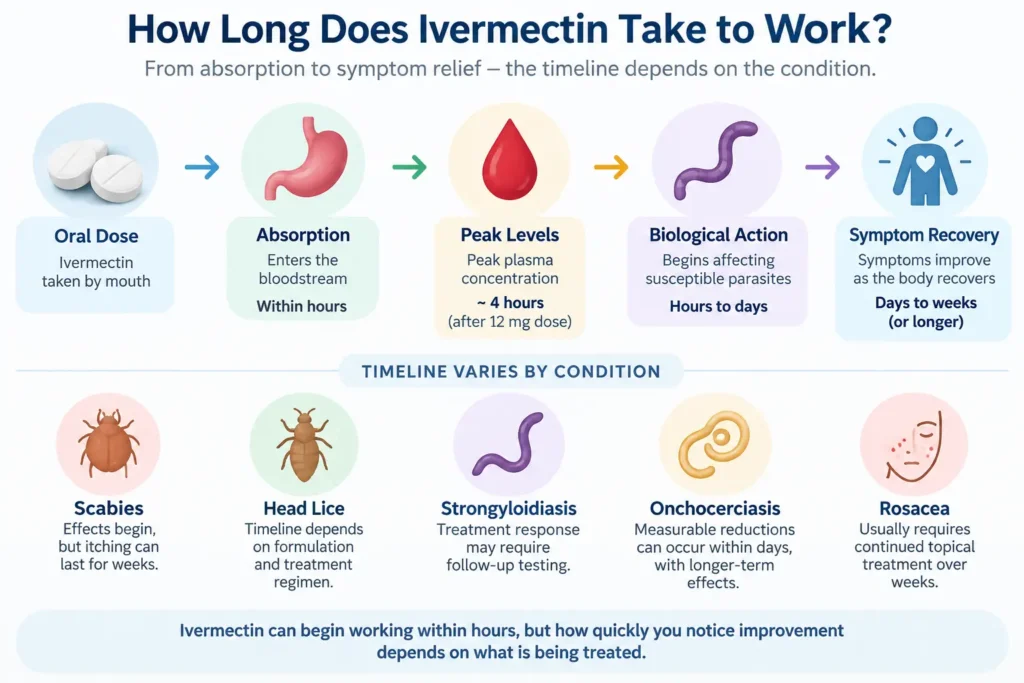
For example, oral ivermectin reaches peak plasma concentration at approximately 4 hours after a 12 mg dose in pharmacokinetic studies, while the clinical response for different parasitic infections can be observed over days, weeks or longer.
Medical disclaimer: This article is for general educational purposes only. It does not provide individualized medical advice. The appropriate ivermectin treatment and timing depend on the diagnosis, formulation, dosage and healthcare professional’s instructions.
Quick Answer: How Fast Does Ivermectin Work?
The simplest answer is:
Ivermectin starts being absorbed within hours, but the time required to see a clinical effect varies by condition.
For oral ivermectin, peak plasma concentrations following a 12 mg dose occurred at approximately 4 hours in pharmacokinetic studies. The plasma half-life is approximately 18 hours.
But:
Peak blood concentration ≠ instant symptom relief.
A person may still experience itching, inflammation or other symptoms after the medicine has begun acting.
How Long Does Oral Ivermectin Take to Work?
After an oral dose, ivermectin is absorbed into the bloodstream and reaches peak plasma concentrations at approximately 4 hours following a 12 mg dose under fasting conditions in pharmacokinetic studies.
The medicine is then metabolized primarily in the liver, while ivermectin and/or its metabolites are excreted predominantly through the feces. The reported plasma half-life is approximately 18 hours.
However, the clinical effect depends on the condition being treated.
So it is useful to separate two questions:
1. When does ivermectin enter the bloodstream?
Within hours.
2. When will I feel better?
That varies considerably.
Ivermectin: Drug Action vs Symptom Relief
This distinction is extremely important.
Imagine taking ivermectin for a parasitic infection.
The medicine may begin affecting susceptible parasites relatively quickly, but:
Parasite reduction → inflammation changes → tissue recovery → symptoms improve
Those are different stages.
This is why someone can have an appropriate treatment but continue experiencing symptoms temporarily.
The same principle applies particularly well to scabies, where itching can continue after successful treatment because the skin’s inflammatory response does not necessarily disappear immediately.
How Long Does Ivermectin Take to Work for Scabies?
Scabies is one of the most commonly searched ivermectin-related conditions.
For people using oral ivermectin under appropriate medical guidance, improvement isn’t necessarily immediate.
What you may notice:
First few days
The treatment begins acting against susceptible mites, but itching may continue.
Following days to weeks
The skin gradually recovers and itching may decrease.
Several weeks
Some people may continue experiencing post-treatment itching even when the infestation has been successfully treated.
CDC notes that itching can continue for several weeks after successful scabies treatment because of the body’s reaction to the mites and their remnants. New burrows or new pimple-like rashes, however, can suggest persistent infestation or reinfection.
For more information:
Why Does Scabies Still Itch After Ivermectin?
This is one of the most important points for readers to understand.
Itching does not automatically mean ivermectin failed.
Scabies causes an inflammatory reaction in the skin.
Even after the mites have been eliminated, the immune response can take time to settle.
Therefore:
Treatment completed ≠ symptoms disappear immediately
If new burrows or new lesions continue to develop, however, medical reassessment may be appropriate.
How Long Does Ivermectin Take to Work for Head Lice?
The answer depends on the formulation being used.
This is important because ivermectin is available in both oral and topical formulations for different medical uses. FDA notes that some topical ivermectin products are approved for external parasites such as head lice, while oral ivermectin tablets have different approved indications.
Therefore, we should not treat:
oral ivermectin
and
topical ivermectin lotion
as though they have identical treatment timelines.
For more information:
How Long Does Ivermectin Take to Work for Strongyloidiasis?
Strongyloidiasis is different from skin infestations.
Ivermectin is an established treatment for intestinal strongyloidiasis. FDA-approved labeling describes ivermectin for this indication and notes that follow-up stool examinations may be used to confirm eradication.
Clinical response therefore isn’t simply measured by whether symptoms disappear after a few hours.
Testing matters.
In one study described in the prescribing information, recurrence of Strongyloides larvae was observed in some patients as long as 106 days after treatment, illustrating why follow-up can matter in determining whether infection has been eradicated.
For more information:
Ivermectin for Strongyloidiasis
How Long Does Ivermectin Take to Work for Strongyloides Hyperinfection?
This is very different from uncomplicated strongyloidiasis.
Strongyloides hyperinfection is a potentially life-threatening medical emergency.
Treatment may involve repeated or prolonged ivermectin under specialist supervision rather than simply taking a routine dose and waiting for symptoms to disappear.
The treatment response must be assessed clinically and, where appropriate, through laboratory testing.
For more information:
Ivermectin for Strongyloides Hyperinfection
How Long Does Ivermectin Take to Work for Onchocerciasis?
Onchocerciasis, or river blindness, provides an excellent example of why “how quickly does ivermectin work?” has a complicated answer.
Clinical studies in the ivermectin prescribing information found substantial reductions in skin microfilariae after treatment.
In one study, the geometric mean skin microfilariae count decreased by:
- 83.2% at 3 days
- 99.5% at 3 months
after a single 150 mcg/kg dose. A reduction greater than 90% was maintained for up to 12 months in that study.
So ivermectin can begin producing measurable antiparasitic effects quickly, but the overall management of onchocerciasis is a long-term process.
For more information:
How Long Does Ivermectin Take to Work for Rosacea?
Rosacea is another situation where expectations need to be different.
Topical ivermectin cream is used for inflammatory lesions associated with rosacea.
Unlike a treatment where a parasite is rapidly eliminated, improvement in an inflammatory skin condition can take weeks of regular treatment.
The pharmacokinetic profile is also different from oral ivermectin. For ivermectin 1% cream, prescribing information reports that plasma concentrations peaked at approximately 10 hours after application at steady state, while the apparent terminal half-life following repeated topical use averaged approximately 6.5 days.
This illustrates an important principle:
Topical ivermectin ≠ oral ivermectin.
They should not be assumed to have the same absorption, pharmacokinetics or clinical timeline.
For more information:
How Long Does Ivermectin Take to Work for Demodex?
Demodex-related skin conditions can also involve inflammation.
Therefore, symptom improvement may not occur immediately after ivermectin begins acting.
In particular, when Demodex is associated with rosacea-like inflammation, improvement may require continued treatment and skin recovery.
For more information:
Does Ivermectin Work Immediately?
No — not in the sense of immediate symptom disappearance.
Ivermectin begins being absorbed relatively quickly after oral administration, but the clinical effect depends on the disease.
A useful way to think about it is:
Hours → drug absorption
Days → biological effect may become measurable
Days to weeks → symptoms may improve
Weeks/months → some infections require testing or repeated treatment
These are general concepts, not a universal timetable.
How Long Does Ivermectin Stay in the Body?
This is related to, but different from, how long ivermectin takes to work.
For oral ivermectin, the reported plasma half-life is approximately 18 hours.
However, ivermectin and/or its metabolites are excreted predominantly through feces over an estimated period of approximately 12 days.
Therefore:
Half-life does not mean the drug suddenly disappears from the body after 18 hours.
It refers to the time required for the plasma concentration to decrease by approximately half.
We can cover this in greater detail in our planned article:
How Long Does Ivermectin Stay in Your System?
If this URL has not yet been created on your site, don’t publish this link until we create the page.
Does a Higher Dose Make Ivermectin Work Faster?
Not necessarily.
This is an important misconception.
Ivermectin dosing depends on the specific condition, body weight, formulation and applicable treatment guidance.
Taking more ivermectin does not simply mean:
“more medicine = faster recovery.”
FDA warns that taking large doses of ivermectin can be dangerous and that overdose can cause serious adverse effects.
For general dosing information:
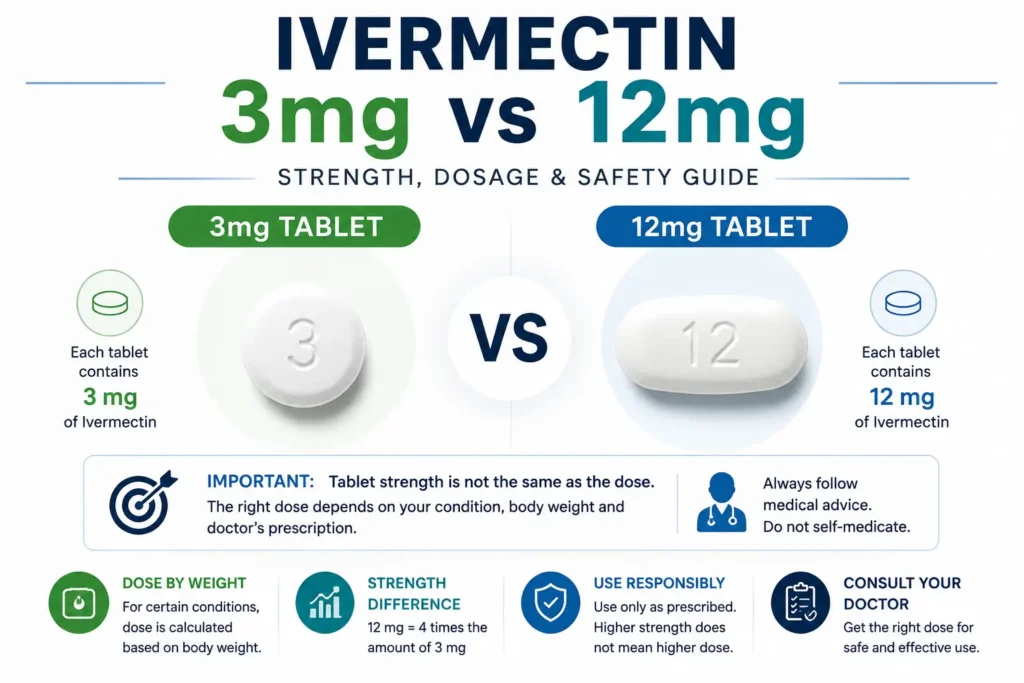
Does Ivermectin 12mg Work Faster Than 3mg?
Tablet strength alone does not determine how quickly ivermectin works.
This is another reason we shouldn’t confuse tablet strength with prescribed dose.
Ivermectin tablets are available in different strengths depending on the product and market, and appropriate dosing is based on the relevant indication and patient factors.
Our existing guide explains the distinction:
What If I Don’t Feel Better After Taking Ivermectin?
Don’t automatically assume that the treatment failed.
The first question should be:
What condition is being treated?
Then consider:
- Is the expected treatment timeline longer?
- Can symptoms persist after successful treatment?
- Is a repeat dose part of the treatment regimen?
- Does the condition require laboratory confirmation?
- Could reinfection have occurred?
- Was the original diagnosis correct?
- Is another condition causing the symptoms?
This is especially important with conditions such as scabies, where itching can continue after treatment.
When Should You Contact a Healthcare Professional?
Medical reassessment may be appropriate if:
- Symptoms are getting worse
- New lesions or burrows continue appearing
- Severe adverse effects develop
- Symptoms persist beyond the expected treatment period
- You suspect reinfection
- You have taken more ivermectin than prescribed
- You are taking multiple medicines
- You are pregnant
- A child is being treated
- You have significant immune suppression
- You have suspected Strongyloides hyperinfection
For severe symptoms such as breathing difficulty, seizures, severe dizziness, confusion or loss of consciousness, seek urgent medical attention.
FDA warns that ivermectin overdose can cause serious toxicity, including low blood pressure, dizziness, problems with coordination, seizures, coma and death.
Ivermectin With Food
Food can affect the absorption of oral ivermectin.
Current prescribing information reports that a high-fat meal substantially increased ivermectin bioavailability in a pharmacokinetic study.
However, the appropriate administration instructions can depend on the specific indication and product labeling.
Therefore, patients should follow the instructions provided with their prescribed product rather than changing how they take it in an attempt to make it work faster.
Ivermectin and Other Medicines
Ivermectin can interact with other medicines.
This becomes particularly important when someone is taking:
- Blood thinners
- Medicines affecting the central nervous system
- Other prescription medicines
- Multiple medicines simultaneously
FDA specifically warns that ivermectin can interact with other medicines, including blood thinners.
For more information:
Oral vs Topical Ivermectin: Why the Timeline Is Different
This is a particularly important distinction.
Oral ivermectin
The medicine enters systemic circulation after being swallowed.
For a 12 mg oral dose, peak plasma concentration occurred at approximately 4 hours in pharmacokinetic studies.
Topical ivermectin
Absorption depends on the formulation and application.
For ivermectin 1% cream used for rosacea, peak plasma concentrations at steady state occurred at approximately 10 hours after application.
Therefore, we shouldn’t combine all ivermectin products into one generic timeline.
Ivermectin Timeline by Condition
Here’s the simple version:
| Condition | What “working” means | General timeline |
|---|---|---|
| Scabies | Reduction/elimination of mites; symptoms may persist | Effects begin after treatment, but itching can last weeks |
| Head lice | Reduction/elimination of lice | Depends on formulation and treatment regimen |
| Strongyloidiasis | Parasite eradication | Requires appropriate treatment and follow-up |
| Strongyloides hyperinfection | Control of potentially disseminating infection | Urgent specialist treatment; not a simple single-dose timeline |
| Onchocerciasis | Reduction of microfilariae | Measurable reductions can occur within days; long-term control continues |
| Rosacea | Reduction in inflammatory lesions | Usually requires continued topical treatment rather than immediate relief |
| Demodex-related conditions | Reduction in mites/inflammation | Improvement varies and may take time |
The key takeaway is:
There is no single “ivermectin working time.”
Does Ivermectin Kill Parasites Immediately?
Not necessarily.
The medicine can begin interacting with susceptible parasites after absorption, but parasite elimination and clinical recovery are separate processes.
For onchocerciasis, for example, clinical studies demonstrated a major reduction in microfilariae within days, while the broader effect persisted for months.
For Strongyloides, follow-up testing may be necessary because eradication isn’t determined simply by how a person feels.
Why Symptoms Can Continue After Ivermectin
Persistent symptoms may occur because:
1. The body needs time to recover
Inflammation can continue after the underlying parasite has been reduced.
2. The treatment regimen isn’t complete
Some conditions require repeat treatment.
3. Reinfection can occur
Particularly with contagious infestations such as scabies.
4. The original diagnosis may be incorrect
Not every itchy rash or skin problem is caused by a parasite.
5. The infection requires follow-up testing
Strongyloidiasis is a good example.
Ivermectin Side Effects
Ivermectin can cause adverse effects, and these shouldn’t be confused with the underlying condition.
Potential adverse effects vary according to the formulation and indication.
For general safety information:
Ivermectin Side Effects & Safety
If symptoms are severe or unexpected, seek medical advice rather than assuming they are part of the treatment process.
Frequently Asked Questions
How quickly does ivermectin start working?
After oral administration, ivermectin reaches peak plasma concentrations at approximately 4 hours following a 12 mg dose in pharmacokinetic studies. The clinical effect, however, depends on the condition being treated.
How long before ivermectin starts killing parasites?
The medicine begins acting after absorption, but there is no single time that applies to every parasite. Clinical studies show that measurable effects can occur within days for some infections.
How long does ivermectin take to work for scabies?
It can begin acting against mites after treatment, but itching may continue for several weeks even after successful treatment.
How long does ivermectin take to work for Strongyloides?
Ivermectin is an established treatment for intestinal strongyloidiasis, but successful treatment may require follow-up testing rather than simply waiting for symptoms to disappear.
How long does ivermectin take to work for onchocerciasis?
Clinical studies have demonstrated substantial reductions in skin microfilariae within days, with effects continuing for months.
Does ivermectin work immediately?
No medicine should be assumed to produce immediate symptom relief. Ivermectin begins being absorbed relatively quickly, but clinical improvement depends on the condition.
Does 12 mg ivermectin work faster than 3 mg?
Not necessarily. Tablet strength and prescribed dose are different concepts, and treatment should be based on the specific indication and appropriate dosing guidance.
Can I take more ivermectin if it isn’t working?
No. Do not increase the dose on your own. Taking excessive ivermectin can cause serious toxicity.
Why am I still itching after ivermectin?
With scabies, itching can continue for weeks because the skin’s inflammatory response may persist after treatment.
How long does ivermectin stay in the body?
The reported plasma half-life of oral ivermectin is approximately 18 hours, while ivermectin and/or its metabolites are excreted predominantly in feces over an estimated 12 days.
Does food affect ivermectin?
Yes. Pharmacokinetic studies show that a high-fat meal can substantially increase ivermectin exposure. Follow the administration instructions for the specific product and indication.
Key Takeaways
If you’re wondering how long ivermectin takes to work, remember:
- ⏱️ Oral ivermectin is absorbed relatively quickly
- 💊 Peak plasma concentration after a 12 mg oral dose occurs at about 4 hours
- 🦠 Clinical effect varies by condition
- 🧴 Topical and oral ivermectin have different pharmacokinetic profiles
- 🪳 Scabies symptoms can continue after successful treatment
- 🪱 Strongyloidiasis may require follow-up testing
- 👁️ Onchocerciasis can show measurable microfilarial reductions within days
- ⚠️ Strongyloides hyperinfection requires urgent specialist treatment
- 🚫 Taking more ivermectin does not necessarily make it work faster
- 🩺 Persistent or worsening symptoms deserve medical reassessment
The most important point:
Ivermectin can begin acting within hours, but how quickly you notice improvement depends on what is being treated. Drug absorption, parasite reduction and symptom recovery are three different timelines.
Related Ivermectin Guides
Continue exploring our Ivermectin educational series:
- Ivermectin Educational Guide
- Ivermectin Uses
- Ivermectin Dosage Guide
- Ivermectin 3mg vs 12mg
- Ivermectin Side Effects & Safety
- Ivermectin Drug Interactions
- Ivermectin for Scabies
- Ivermectin for Head Lice
- Ivermectin for Strongyloidiasis
- Ivermectin for Strongyloides Hyperinfection
- Ivermectin for Onchocerciasis
- Ivermectin for Rosacea
- Ivermectin for Demodex Mites
Medical Disclaimer
This article is provided for general educational and informational purposes only. It is not intended to diagnose, treat, cure or prevent any disease and should not replace advice from a qualified healthcare professional.
Ivermectin products differ in formulation, strength, route of administration, indication, dosage and regulatory status. Always follow the official product information applicable to your country and consult a qualified healthcare professional for individual medical advice.
Authoritative References
DailyMed — Ivermectin Tablets
DailyMed: Ivermectin Tablets — Prescribing Information
The prescribing information provides pharmacokinetic information including approximately 4-hour peak plasma concentration after a 12 mg dose and an approximately 18-hour plasma half-life.
DailyMed — Ivermectin Tablets, 3 mg / 6 mg
FDA — Ivermectin and COVID-19
The FDA page also provides important safety information regarding excessive ivermectin use and distinguishes approved human ivermectin products from veterinary products.