Table of Contents
1. Introduction
Biologic medicines have transformed modern medicine over the past two decades, enabling targeted therapy for conditions involving inflammation, immune dysregulation, and chronic disease pathways. Among these biologics, Adalimumab is one of the most widely studied monoclonal antibodies globally.
Originally approved in the early 2000s, it has become a benchmark in immunology research for its targeted inhibition of a specific inflammatory pathway.
This guide provides a comprehensive educational and scientific overview of Adalimumab—its history, mechanism, regulatory status, manufacturing, biosimilars, and role in global medicine.
Disclaimer:
This blog is purely educational. It does not provide medical advice or promote the sale or use of prescription-only biologics.
2. What Is Adalimumab?
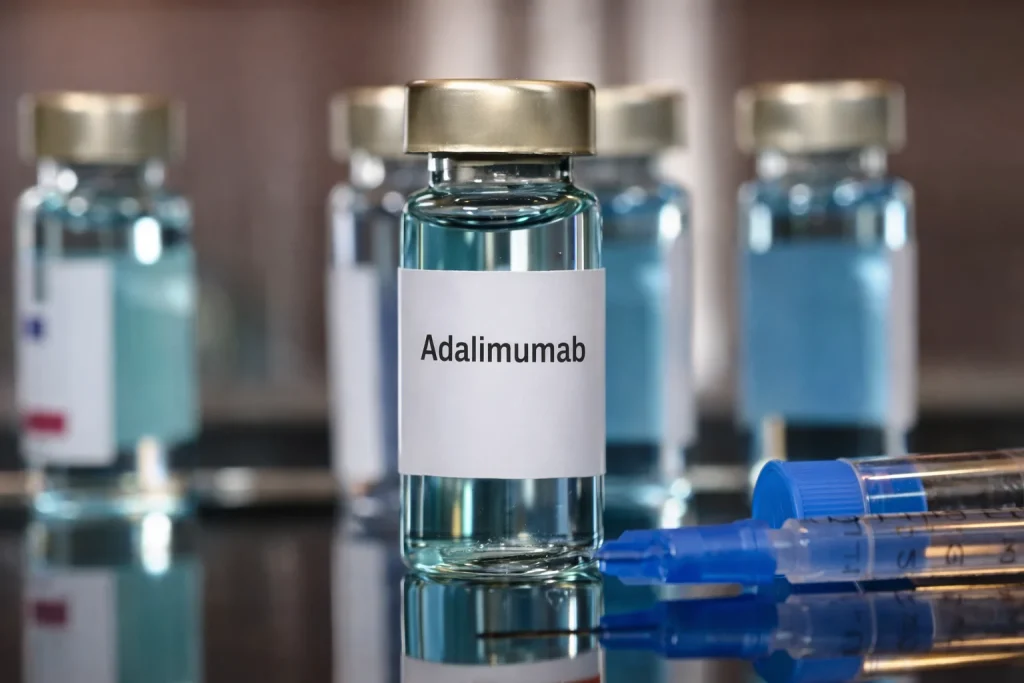
Adalimumab is a fully human monoclonal antibody (IgG1 subtype) designed to target Tumor Necrosis Factor-alpha (TNF-α), a cytokine involved in inflammatory signaling.
It was the first fully human monoclonal antibody to achieve global regulatory success and remains one of the most studied biologics across rheumatology, dermatology, and gastroenterology.
3. History & Development Timeline
| Year | Milestone |
|---|---|
| 1990s | Development of human monoclonal antibody technology |
| 2002 | First approval in the USA |
| 2003–2010 | Expansion to multiple therapeutic indications |
| 2014–2020 | Global biosimilar development |
| 2023–2025 | Widespread adoption of biosimilars in Asia, EU & emerging markets |
Adalimumab’s success accelerated biologic innovation worldwide.
4. Mechanism of Action
Adalimumab works by binding selectively to TNF-α, preventing it from interacting with cell-surface receptors.
TNF-α (Tumor Necrosis Factor-alpha)
A naturally occurring cytokine responsible for:
- Inflammatory signaling
- Acute-phase immune responses
- Cellular regulation
While TNF-α is essential for normal immunity, excessive signaling has been linked to chronic inflammatory disease pathways.
Adalimumab’s mechanism, simplified:
- Binds TNF-α
- Prevents receptor activation
- Reduces downstream inflammatory activity
This mechanism is not a cure, but a targeted pathway modulation studied extensively in modern immunology.
5. What Conditions Is Adalimumab Studied & Approved For?
Adalimumab is one of the biologics with the widest range of approved indications across regions.
Approvals vary by country but generally include:
Rheumatology
- Rheumatoid arthritis
- Psoriatic arthritis
- Ankylosing spondylitis
- Juvenile idiopathic arthritis
Dermatology
- Plaque psoriasis
- Hidradenitis suppurativa
Gastroenterology
- Crohn’s disease
- Ulcerative colitis
Ophthalmology
- Non-infectious uveitis
This list is educational; approvals differ by regulatory authority.
6. How Is Adalimumab Manufactured?
Adalimumab is produced using:
- Recombinant DNA technology
- Cultured mammalian cell lines
- Multiple purification and quality-control stages
Biologics are highly complex molecules with large protein structures, requiring stringent:
- Cold-chain handling
- Stability monitoring
- Batch documentation
- Good Manufacturing Practices (GMP)
7. Delivery Forms & Strengths
Adalimumab is administered by subcutaneous injection.
Common presentations:
- 40 mg pre-filled syringe
- 40 mg autoinjector pen
- Other strengths for pediatric use
Formulations differ by manufacturer and biosimilar brand.
8. Pharmacokinetics
| Parameter | Adalimumab |
|---|---|
| Half-life | ~10–20 days |
| Onset | Varies by condition |
| Peak concentration | ~5 days after injection |
| Route | Subcutaneous |
| Frequency | Usually every 1–2 weeks (per label) |
Biologics have long half-lives due to their immunoglobulin structure.
9. Safety Considerations
Commonly noted effects:
- Injection-site reactions
- Redness
- Itching
- Swelling
- Mild upper respiratory symptoms
Less common (monitored clinically):
- Increased infection susceptibility
- TB reactivation risk
- Liver enzyme elevation
Because Adalimumab modulates immune pathways, screening and periodic monitoring are standard in clinical practice.
10. Contraindications
Adalimumab is generally avoided in individuals with:
- Active serious infections
- Untreated tuberculosis
- Severe immunosuppression
- Certain neurological conditions
Final suitability depends on a professional evaluation.
11. Biosimilars — A Major Global Development
Since the patent expiry, many biosimilars have been approved globally:
In the USA
- Amjevita
- Hyrimoz
- Cyltezo (interchangeable)
- Hadlima
- Yusimry
In the EU & UK
- Imraldi
- Idacio
- Halimatoz
- Amsparity
In India
Multiple CDSCO-approved biosimilars exist, manufactured by leading biopharma companies.
Biosimilars are not identical but are highly similar to the original biologic, tested for:
- Efficacy equivalence
- Safety similarity
- Immunogenicity profile
12. Regulatory Status Worldwide
| Region | Access Type |
|---|---|
| USA | Prescription-only |
| EU | Prescription-only |
| UK | Prescription-only |
| Canada | Prescription-only |
| Australia | Prescription-only |
| India | Prescription-only biologic |
Biologics require:
- Cold-chain transport
- Strict documentation
- Traceability records
- Professional oversight
13. Storage, Handling & Cold-Chain Requirements
Adalimumab must be:
- Stored at 2–8°C
- Protected from light
- Not frozen
- Transported with validated cold-chain packaging
These requirements ensure protein integrity and stability.
14. How Globalstar Supports International Buyers
Globalstar International provides:
- Verified sourcing of originator and biosimilar Adalimumab
- Cold-chain compliant packaging
- Batch documentation (COA, temperature logs, MSDS)
- Export paperwork for international buyers
- Support for pharmacies, hospitals & individual compliance inquiries
- Transparent Ask-for-Price communications
No online selling or medical advice is provided.
15. Frequently Asked Questions
Q1. What is Adalimumab?
A fully human monoclonal antibody targeting TNF-α.
Q2. Is Adalimumab a biologic?
Yes. It is a complex protein-based medicine produced via biotechnology.
Q3. What conditions is it used for?
Conditions related to immune dysregulation — approvals vary by country.
Q4. Is Adalimumab available as a biosimilar?
Yes. Many biosimilars are globally approved.
Q5. Why does it require cold-chain storage?
Biologics degrade if exposed to high temperatures.
Q6. Is it available in India?
Yes, as prescription-only (originator + biosimilars).
Q7. Can individuals store Adalimumab at home?
Patients typically store it refrigerated; guidance varies.
Q8. Does it suppress immunity?
It modulates immune pathways; literature indicates infection risks.
Q9. What are common side effects?
Injection-site reactions, mild respiratory symptoms.
Q10. Why do doctors screen for TB?
TNF-α inhibitors can increase reactivation risk.
Q11. How long does it stay in the system?
Half-life ranges from 10–20 days.
16. Scientific References
- NEJM — TNF-α blocker clinical studies
- The Lancet — Immunology research
- Arthritis & Rheumatology Journal
- Journal of Gastroenterology — Long-term biologic safety
- FDA & EMA public assessment reports
- Nature Reviews Immunology — TNF-α pathway biology
17. Conclusion
Adalimumab remains a significant milestone in the evolution of biologic therapies. With its targeted TNF-α mechanism, long regulatory history, and wide range of indications, it has reshaped modern immunology research and clinical practice. The development of biosimilars has expanded global access while maintaining rigorous quality standards.
Understanding Adalimumab’s scientific background, mechanism, and regulatory environment helps individuals and professionals approach biologic therapies with clarity and awareness.
📩For Compliant Export Support
📧 connect@export.globalstarco.com
🌐 https://export.globalstarco.com